



South Sudan has begun discussions on expanding roads, railways, and energy infrastructure without damaging one of the world’s largest wildlife migration systems, officials and conservation experts said at a workshop in the capital Juba on Wednesday.
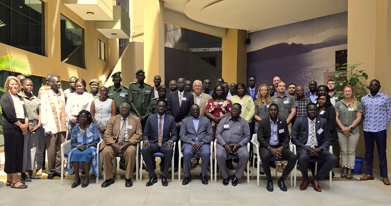
The workshop on ecologically sensitive infrastructure planning brought together government ministries, conservation groups, and development experts as the country pushes ahead with major transport and energy projects.
Officials from the Ministry of Lands, Housing, and Urban Development said South Sudan’s growing demand for roads, pipelines, electricity transmission lines, and fiber optic networks must be balanced with environmental protection.
“Sensitive linear infrastructure such as roads, railways, electricity transmission lines, water pipelines, fiber optic networks, and oil pipelines forms the backbone of national development,” said George Ritti Richard, Director at South Sudan’s Ministry of Lands, Housing and Urban Development
He said better infrastructure was needed to connect communities to markets, schools, and hospitals, but warned development must remain “environmentally responsible”.
South Sudan is home to vast wetlands and wildlife habitats, including what officials described as the world’s largest land mammal migration.
Peter Loro, undersecretary at the Ministry of Wildlife, Tourism and Conservation, warned that poorly planned infrastructure could fragment habitats and disrupt migration routes.
“If we build blindly, we risk fragmenting critical habitats, disrupting ancient migration corridors, and driving human-wildlife conflict to unsustainable levels,” he said.
Officials from the transport ministry said the government was drafting a strategic road transport policy that incorporates environmental considerations into infrastructure planning.
Mandella Jackson Peter, a senior inspector for certification at the ministry, said authorities were working with wildlife officials to ensure transport projects take ecosystems and migration corridors into account.
Denay Jock Chagor, the National Minister of Wildlife, Conservation, and Tourism, South Sudan, urged participants to view environmental protection as a national responsibility.
“God has given you a gift that he has not given anywhere on Earth,” Chagor said, referring to South Sudan’s wildlife migration systems.
African Parks, one of the organisations supporting the workshop, said South Sudan still had an opportunity to avoid development mistakes made elsewhere.
Dr. Timothy Philip Berke, land use coordinator for African Parks, said poor coordination between ministries remained a major challenge in land management.
“You could have a national park where there’s also a road going through it, while communities are living inside the park and oil blocks overlap with conservation areas,” he said.
The South Sudan Roads Authority outlined several infrastructure projects either planned or under construction, including the Kapoeta-Boma corridor, the Pagak-Palouch road, and the Bor-Malakal-Renk highway.
Kose Luke Igga, Executive Director of South Sudan Roads Authority, said many of the projects pass through wetlands and floodplains, making environmental assessments critical.
“The big question remains: how do we build these lifelines without damaging the lifelines of our environment?” Igga said.
He said proposed mitigation measures included wildlife crossings, speed controls, and protection of rivers and floodplains during construction.
“Most of the developing world built their infrastructure poorly and are now spending billions trying to rectify their mistakes,” he added. “With South Sudan, we can do it correctly the first time.”

 and then