



South Sudanese Civil society organisations, in partnership with the Norwegian Church Aid and the Ministry of Gender, Child and Social Welfare, have moved to establish a multi-stakeholder technical working group to coordinate efforts towards implementing the African Union’s Maputo Protocol on women’s rights, more than two years after the country ratified the instrument.
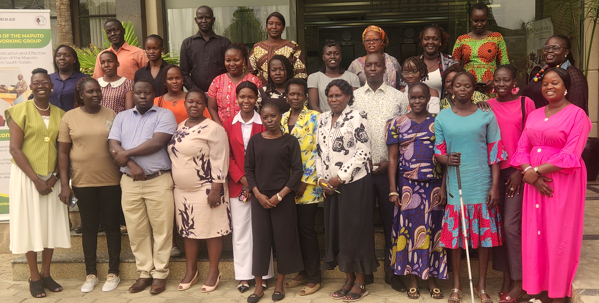
The initiative was launched in Juba on Wednesday, during a meeting organized by Global Voices Organisation (GVO) in partnership with Norwegian Church Aid (NCA), and brought together government representatives, civil society organisations and women’s rights groups.
Josephine Chandiru, Executive Director of Global Voices Organisation, said the working group would oversee efforts to domesticate and implement the protocol through a National Action Plan (NAP), which will serve as a roadmap for government institutions, civil society organisations and other stakeholders.
She said the group would establish technical committees focusing on legal and policy reforms, monitoring and evaluation, and public awareness to ensure that commitments under the protocol translate into practical action.
“One of the action points was to establish a working group, a technical working group, to push for the domestication and implementation of the Maputo Protocol in South Sudan,” Chandiru said.
She explained that the establishment of the group followed recommendations from a national consultative workshop held in Juba in August 2024, which also called for state-level consultations and training of stakeholders on treaty reporting.
Chandiru said consultations had been conducted in Torit in December 2025, but plans to extend the exercise to six states had been affected by resource constraints.
Representing the Ministry of Gender, Child and Social Welfare, Miriam Betty Okech, Director for Child Protection, called on civil society organisations and development partners to work closely with the government in advancing the implementation process.
She said the ministry expected the newly established working group to prioritise state-level consultations to gather information needed for developing the National Action Plan.
“We have to see that this group works effectively, not forming it alone,” she said.
Meanwhile, Nyakuoth Top Kuek, Gender-Based Violence and Adolescent Sexual and Reproductive Health Coordinator at Norwegian Church Aid, said the initiative should translate commitments on gender equality and women’s rights into practical interventions.
She urged members of the working group to approach their responsibilities with commitment and ensure that the National Action Plan strengthens advocacy, informs legal and policy reforms and improves accountability for the rights of women and girls.
The Maputo Protocol, formally known as the Protocol to the African Charter on Human and Peoples’ Rights on the Rights of Women in Africa, provides protections for women against discrimination and gender-based violence, while promoting their access to justice, reproductive health rights and participation in political and decision-making processes.
South Sudan ratified the instrument in 2023, but efforts to develop a comprehensive roadmap for its domestication and implementation have faced delays, partly due to inadequate funding.

 and then