



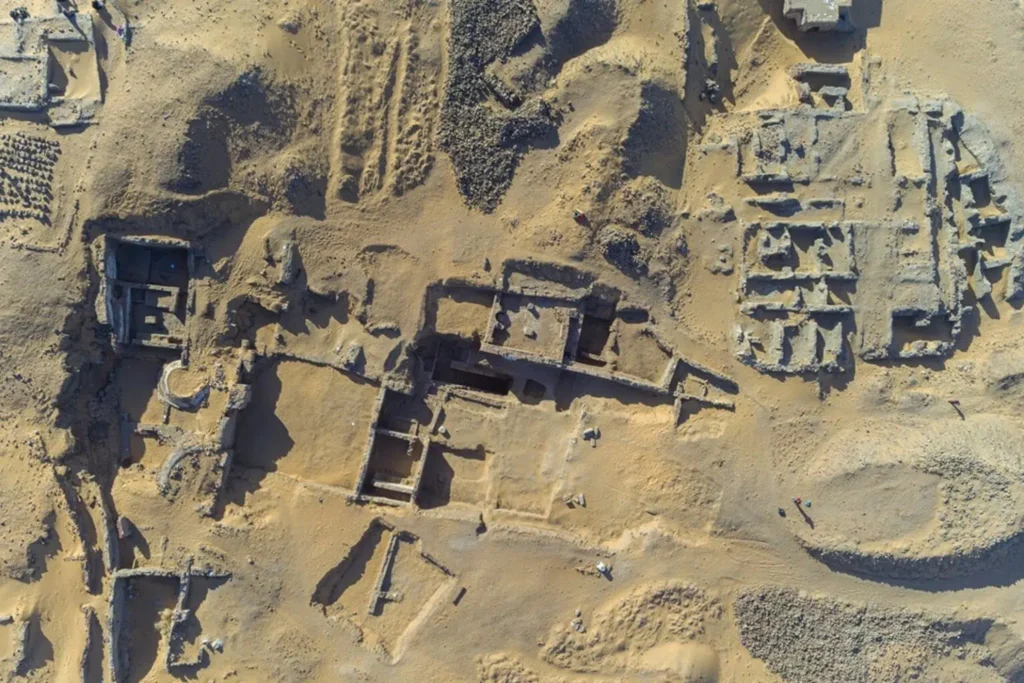
Archaeologists excavating the ancient city of Old Dongola in northern Sudan have reached the original floor of a monumental medieval cathedral for the first time, uncovering new evidence of the scale and architectural significance of one of Nubia’s most important Christian buildings.
The Great Church of Jesus measures about 47 metres (154 feet) wide and 57 metres (187 feet) long and may have stood approximately 21 metres (69 feet) high, according to researchers.
The latest discoveries include a monumental staircase, sections of the original floor and structural supports around the cathedral’s apse. Walls near the staircase remain standing up to 11 metres (36 feet) high, offering a rare glimpse into the building’s construction.
The excavation is led by Professor Artur Obłuski of the University of Warsaw’s Polish Centre of Mediterranean Archaeology, in partnership with Sudan’s National Corporation for Antiquities and Museums. The team identified the structure as the Great Church of Jesus in 2021, but much of the building remains buried.
A landmark of Nubian architecture
The cathedral’s massive walls have made excavation challenging, requiring researchers to remove substantial layers of accumulated debris before reaching its original levels. The staircase is currently the only area where the team has exposed the original floor.
The newly uncovered staircase and buttresses supporting the apse provide further evidence of the building’s monumental design. The apse, typically located at the eastern end of a church, houses the main altar.
Obłuski said the cathedral could have played an influential role in the development of religious architecture in Nubia and possibly other parts of Africa.
“In the history of architecture, certain buildings emerge that, to use a modern term, become trendsetters. Hagia Sophia in Constantinople, modern-day Istanbul, is certainly one such example. The Great Church of Jesus appears to be a natural candidate for such a role in Nubia, and perhaps even in this part of Africa,” he said.
Further excavations are expected to help establish whether the cathedral influenced the design of other religious buildings in the region.
Obłuski said the discovery could also prompt historians to reconsider the function of another church previously identified as Dongola’s cathedral, suggesting that the Great Church of Jesus may have occupied a more prominent position in the city’s religious hierarchy.
Excavations reveal religious artwork
The team has also uncovered evidence of a second church within an adjoining structure. The building occupied an upper floor of an extension to the main complex.
Although only about one metre (3.3 feet) of its walls survives, archaeologists recovered traces of painted decoration and numerous fragments of painted plaster from the debris.
The expedition has collected six large shelving units of painted plaster fragments, Obłuski said, adding that the material could help reconstruct the church’s original decoration.
Researchers also found fragments bearing Greek inscriptions. Agata Deptuła, the expedition’s epigrapher, said the texts include biblical canticles, religious songs and hymns used in Christian worship.
One fragment contains part of the Prayer of Hannah, the biblical mother of the prophet Samuel. The Greek text was written in a carefully executed book hand, with letters measuring about half a centimetre (0.2 inches) high.
The discovery adds to evidence of Christian religious practices at Old Dongola. Although archaeologists have previously found numerous references to the Psalms at the site, the biblical odes represent a new category of religious texts identified there.
Old Dongola was a Christian kingdom’s capital
Old Dongola, historically known as Tungul, was the capital and principal religious centre of the medieval Nubian kingdom of Makuria, which controlled territories along the Nile in present-day Sudan.
Makuria adopted Christianity in the sixth century, and Old Dongola developed into a major centre of political and religious authority. The city housed churches, monasteries and monumental buildings and became the seat of the head of the Makurian Church.
Christian Nubia maintained religious and cultural links with the Byzantine Empire and the wider Mediterranean world while developing distinctive artistic and architectural traditions. Greek and Old Nubian inscriptions, church paintings and other archaeological remains provide evidence of those connections.
The Great Church of Jesus appears to have been among the most ambitious religious structures in the kingdom. Its dimensions and architectural features point to its importance within Makuria’s religious landscape.
Makuria’s political influence declined during the 14th century amid prolonged conflicts and changing regional power structures. The royal court left Old Dongola in 1365, although the settlement remained inhabited for centuries.
Further work needed
Researchers hope to establish the cathedral’s full dimensions during the next excavation season. Much of the structure remains underground, and determining its complete layout will require deeper excavations and additional resources.
The work is also taking place alongside efforts to protect the wider archaeological site. Severe flooding in autumn 2024, the worst since 1988, damaged some protective roofs covering archaeological remains. Conservation and structural protection work preceded the latest excavation season.
The excavation forms part of broader efforts to reconstruct the history of Old Dongola and understand its role as a political, religious and cultural centre in medieval Nubia.
Researchers say further discoveries could shed light on the architectural ambitions, religious institutions and artistic traditions of a Christian African kingdom that flourished along the Nile.

 and then