



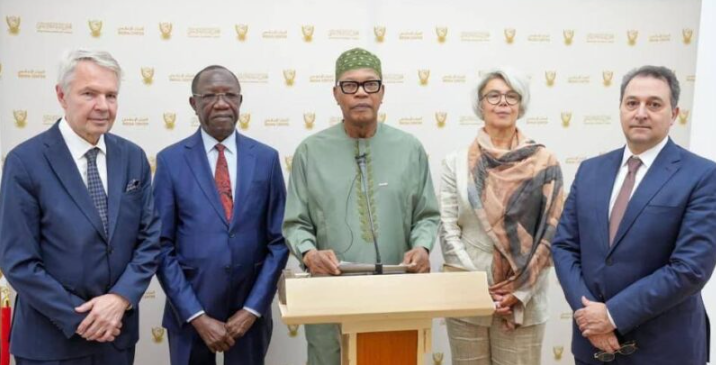
Representatives of a five-member international mediation group comprising the African Union, Intergovernmental Authority on Development (IGAD), Arab League, European Union and United Nations on Thursday called for an inclusive, Sudanese-led political process to end the country’s war, saying there is no military solution to the conflict.
The Quintet made the call at the end of a “good offices” mission to Khartoum, where it held talks with the chairman and deputy chairman of Sudan’s Transitional Sovereignty Council, Prime Minister Kamil Idris and the undersecretary of the Ministry of Foreign Affairs and International Cooperation.
The group also attended a working dinner hosted by the finance minister with political and civilian actors and met representatives of the Democratic Bloc and a committee working to create conditions for a Sudanese dialogue, according to a statement issued on Thursday.
The delegation also held talks with independent women’s and youth groups.
The Quintet said the mission was intended to listen to stakeholders inside Sudan and link its international engagement with political initiatives emerging within the country.
It said its efforts are aimed at advancing a “credible and inclusive Sudanese-led and Sudanese-owned political track” leading to a democratic, civilian-led government that reflects the aspirations of the Sudanese people.
The group said a durable political process must be accompanied by concrete steps to protect civilians and end hostilities.
It also reaffirmed its respect for Sudan’s sovereignty, unity and territorial integrity and rejected the establishment of parallel governing structures.
The Quintet arrived in Sudan on Tuesday for consultations with political and civilian groups, including Prime Minister Idris and members of a committee preparing for an internal national dialogue.
Sudan’s war erupted in April 2023 after disagreements between the army and the paramilitary Rapid Support Forces (RSF) over the integration of the RSF into the regular military.
The conflict has killed tens of thousands of people, displaced millions and triggered famine and a major humanitarian crisis.

 and then