



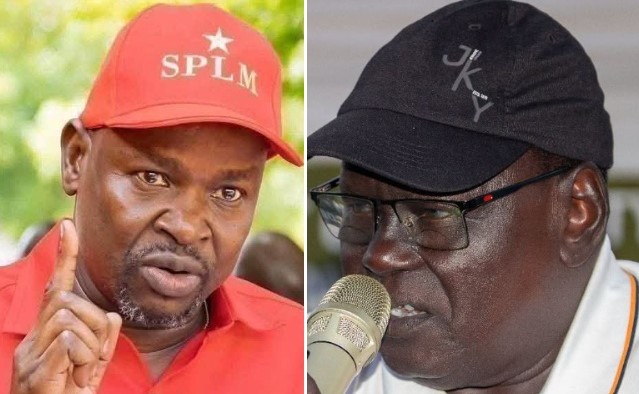
A prominent community leader from South Sudanese President Salva Kiir Mayardit’s home area has accused former Vice-President Benjamin Bol Mel of plotting to overthrow the president, alleging that nine people from the Awan community remain in detention over the purported coup attempt.
Gen. Mawien Mathiang Gor, an Awan Pajok community leader, made the allegations on Friday during a thanksgiving ceremony organised by the Noon Mayomdit Community Association in Juba to celebrate the release of businesswoman Achan Agoth Akiech and two other former government officials.
Mawien alleged that Bol Mel, who had emerged as a potential successor to Kiir, turned against the president after being elevated to senior government positions. He said the alleged plot risked plunging the country into renewed bloodshed.
Mawien did not provide details of the alleged plot, and it was not immediately clear whether investigators had formally accused Bol Mel or the other detainees of attempting to overthrow the government. Bol Mel’s response to the allegations was not immediately available.
“Bol Mel was picked from nowhere by Salva Kiir, which shocked everyone,” Mawien said. “He is not even a member of the Red Army.”
The Red Army refers to a group of young people associated with the Sudan People’s Liberation Movement (SPLM) during the liberation struggle before South Sudan gained independence.
Mawien said Bol Mel’s rise to prominence had prompted questions among members of the president’s community, with some expressing anger over his appointment and threatening violence against him.
“People came to me asking why the president chose him. They said they would go to his office and slaughter him in broad daylight,” he said.
He alleged that Bol Mel later turned against Kiir and coordinated a failed coup attempt involving nine people from Awan Community who remain in detention.
“Now people are calling for his release. Do they know how many sons of Awan are in custody?” Mawien said. “There are nine of them who joined Bol Mel, and nobody talks about them.”
He did not identify the nine detainees or explain their alleged roles in the purported plot.
Mawien urged those calling for Bol Mel’s release to stop campaigning on his behalf, saying the decision on the former vice-president’s fate rest with Kiir.
“Leave it to President Kiir. He is the one to decide what he wants to do with them, whether to take them to court or do something else,” he said.
“This failed coup attempt was about to drag the country into another bout of bloodshed,” Mawien added.
Bol Mel’s fall from power
In November 2025, Kiir dismissed Bol Mel as vice-president in a surprise move that fuelled speculation about the president’s succession plans. Bol Mel was also removed from senior positions in the ruling SPLM and the security establishment, stripped of his military rank of general and placed under house arrest at his residence in Juba, with his security detail withdrawn.
The government did not publicly explain the reasons for his dismissal or the restrictions on his movements.
Bol Mel, a businessman from Aweil East County in Northern Bahr el Ghazal State, had risen rapidly through the political and security establishments and was widely viewed as a possible successor to Kiir, although no formal succession arrangement had been announced.
Mawien’s allegations add to questions surrounding Bol Mel’s political downfall and the wider investigation involving people linked to the former vice-president
Three officials released
Mawien made the remarks during a ceremony celebrating the release of Achan Agoth Akiech and former lawmakers Kom Kom Geng and Ayii Ayii Akol, who had been detained since May 2026.
The three were held at the National Security Service detention facility known as the Blue House in Juba. They were released following a presidential order after nearly five months in custody without being brought before a court.
They had been accused of forging Kiir’s signature, unlawfully using presidential symbols of authority, smuggling documents and interfering with an ongoing financial crimes investigation involving 16 detainees, including Bol Mel.
Their arrests followed a directive from Kiir after parliament lifted the immunity of the two lawmakers to allow their detention. The allegations against the three officials had not been tested in court before their release.
Mawien criticised those advocating for the release of people still in detention, arguing that they are overlooking members of his own community. He also referred to detainees from the Twic community, including Ajing Deng Ajiing and Dominic Juuk Chom.
He urged members of the public to avoid intervening in the cases of detained individuals and leave decisions about their fate to the president.
Mawien also defended Kiir’s leadership, saying the country would struggle to find a comparable leader after his departure.
“When he is gone, you will never see a president like him again,” he said.
Warning against actions he believes could threaten national stability, Mawien said the liberation struggle had cost many lives and that he would not tolerate attempts to undermine the country.
“The one who will come after him is a killer like me, standing in front of you now. I am a killer,” he said, adding that he doesn’t tolerate what he described as disorder.
Recalling the liberation struggle
Mawien described himself as one of the founders of South Sudan’s liberation movement and recalled his early involvement in military operations under Kiir’s leadership.
Mawien concluded by urging members of his community to refrain from speaking publicly about the detention cases and to allow Kiir to handle them.
Awan Pajok is a subsection of the wider Awan community, from which Kiir hails, in the Gogrial area of Warrap State.
South Sudan is scheduled to hold general elections in December 2026, amid persistent political tensions and uncertainty over the country’s political transition.

 and then