



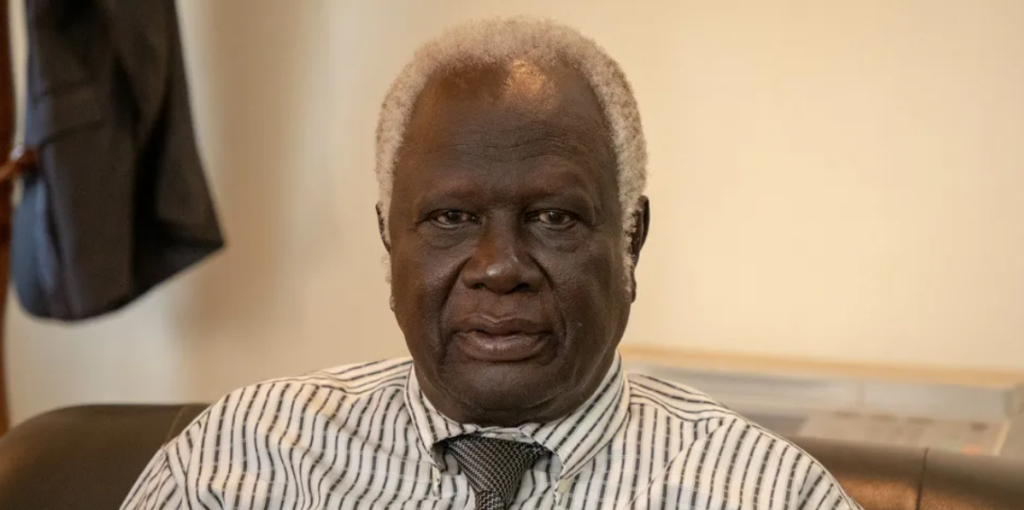
South Sudan’s former elections chief Prof. Abednego Akok Kacuol has urged his successor to build on preparations for elections scheduled for Dec. 22, saying his removal from office should not disrupt the electoral process.
President Salva Kiir removed Akok as chairperson of the National Elections Commission (NEC) on Tuesday and appointed Gabriel Bol Deng Majok, who had been the commission’s secretary-general, as his replacement. No official reason has been given for the change.
Speaking to Radio Tamazuj on Thursday, Akok said he accepts the decision and supports the appointment of his successor.
“There is no problem with my dismissal because I have served for 14 years and it is necessary that a new person takes over to evaluate the work progress,” he said.
Akok, who was first appointed NEC chairperson in August 2012 and reappointed in 2023, said he is grateful for the opportunity to lead the electoral body.
He cited the establishment of NEC offices across the 10 states and three administrative areas, as well as training for electoral officials and commissioners with support from development partners including the United Nations, among the work completed during his tenure.
He urged Majok to maintain continuity rather than start the preparations from scratch.
Majok, who previously served as secretary-general, is already familiar with the commission’s work and outstanding preparations, Akok said.
Akok also urged South Sudanese to register when the exercise begins and participate peacefully in the elections.
He said he would return to his academic work at the University of Juba after his removal from the NEC.
Questions over removal
The leadership change has prompted questions from civil society groups because it came about three months before the scheduled elections.
Women’s rights activist Kenya Mach questioned the timing of the change and whether it could affect preparations for the polls, while saying Majok’s previous role at the NEC could provide some continuity.
“Many questions arise. Is the change done to favour certain candidates during the polls or for something else?” she said.
Bol Deng Bol, chairperson of the National Civil Society Coalition and the Jonglei Civil Society Network, said the NEC is already facing significant challenges in preparing for the elections.
He also questioned whether the legal procedure for removing the chairperson had been followed.
South Sudan’s National Elections Act, as amended in 2023, the NEC chairperson, deputy chairperson or other commissioners can be removed on grounds including proven partiality, incapacity to perform their functions or gross misconduct. The law provides for a recommendation supported by two-thirds of NEC members and approval by two-thirds of the Transitional National Legislative Assembly. During the transitional period, the president is also required to consult and agree with the first vice president and four vice presidents.
“The public ought to know the grounds upon which the Chairperson was removed by the President,” Bol said.
He questioned whether the required NEC resolution and consultations had taken place.

 and then