



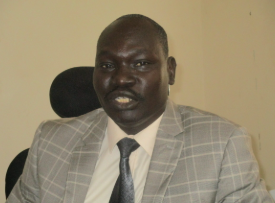
A South Sudanese political scientist has backed the government’s call for foreign countries to respect the country’s sovereignty, saying the move is necessary due to the growing external pressure on Juba.
Prof. Abraham Kuol Nyuon, a political science professor at the University of Juba, described the government’s recent statement urging international partners, including Western countries and Japan, not to interfere in South Sudan’s affairs as “overdue.”
He said sovereignty should remain central to South Sudan’s engagement with the international community, arguing that foreign countries should respect the country’s territorial integrity and right to determine its own affairs.
“Such a statement is overdue,” Prof. Kuol said, arguing that South Sudan needs to develop a stronger and clearer foreign policy as it navigates relations with international partners.”
He said the country’s heavy reliance on external assistance has also contributed to a situation in which outside actors can exert influence over domestic affairs.
The don compared the situation to a family that receives all the necessary resources from others but fails to take responsibility for managing its own affairs, saying South Sudanese themselves must accept collective responsibility for the country’s challenges.
He said the responsibility should not be placed solely on President Salva Kiir, the security institutions or ordinary citizens, but should instead be shared by all South Sudanese.
The professor also linked the country’s foreign policy challenges to its prolonged political transition, arguing that South Sudan should not remain indefinitely under transitional arrangements established by the peace agreement.
“Peace does not mean permanent transition,” he said, stressing that elections remain the key mechanism for moving the country beyond the transitional period.
Kuol called for elections to be held, arguing that South Sudanese need an opportunity to choose leaders they recognize as their own.
He further urged the international community to support the right of South Sudanese citizens to choose their leaders rather than backing political arrangements that, in his view, allow leaders to remain in power without a direct electoral mandate.
He also challenged Western countries, particularly the United States, to remain consistent with their stated democratic principles when engaging with South Sudan. He argued that if international actors support democracy, they should support the ability of South Sudanese citizens to choose their leaders.
Kuol’s comments come amid renewed debate over South Sudan’s relations with international partners, the country’s sovereignty and the future of the transitional political arrangement.
He said strengthening South Sudan’s foreign policy, reducing excessive dependence on external actors and allowing citizens to determine their political leadership through elections would be important steps toward greater national ownership of the country’s affairs.

 and then