



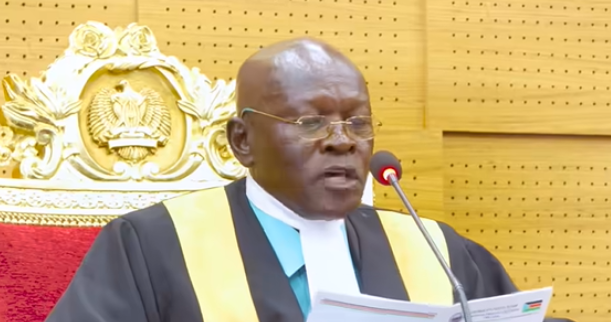
South Sudan’s parliament on Wednesday approved controversial amendments to the 2018 Revitalized Peace Agreement, removing requirements for a population census and a permanent constitution before elections due in December 2026, despite objections from opposition lawmakers.
The National Legislature voted to defer the two provisions until after the elections, with parliamentary officials saying the move clears major legal obstacles to holding the vote.
Parliament, however, left intact provisions of the 2018 peace agreement that give it precedence over conflicting national laws, including the transitional constitution, after pressure from the international community to preserve the accord’s legal foundation.
Oliver Mori Benjamin, caretaker chairperson of the parliament’s Information Committee, said the amendments would allow election preparations to accelerate.
“The two main provisions amended concern the population census and the permanent constitution making process,” Mori told reporters after the sitting.
He said both processes would instead be carried out by an elected government after the polls.
“These two have been deferred until after the elections and will be undertaken by the elected government. This resolution now allows the National Elections Commission and political parties to speed up their activities in preparation for the elections,” he said.
Mori said removing the census and constitution making requirements eliminated the biggest barriers to holding the elections on schedule.
“These were the main obstacles because they could each take more than a year to complete. Now that they have been removed by parliament, the remaining processes such as voter registration and publication of the voters register can be completed within two or three months before the elections,” he said.
He also dismissed concerns that insecurity would derail the vote.
“Security arrangements are a process, not an event. They are ongoing and will not obstruct the conduct of the elections,” he said.
However, opposition lawmaker Bol Joseph Agau of the National Democratic Movement challenged the legality of the amendments, saying parliament had failed to follow procedures set out in the peace agreement and the transitional constitution.
Agau said amendments should first be initiated by the agreement’s signatory parties, endorsed by a two thirds majority of the Council of Ministers, approved by a majority of the Reconstituted Joint Monitoring and Evaluation Commission, and only then ratified by parliament.
He also questioned what he described as a second amendment introduced by the Minister of Cabinet Affairs while lawmakers were scrutinizing the original bill.
Deputy Justice and Constitutional Affairs Minister Joseph Malek defended the amendments, saying South Sudan had followed the required procedures and had the sovereign right to proceed with elections.
“The agreement belongs to the South Sudanese parties. It cannot stop our will if we decide to go for elections,” Malek said.
He said parliament’s approval had removed the legal barriers to holding elections and reaffirmed citizens’ right to elect their leaders.
The amendments come as South Sudan steps up preparations for its first national elections since gaining independence in 2011.
On Tuesday, the Political Parties Council (PPC) granted full registration to five additional political parties, including the former SPLM-IO faction, now renamed the IO Party and led by Peacebuilding Minister Stephen Par Kuol, bringing the total number of legally registered parties eligible to contest the elections to 36.
The National Elections Commission (NEC) announced on June 22 that voting would take place in December 2026, meeting the legal requirement to declare the election at least six months in advance.
The commission has, however, warned that funding shortages, legal inconsistencies and delays in implementing key provisions of the 2018 peace agreement could hamper preparations.
While President Salva Kiir’s camp insists the elections will proceed as scheduled, several opposition groups, including the SPLM-IO led by detained First Vice President Riek Machar, say key benchmarks such as security reforms, constitution making and the unification of forces remain incomplete, raising doubts over whether conditions for a credible vote are in place.

 and then