



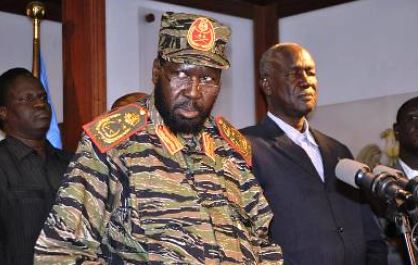
More than ten years ago, when one hundred US dollars was worth only two hundred and fifty South Sudanese Pounds, and life seemed to smile upon people with relative abundance, I had a terrifying dream on a long and quiet autumn night. In that dream, I saw General Salva Kiir and senior leaders of the SPLM attending a lavish dinner banquet organised in his honour.
I distinctly remember that General Kiir was wearing his official military uniform. What immediately caught my attention, however, was that the badges, medals, and buttons on his shoulders were upside down. Despite the visible confusion and discomfort on the faces of those present, no one dared to ask him about his strange appearance.
Perhaps in an attempt to divert attention from the awkward situation, the master of ceremonies asked the DJ to play a clip of Garang Ateny’s well-known anthem, its lyrics insisting that South Sudan was won by the gun and not by paperwork. The audience reacted to the song. Immediately afterward, the General for Codes and Operations since the days of the late Dr John Garang, as usual, took the microphone. He welcomed the guests and began his remarks:
“We have organised this dinner in honour of General Salva Kiir, who successfully led the transitional period. Today, however, we are entering a new era in our history: an era in which certificates and institutions have become extremely important.”
He continued by explaining that the purpose of the gathering was, first, to honour General Salva Kiir and, more importantly, to discuss the peaceful transfer of leadership within the Sudan People’s Liberation Movement.
The audience erupted with excitement, interrupting the speaker repeatedly with applause and chants of “SPLM Oyee!”, while the man being celebrated lowered his head. Then, in an angry voice, he interrupted the cheering crowd: “Let us begin by discussing the agenda that you have all applauded and chanted for in perfect unison”.
It did not go as anyone in the room expected.
Those present eventually agreed to discuss a model inspired by the Chinese Communist Party, based on the peaceful transfer of leadership within the party after a defined period of time.
That night, General Kiir reacted with outrage that astonished everyone present.
Without warning, he grabbed a piece of glass and violently threw it to the ground. As the shattered pieces scattered across the floor, he declared: “If you want me to hand over South Sudan, I will hand it over to you in pieces, like these scattered shards of glass.” With those words, the meeting came to an end.
It was not a successful gathering. Everyone left deeply worried about what the future might hold, especially after witnessing the strange uniform worn by General Salva Kiir and hearing the words that had concluded the meeting.
Whether this was merely a dream or a warning from history is something the people of South Sudan may judge for themselves.
What is clear, however, is that General Kiir’s long exercise of power has entrenched the idea that “Either we rule you, or we hand over a torn South Sudan” is now an ideology of the State, defended by his supporters from the Bahr el Ghazal region. In this writer’s assessment, those supporters are positioning Ms Adut Salva Kiir to succeed her father, whatever the cost to the country’s unity.
Today, the manifestations of this ideology are increasingly evident. This is particularly true given that South Sudan is politically governed from Warrap State, as clearly demonstrated by the monopolisation of key positions of power by those who subscribe to this ideology.
The situation has become so striking that Ms Adut Salva Kiir, the Presidential Envoy for Special Programs, represented South Sudan at the 21st Extraordinary Session of the African Union Assembly on Conflict Prevention and Resolution in Luanda, Angola, representing her father in a country that officially has five vice presidents.
The concentration of power, wealth, and prestige around leaders hailing from General Salva Kiir’s tribal strongholds, particularly in Warrap State and Bahr el Ghazal in general, warrants serious discussion. Consider that the Mini-Security Council, chaired by General Salva Kiir himself, operates at the expense of diversity. Yet the supporters of the tribal segregation state go to extremes in misleading citizens by claiming that we are one people and one nation!!
Look where the ideology of “either we rule you, or we hand you a torn-up South Sudan” has led the country today. While General Salva Kiir was receiving medical treatment in South Africa, he instructed the Chief of Staff of the segregation regime’s militia, General Santino Deng Wol, to reinforce security deployments and intensify patrols in the capital, Juba.
Of course, how can Juba be safe when, in Warrap State, at least 49 people were killed and 33 injured in a cattle raid? In Western Equatoria State, specifically in Mundri West County, two police officers were abducted and the county commissioner’s vehicle was burned. In Jonglei State, specifically in Bor County, the county commissioner’s house was burned down. In Eastern Equatoria State, specifically in Kapoeta East County, a mother and her daughter died of starvation amidst a worsening food crisis. And in Lafon Area, hundreds of families were displaced from their homes following an attack on Nyaro village.
At a time when the country is witnessing a continuous deterioration in security and humanitarian conditions, and allegations of corruption and the misuse of public resources and donor aid continue to fuel public anger, we humbly ask: what kind of state is being prepared for elections while its citizens still face insecurity, displacement, hunger, and political instability?
Today in South Sudan, the question is perhaps no longer just about morality. It is about whether the existing regime can produce anything other than the crisis we are witnessing, a crisis within which changing the existing regime has become an integral part of the struggle for peace, justice, citizenship and national unity.
Look how, just yesterday, they turned the National Assembly into a military barracks to pass their crime against our people. Nothing is more dangerous to national security than passing amendments to the Transitional Constitution in the hope of renewing the legitimacy of a state-terrorist regime that is training more than 5,000 police officers in Warrap State to secure the general elections scheduled for the end of this year.
Can elections held under conditions of militarisation, political exclusion, insecurity and fear truly represent the democratic will of the people?
The boycott of the Warrap State elections, conducted in the name of the Republic of South Sudan, is a national duty before anything else. Therefore, we say to the people of South Sudan: do not be deceived by elections held in the name of the Republic. Do not allow anyone to falsify your political will. Do not become complicit in manipulating your future. Make the struggle for genuine change your highest priority.
Elections protected by a single tribal faction and conducted with a mindset that suggests “either we rule you, or we hand you a fragmented South Sudan” cannot automatically become elections of the people.
How can we truly claim to be one people and one nation when citizens continue to question the regional balance and national character of those overseeing the most important political processes in the country?
How can people trust promises of free, fair, transparent and democratic elections when the political climate remains characterised by fear, militarisation, exclusion and insecurity? These are questions that demand honest answers.
Today’s stand is not only about boycotting the elections, though that is part of the resistance, but about strengthening our people’s struggle for the change they deserve.
The writer, Sokiri Lo Poni, is a concerned South Sudanese. He can be reached via Sokiril8@gmail.com.
The views expressed in ‘opinion’ articles published by Radio Tamazuj are solely those of the writer. The veracity of any claims made is the responsibility of the author, not Radio Tamazuj.

 and then