



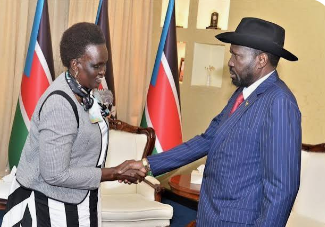
The recent comment by Vice President Rebecca Nyandeng De Mabior that South Sudan’s current regime and its leaders have inflicted more serious harm on the South Sudanese people and their fellow liberators than their former primary enemy, Khartoum, is a genuine concern that resonates with millions of South Sudanese. In her remarks at the funeral of former Finance Minister Kosti Manibe Ngai in Juba, the vice president declared, “We have inflicted upon ourselves things that our enemies did not do to us.” Her remark further exposes the inner workings of a regime that consistently seeks to conceal its failures while presenting an image of legitimacy through reform-laced policies. However, instead of addressing the issues raised by the vice president, the office of President Salva Kiir released a statement that failed to address those concerns and instead resorted to its long-standing strategy of deflection, attempting to justify its deceptive and self-serving policies.
As she correctly observed, the battlefield during the struggle was brutal, but nothing has devastated South Sudan quite like the savage efficiency of Kiir’s authoritarian rule and rampant corruption. Under Salva Kiir’s regime, South Sudan is not functioning like a normal country, politically or economically. What we have is not a legitimate government but a regime that operates like a mafia enterprise, where every decision or action is directly or indirectly sanctioned by the mafia boss. Kiir’s leadership record is well documented and known to both South Sudanese citizens and the international community. To deflect from or distort the vice president’s genuine words while lecturing her and the public about Kiir’s supposed successes is the work of utter sycophants and political pawns.
Barely two days after her remarks, Kiir’s office issued a statement defending his leadership record and boldly calling on anyone who challenges the regime to contest the planned December 2026 elections. In that announcement, the Office of the President declared, “When reference is made to those who stood with the late Dr. John Garang de Mabior, it must be remembered that the struggle was collective.” It added, “Those who believe the government has failed should present their case to the people; those seeking change should organize and persuade voters. The people—not political elites, government positions, or political rhetoric—must decide.”
The statement further asserts, “As elections are being prepared for, some of those who demanded elections now appear increasingly opposed to the very process they once demanded,” and goes on to question whether concerns raised by the main opposition political leaders and the people of South Sudan about the credibility of the elections, their potential to bring an end to the ongoing civil war, and their ability to improve the country’s fragile humanitarian situation are based on “principle or political calculation.”
The invocation of the “collective” nature of the liberation struggle sits uneasily with Kiir’s own longstanding political narrative. During the liberation struggle, Kiir repeatedly portrayed himself as the more democratic alternative to Dr. John Garang and criticized Garang’s leadership as dictatorial; yet after Garang died in a helicopter crash on July 30, 2005, and Kiir rose to power, the democratic credentials he once emphasized became increasingly difficult to reconcile with his subsequent exercise of power. In this context, his sudden emphasis on the collective struggle can reasonably be viewed as politically self-serving.
Kiir’s own version of events raises a fundamental contradiction in his invocation of the liberation struggle as a collective achievement. On May 16, 2026, he claimed that he personally rejected a $500 million offer from the regime of former Sudanese President Omar al-Bashir, allegedly intended to persuade him to prevent South Sudanese from voting for independence. If the independence struggle was genuinely collective, why present himself as the singular figure who personally stood between the South Sudanese people and the loss of their right to independence? This apparent contradiction raises an important question: Why does it seem that whenever collective sacrifice strengthens his political legitimacy, Kiir invokes the liberation struggle as a collective achievement, but when personal glory serves his historical narrative, he positions himself as the guardian of South Sudan’s independence? One cannot claim that the struggle belonged to everyone while portraying oneself as the person who alone secured its ultimate achievement.
The same contradiction is evident in Kiir’s invitation to those who believe his government has failed to “present their case to the people” and to those seeking change to “organize and persuade voters.” Such a challenge has little democratic meaning when Kiir himself systematically restricts the very political environment in which opposition and other democratic-minded leaders are expected to organize, mobilize, or persuade voters. It is not enough for an incumbent government to point to elections and declare that the people must decide; democratic choice requires a political space in which alternatives can actually emerge and compete. The central question is therefore not whether Kiir can invoke voters, elections, or the collective struggle, but whether his government has created the conditions necessary for those words to have substantive meaning.
The same pattern is evident in the regime’s response when it questions whether criticism of the planned elections is based on “principle or political calculation.” Questions about the credibility of the elections, whether their results can help bring an end to the ongoing civil war, and whether they can improve the country’s fragile humanitarian situation are not, in themselves, expressions of opposition to elections. Rather, they are legitimate questions about whether the electoral process can produce a credible and meaningful political outcome. If the government genuinely believes that “the people” must decide, then concerns raised by political leaders and citizens about the conditions under which that decision will be made should be addressed on their substance rather than dismissed by questioning the motives of those who raise them.
These contradictions make the presidential statement appear less like a confident defense of democratic competition than an attempt to assert democratic legitimacy while deflecting scrutiny of the political constraints surrounding that competition. The comparison with Kiir’s alleged $500 million bribe claim is therefore unavoidable. In both narratives, Kiir’s personal role is elevated when it serves to reinforce his historical and political legitimacy, while the collective nature of the struggle is emphasized only when that framing is more advantageous.
There is nothing wrong with Vice President Rebecca Nyandeng’s claims; in fact, her views are both correct and well-founded. Indeed, the questions raised in her remarks deserve to be addressed directly rather than dismissed.
For the regime and those who disagree with her assertions, these are the questions they should answer:
Isn’t it true that many former liberation fighters are jobless and living on the streets of South Sudan? Isn’t it true that there are millions of South Sudanese in neighboring East African countries living as refugees, while millions more live in United Nations-run Protection of Civilians (PoC) sites? Isn’t it true that corruption is the unspoken policy of the Kiir regime? Isn’t it true that Salva Kiir fears reform-minded opposition leaders more than he fears the future of the country, and that this is precisely why he prefers weak and briefcase political parties over strong and influential ones, while also prosecuting opposition leaders, such as those of the Sudan People’s Liberation Movement/Army-In-Opposition (SPLM/A-IO)? Isn’t it true that Kiir has effectively replaced the decades-old reform ideas of the liberation struggle with kleptocratic and dictatorial practices? Isn’t it true that Kiir has systematically obstructed the implementation of the September 2018 Revitalized Agreement on the Resolution of the Conflict in South Sudan (R-ARCSS) and unilaterally amended its provisions to justify his ambition to hold what critics describe as staged elections in December 2026, so that he can claim legitimacy after announcing results produced under his government’s control? Is he not the same Kiir who persistently ignored the advice of religious leaders, both local and foreign, including Pope Francis, who knelt and kissed his feet on April 11, 2019, only to have Kiir later ignore the Pope’s call for peace? Is he also not the same Kiir who orchestrated the so-called National Parliamentary Prayer Breakfast in Juba on July 7–8, 2026, under the theme “One Nation, One People, One Future: Seeking God’s Wisdom for Peace and Elections in 2026,” even as he has intentionally and repeatedly impeded the path to unity and lasting peace in the country?
As evidence suggests, none of these questions is unfounded. This is why the regime and its supporters should embrace Rebecca Nyandeng’s observation, as she seems to be among a small group of reasonable national leaders within the government who prioritize the interests of and care about ordinary citizens and the country’s future. It would not surprise me if Kiir’s inner circle were to launch a purge against the vice president, especially given that she has reportedly been denied access to Kiir for at least two years. This mafia-like regime is so intoxicated with the country’s resources, coupled with Uganda-baptized authoritarianism, that its members often treat dissenting high-profile voices, like that of Rebecca Nyandeng, as a threat to their political survival.
Rebecca Nyandeng’s warning should not be dismissed as an internal political disagreement; it should instead be understood as a serious warning about the consequences of a system that has failed the very people in whose name the liberation struggle was fought. If Kiir’s regime truly believes that the people must decide South Sudan’s future, then it should first create the political conditions under which they can do so freely and meaningfully. Until then, invoking liberation, elections, and popular sovereignty will remain little more than a political shield for a regime unwilling to confront the devastation under its rule. A regime that fears genuine political competition cannot credibly claim to trust the people’s judgment.
Duop Chak Wuol is an analyst, critical writer, and former editor-in-chief of the South Sudan News Agency. He is a graduate of the University of Colorado and writes on geopolitics, security, and social affairs in South Sudan and the broader East Africa region. His work has appeared in leading regional and international outlets, including AllAfrica, Radio Tamazuj, The Independent (Uganda), The Arab Weekly, The Standard (Kenya), The Chronicle (Ghana), Addis Standard (Ethiopia), and Sudan Tribune. In 2017, the Ethiopian Broadcasting Corporation highlighted his article on Meles Zenawi’s role in Ethiopia’s economic transformation. He can be reached at duop282@gmail.com.
The views expressed in ‘opinion’ articles published by Radio Tamazuj are solely those of the writer. The veracity of any claims made is the responsibility of the author, not Radio Tamazuj.

 and then