



I have always wondered what happens when a country acquires the sovereignty of a state but none of the functioning institutions of one. South Sudan appears to have invented the answer: a modern charity organization with a national anthem, a flag, diplomatic immunity, and citizens auctioned daily on the altar of corruption.
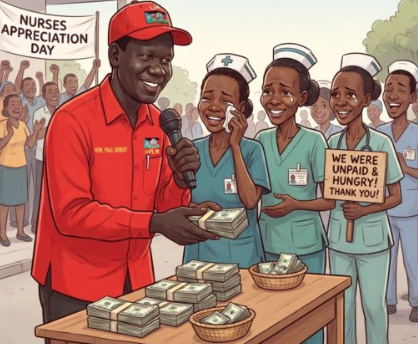
The spectacle in Rumbek tells the story better than any constitutional textbook. Akol Paul Kordit, Secretary-General of the ruling SPLM Party, reportedly handed USD 21,000 to 210 health workers, USD 100 each, after months without salaries. On the surface, it is a generous gesture. I do not quarrel with helping hungry nurses and health workers. They deserve every penny. However, I cannot help asking the embarrassing question: Why must a political party secretary-general become the emergency Ministry of Finance of a sovereign republic? A hospital worker should receive a salary, not a political blessing.
A doctor should be paid through the public payroll, not through the generosity of a political office-holder. A nurse should not have to stand in a hospital compound waiting for a politician to arrive carrying an envelope large enough to temporarily rescue the state from its own responsibilities. This is where the comedy becomes tragedy.
We have created a state that increasingly resembles a bat: constitutionally a mammal, politically dressed like a bird, and institutionally unable to decide whether it is flying, crawling, or hanging upside down. It possesses sovereignty without solvency, immunity without accountability, ministries without money, hospitals without salaries, and political institutions without institutional memory. And then we call this government, but I call it political improvisation with a flag.
If 210 health workers have worked for months without pay, then the USD 21,000 does not demonstrate that the system is functioning. It demonstrates precisely the opposite. It is the receipt issued by a broken payroll system. The political marketplace has replaced the public administration. Rights have become favors, donations have replaced budgets, charity has replaced institutions, accountability has disappeared into the pockets of personalities, speeches have become monthly salaries, and salaries have become the political equivalent of a consolation prize.
The most dangerous transformation is not merely that workers go unpaid. It is that unpaid labor begins to look normal. Imagine the absurdity: a government can have employees working for months without wages, while the political class continues operating, travelling, holding retreats, issuing statements, discussing elections, and even giving huge sums of money in personal donations that can pay three-quarters of the employees of the same state.
Apparently, the state has money for politics but not necessarily for the people who keep its hospitals alive. This is where the language of modern slavery becomes uncomfortably relevant, not because public servants are legally slaves, but because a system that demands continuous labour while withholding the means of survival begins to reproduce the economic coercion associated with servitude.
And the citizens are expected to applaud when somebody finally hands them USD 100. What a magnificent achievement: the state has failed to pay you, but the party has arrived to rescue you from the state! That is not institutional governance. That is robbing Peter to pay Paul while Peter is still waiting for his salary.
Worse still, nobody can clearly tell the public whether the USD 21,000 was personal money, party money, or public money. That uncertainty itself is symptomatic of a deeper problem: the dangerous disappearance of the line between public resources, party resources, and personal political generosity.
In a healthy constitutional democracy, public money follows a budget, but in a patronage system like South Sudan, money follows relationships. In a collapsing system, citizens follow politicians carrying money. That is how sovereignty becomes a cloak for opacity.
State secrecy becomes political secrecy. Official immunity begins to resemble immunity from scrutiny. Public office becomes an investment vehicle, and accountability becomes an inconvenient guest nobody invited to the dinner table.
I therefore refuse to romanticize this USD 21,000 as evidence of a functioning government. The nurses deserve praise; the system deserves interrogation. If the government can only pay workers when a senior party official personally intervenes, then the question is no longer simply “Who gave the money?”
The questions are: Where is the state? Where is the Ministry of Finance? Where is the approved health budget? Where is the payroll? Where are the public accounts? Where is parliamentary oversight? Where is the constitutional responsibility of government to provide public services? And where, precisely, did the sovereignty go while the nurses were working for months without wages?
This is the tragedy of the scam modern state: it looks magnificent on the world map but miserable on the ground. It has embassies abroad but patients without medicine at home. It has sovereignty at the United Nations but salary arrears in its hospitals. It has political conferences but empty public coffers. It has officials with titles longer than the list of unpaid workers. It has elections on the calendar while public servants are still waiting for yesterday’s salaries.
A state that survives from hand to mouth cannot seriously pretend to be building a future. In addition, perhaps that is our greatest political joke: we keep talking about the future of South Sudan while the state itself is struggling to finance the present.
I am not against charity. I am against turning charity into a substitute for government. I am not against political leaders helping citizens. I am against creating a system in which citizens must depend upon political leaders for what should already be guaranteed by law.
The nurses of Rumbek do not need political mercy, but they need a functioning state. They do not need to be rescued from their employer by the employer’s political relatives. They need their salaries paid on time, every month, through institutions that cannot be switched off by political convenience.
Until then, I will continue to describe this strange creature honestly: a private organization wearing the sovereignty of a state; a charity organisation carrying the passport of a republic; a political marketplace masquerading as public administration; and a bat on the world map, legally a mammal, visually confused, and hanging upside down while its citizens wait for tomorrow. And the saddest part? Tomorrow keeps being promised because today has already been sold.
The writer is a South Sudanese constitutional lawyer, academic, and political figure. He studied law at Makerere University in Kampala, Uganda. He is an independent legal researcher and constitutional expert, and serves as a lecturer and Deputy Dean of the College of Law at Starford International University in Juba. He is also a member of the Sudan People’s Liberation Movement-in-Opposition (SPLM-IO).
The views expressed in ‘opinion’ articles published by Radio Tamazuj are solely those of the writer. The veracity of any claims made is the responsibility of the author, not Radio Tamazuj.

 and then