



Following independence in 2011, the Government of South Sudan assumed the existing Exploration and Production Sharing Agreement (EPSA) originally established by the Sudanese government with a consortium of Asian oil companies—China National Petroleum Corporation (CNPC), Petronas of Malaysia, and Oil and Natural Gas Corporation (ONGC) of India. Subsequently, South Sudan formalized a new EPSA framework with the consortium to regulate post-independence oil operations.
The government of South Sudan and the oil companies, mostly from Asian countries renegotiated in January 2012 and formalized a new Exploration and Production Sharing Agreement (EPSA). The agreement was established with a fixed duration of sixteen years, set to expire in 2028. This integrated exploration–production framework was designed to provide sufficient operational continuity, enabling both the host state and its corporate partners to maximize resource development and long-term investment returns. At the time of EPSA initiation, South Sudan, as a newly independent state, possessed limited institutional capacity and human resource expertise to negotiate effectively with international oil companies. Consequently, several critical dimensions of the agreements were inadequately addressed, most notably the environmental implications of exploration and production activities.
As the current operational framework (EPSA) approaches its expiration in 2028, it is imperative to establish clearly defined priority areas through inclusive stakeholder engagement. The National Government, represented by the Ministry of Petroleum, should convene a high-level consultative process involving states and administrative areas authorities in oil-producing regions. Active participation from the Ministries of Health, Environment, and Legal Affairs is essential to ensure accountability and comprehensive oversight. Given its scope, this initiative must be recognized as inherently multi-stakeholder and multidisciplinary in nature, requiring coordinated input across governance, technical, and regulatory domains. Members of parliament who held from producing areas, from both upper and lower houses, youth organizations must actively engage and participate in this process. This ensures informed collective work and oversight at the operational time.
The critical components of environmental management in oil production include the treatment of produced water, remediation of contaminated soils resulting from surface and subsurface oil spills, and the safe handling of chemical waste. Operating companies employ diverse technological approaches to manage produced water, with methods varying across production blocks and operators. Contemporary treatment techniques encompass mechanical, chemical, and biological processes, each designed to optimize efficiency and effectiveness. The following section outlines representative technologies currently applied across the three major oilfields.
1. Produced Water and Contaminated Treatment Technologies in Greater Pioneer Operating Company Oilfields, Blocks, 1,2A, 2B, and 4
The primary technology employed by GPOC for produced water treatment is Wetland Bioremediation utilizing Microbial Sulfate Reduction (MSR). This approach has been in use for an extended period and relies on engineered wetlands containing specialized soils and vegetation that foster optimal conditions for microbial communities—including bacteria, fungi, algae, and protozoa. These microorganisms facilitate the degradation of hydrocarbons present in crude-produced water, thereby reducing its toxicity and improving safety for potential reuse. GPOC use soil clearance, excavation and containment of the spilled area contaminated by the crude, transporting it in an organized transportation manner to the treatment site. The contaminated soil is heaved and well placed to the designated sites. The soil is sequentially exposed to high thermal heat to degrade hydrocarbons and heavy metals. This method is efficient and effective.
Currently, five bioremediation systems are operational across GPOC oilfields, including Unity Biorem, Munga Biorem, and Toma South Biorem. The infrastructure requires substantial land allocation and high initial investment. However, many of these systems now lack protective fencing, increasing accessibility by local communities and livestock, which has led to unintended uses such as fishing in retention ponds.
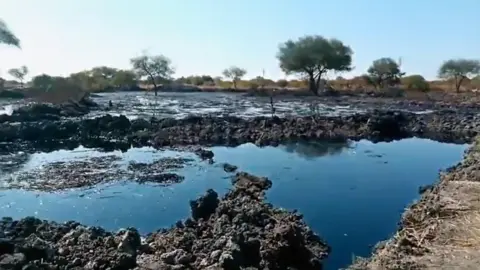
Frequent flooding in the region exacerbates risks, as treated water from bioremediation ponds can infiltrate community water sources used for drinking by both humans and animals. Additionally, soil remediation outcomes remain inadequate, and the intended agricultural reuse of treated water has not been realized in Unity State and the Ruweng Administrative Area. Instead, extensive artificial water bodies—described as “man-made seas and oceans”—have accumulated over nearly three decades since 1999, reflecting both environmental and management challenges associated with the technology.
2. Produced Water and Contaminated Soil Treatment Technologies in Sudd Operating Company Oilfields, Block, 5A
Sudd Petroleum Operating Company (SPOC) employs the same produced water treatment technology as Greater Pioneer Operating Company (GPOC), namely Wetland Bioremediation utilizing Microbial Sulfate Reduction (MSR). This system involves the establishment of engineered wetlands designed to support vegetation and microbial communities. The microbial consortia—comprising bacteria, fungi, algae, and protozoa—facilitate the degradation of hydrocarbons and heavy metals, thereby reducing toxicity and improving water quality for potential reuse.
Contaminated soils are treated using thermal desorption techniques, whereby hydrocarbon-laden soils are exposed to elevated temperatures to accelerate hydrocarbon breakdown. Despite these interventions, several challenges persist. Treated water often remains stored in evaporation ponds for extended periods without being repurposed, undermining the intended agricultural or industrial applications. Furthermore, both treated soils and produced water require independent verification through third-party testing, which should be overseen by the Ministry of Petroleum to mitigate conflicts of interest. Only upon confirmation that hydrocarbon and heavy metal concentrations have been reduced to acceptable standards can reuse be safely implemented. Despite plan placed for reuse of the treated water and soil, there has never been active action taken in ensuring reuse for agro industrial benefits since the first oil operation and production in 1999. The absence of protective fencing around extensive bioremediation sites has resulted in uncontrolled access, thereby increasing the risk of exposure of local communities and their livestock to residual pollutants.
3. Produced Water and Contaminated Soil Treatment Technologies in Dar Operating Company Oilfields, Block, 3 and 7
Dar Petroleum Operating Company (DPOC) primarily uses Produced Water Reinjection (PWRI) and retention pond bioremediation systems for treating oilfield produced water. These methods rely on subsurface reinjection and engineered ponds with microbial activity, but they face significant shortcomings related to environmental safety and reuse. Produced water is injected back into subsurface reservoirs to maintain reservoir pressure and reduce surface disposal. Reinjection minimizes direct discharge into the environment but requires strict monitoring to prevent leakage and contamination. Retention Pond Bioremediation: Constructed ponds are used to store produced water. Microbial communities (bacteria, fungi, algae) degrade hydrocarbons and reduce toxicity. Some systems incorporate fencing and soil stabilization to limit erosion.
Shortfalls of the Technology
a. Environmental Risks: Reinjection has been inconsistently managed, leading to contamination of groundwater and soils.
b. Flooding Vulnerability: Retention ponds are prone to overflow during seasonal floods, allowing contaminated water to mix with community water sources.
c. Reuse Gap: Treated water often remains in evaporation ponds for extended periods without being repurposed for agriculture or industry.
d. Verification Issues: Independent third-party testing is limited; without Ministry of Petroleum oversight, there is risk of conflict of interest in confirming water quality.
e. Community Exposure: Inadequate fencing around ponds increases access by locals and livestock, raising health and safety concerns.
What next as the EPSA is ending in 2028 and the To Be New EPSA?
Before the current EPSA expires in 2028, the Government of South Sudan and oil companies must prioritize environmental cleanup, enforce strict safety standards, and negotiate a new EPSA with binding protections for communities and ecosystems.
Environmental Safety Actions
a. Decontamination of sites: Oil companies must remediate polluted soils, rivers, and wetlands, including removing toxic waste and restoring biodiversity.
b. Waste management plans: Implement strict hazardous waste disposal systems to prevent leaks and spills. Chemical and petroleum based waste management must clearly and strictly be followed by operating companies and their contractors while running operations. Currently There is no clear policy in place in regard to chemical wastes management across the three joint operating companies.
c. Emergency preparedness: Establish rapid response protocols for oil spills, fires, and gas leaks. This can involve carrying effective education and information promotion to communities living around the concession areas of oil operations.
e. Health and safety standards: Adopt World Bank and international EHS guidelines, ensuring worker and community protection.
Community & Social Safeguards
a. Community engagement: Conduct consultations with local populations to address grievances and ensure transparency.
b. Grievance mechanisms: Establish accessible complaint systems for affected residents.
c. Employment standards: Guarantee fair labor practices, training, and inclusion of women and vulnerable groups.
d. Disease prevention: Implement health programs to mitigate risks of communicable diseases linked to oil operations.
Negotiating a New EPSA (Post-2028)
a. Clear environmental clauses: Mandate strict environmental impact assessments and binding cleanup obligations.
b. Local benefit sharing: Ensure revenue allocation to communities for infrastructure, health, and education.
c. Independent monitoring: Require third-party audits of environmental and social performance.
d. Transparency in contracts: Publish EPSA terms to prevent corruption and ensure accountability.
Risks if Not Addressed
a. Environmental degradation: Persistent oil contamination could destroy farmland and water sources.
b. Social unrest: Communities excluded from benefits may resist future oil projects.
c. Investor withdrawal: International financiers demand compliance with global environmental and social standards.
Key Recommendations
1. National Government of Republic of South Sudan: Strengthen regulatory enforcement, align laws with World Bank ESS standards, and demand full site remediation before EPSA renewal, this role can be spearheading by the Ministries of Petroleum and Environment
2. Involvement of Producing States and Administrative Areas, such as Upper Nile State, Unity State and Ruweng Administrative Area governments in discussions on new EPSA in regard to safe environmental practice during exploration and production
3. Oil Companies: Invest in cleanup, adopt best practices in waste management, and commit to transparent community benefit-sharing.
4. Civil Society: Monitor compliance, advocates for community rights, and push for contract transparency.
The writer, Dr. Giel Thuok Yoach Thidor, holds a Master of Medicine (MMed), a Master of Public Health (MPH), and a Bachelor of Medicine and Bachelor of Surgery (MBBS). He is a Consultant Obstetrician and Gynecologist, Public Health Specialist, and expert in environmental and occupational health management in the oil and gas industry.
He can be reached via email at thuokyoach@gmail.com.
The views expressed in ‘opinion’ articles published by Radio Tamazuj are solely those of the writer. The veracity of any claims made is the responsibility of the author, not Radio Tamazuj.

 and then