



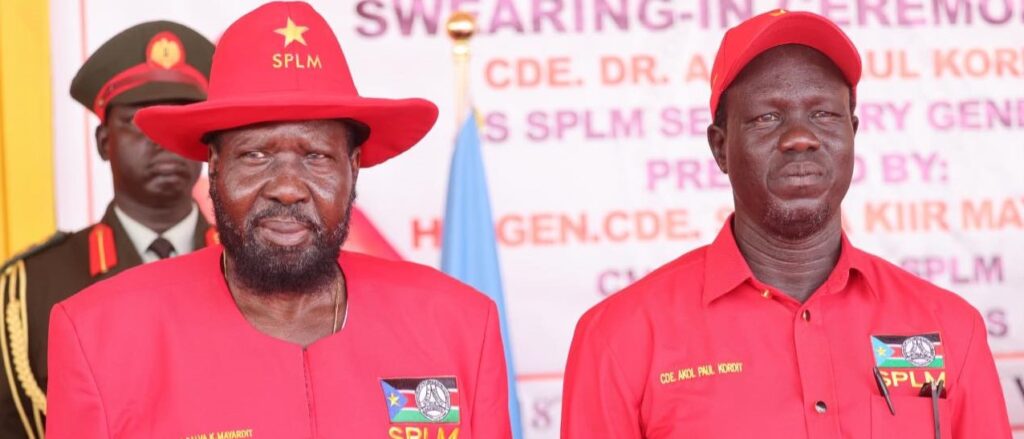
The stability of any political party, particularly one that governs a nation, depends not merely on the strength of personalities, but on fidelity to constitutional order. Political constitutions are designed to restrain arbitrary power, regulate leadership transitions, and preserve institutional integrity. When those constitutional safeguards are ignored or manipulated, the consequences rarely remain confined within party structures; they inevitably spill over into the governance of the state itself. This is precisely the dilemma confronting the Sudan People’s Liberation Movement (SPLM) today.
The SPLM Constitution of 2008, as amended in 2016, establishes the offices of the Chairperson, Deputy Chairpersons and Secretary-General, among others. More importantly, it outlines the procedures governing appointment, accountability and removal from office. In theory, these provisions were carefully crafted to prevent the concentration of authority in one individual and to ensure that the party operates within democratic and institutional frameworks rather than personal discretion.
One of the clearest examples of this constitutional protection appears under Article 28(2) of the SPLM Constitution, which governs the removal of the Secretary-General. The provision states that the Secretary-General may only be removed through a resolution of the National Liberation Council supported by a two-thirds majority of all members, either upon the recommendation of the Chairperson or upon the request of at least one-third of the National Liberation Council members.
The language is deliberate and unambiguous. It was intended to insulate the office from unilateral interference and to ensure that the removal of such a senior party official reflects collective institutional judgment rather than personal political convenience.
In principle, therefore, the SPLM Constitution provides significant protection to the Secretary-General. The office was never designed to function at the mercy of the Chairperson. Instead, the Secretary-General was envisioned as an institutional office-holder accountable to the broader party structure, particularly the National Liberation Council. This arrangement mirrors democratic traditions across political systems, where senior party officials derive legitimacy not solely from the party leader, but from constitutional organs within the party itself.
However, constitutional guarantees are only meaningful when they are respected in practice. The greatest weakness of many African political institutions is not the absence of constitutional provisions, but the culture of selective obedience to them.
The SPLM presents a striking example of this contradiction. The constitutional safeguards protecting the Secretary-General were fundamentally undermined in 2013, when the then Secretary-General, Cde. Pagan Amum, was removed under circumstances widely criticised as unconstitutional. The removal did not follow the rigorous procedure outlined under Article 28(2) of the SPLM Constitution. Crucially, there was no visible institutional resistance or objection from the National Liberation Council or the Political Bureau.
That moment represented more than the dismissal of one individual. It established a dangerous precedent within the SPLM: that constitutional provisions could be suspended whenever they became politically inconvenient.
Since then, the office of the Secretary-General has increasingly appeared vulnerable to the unilateral discretion of the Chairperson. Appointments and removals have often been perceived not as constitutional processes, but as exercises of political patronage. Consequently, the office has gradually lost the institutional independence and security that the Constitution originally intended to guarantee.
From that time to date, the Chairperson has appointed and dismissed Secretaries-General as though they were personal assistants. Such actions have placed every SPLM Secretary-General at the mercy of the Chairperson and his close advisers.
One therefore wonders whether the current SPLM Constitution still protects the Secretary-General from this pattern of one-man rule. In reality, there appears to be little effective legal protection for the current Secretary-General, given that the constitutional provisions are not consistently adhered to and that his security in office depends largely on the will of the Chairperson.
This development raises a deeper constitutional question: what value does a constitutional provision hold if it can be ignored without consequence?
A constitution, whether for a political party or a state, derives its authority not from words written on paper, but from the willingness of institutions and leaders to submit themselves to its limits. Once constitutional compliance becomes optional, governance shifts from institutional rule to personal rule. At that point, legality is replaced by loyalty, and constitutionalism becomes symbolic rather than functional.
The implications of this constitutional erosion extend far beyond the SPLM itself. In South Sudan, the ruling party and the machinery of government are deeply interconnected. The political culture within the SPLM inevitably shapes governance practices across state institutions. When constitutional violations become normalised within the ruling party, the same culture of disregard for legal procedures permeates public institutions.
This reality is evident in broader governance concerns within South Sudan. Questions surrounding the dismissal of judges without proper involvement of the Judicial Service Commission, or appointments and removals affecting the Chief Justice without parliamentary approval, reflect a wider pattern of institutional weakening.
The problem, therefore, is not isolated to party politics; it is systemic. The erosion of constitutionalism inside the SPLM gradually translates into the erosion of constitutional governance within the Republic itself. Thus, violations of the SPLM Constitution inevitably spill over into the Transitional Constitution of the Republic of South Sudan, 2011, as amended.
The danger of such a trend cannot be overstated. Nations do not collapse merely because of economic hardship or political disagreements. They weaken when institutions cease to matter and when constitutional rules are replaced by the preferences of individuals.
Where constitutional order is subordinated to personal authority, citizens lose confidence in governance systems, institutions become fragile, and accountability disappears.
For South Sudan, a country that has endured years of conflict, instability and political fragmentation, the preservation of constitutionalism should not be treated as a technical legal issue reserved for lawyers and politicians. It is fundamentally an issue of national survival.
Constitutional safeguards exist to protect both institutions and citizens from arbitrariness. When those safeguards are undermined within the ruling party, ordinary citizens ultimately bear the consequences through weakened governance, diminished protections of rights and reduced institutional accountability.
It is therefore insufficient for members of the SPLM or the public to remain silent whenever constitutional violations occur within the party. Silence in the face of institutional erosion only legitimises that erosion further.
The National Liberation Council, as the constitutional organ entrusted with oversight responsibilities, carries a particularly important duty to uphold the SPLM Constitution impartially and consistently. Failure to do so transforms constitutional bodies into ceremonial institutions devoid of meaningful authority.
Equally, South Sudanese citizens must recognise that the defence of constitutionalism cannot be selective. Constitutional violations within political parties are not merely internal matters when those parties control state power. The governance culture cultivated inside the ruling party inevitably shapes national governance. In that sense, every citizen has a legitimate stake in ensuring that constitutional norms are respected within the SPLM.
Ultimately, the question is not whether the SPLM Constitution contains provisions protecting the Secretary-General. Clearly, it does. The real question is whether those entrusted with implementing the Constitution are willing to respect it even when it constrains political power.
Without institutional commitment to constitutional order, no office within the SPLM, including that of the Secretary-General, can enjoy genuine legal protection.
The future of constitutional governance in South Sudan depends not only on drafting laws and constitutions, but also on cultivating a political culture in which no individual stands above them. Until that principle is genuinely embraced, constitutional guarantees will remain vulnerable to political expediency, and institutions will continue to weaken under the weight of unchecked authority.
The writer, Chol Deng Anyieth, is an Advocate and Commissioner for Oaths based in Juba. He holds an LL.M in Public International Law from Kampala International University, as well as an LL.M and LL.B from the University of Juba. He can be reached at choldenga@yahoo.com.
The views expressed in ‘opinion’ articles published by Radio Tamazuj are solely those of the writer. The veracity of any claims made is the responsibility of the author, not Radio Tamazuj.

 and then