



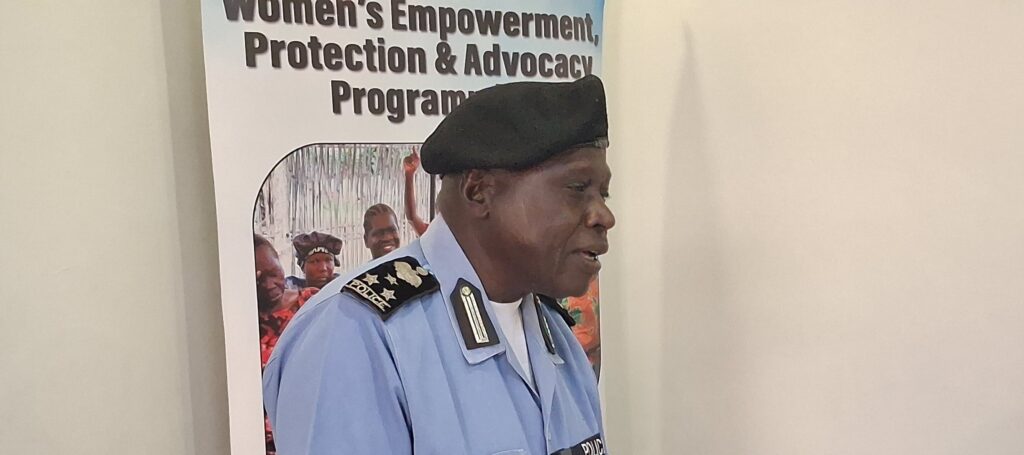
A senior South Sudan interior ministry official on Thursday urged lawmakers to pass the long-delayed Family Bill and Anti-Gender-Based Violence Bill before December elections, saying the legislation is critical to tackling violence against women and promoting gender equality.
Speaking during a three-day training programme for traditional chiefs and women leaders in Juba, Brig. James Dak Carlos, Director of Protection at the Ministry of Interior, said harmful social norms and gender inequality remained deeply entrenched in South Sudanese society and required legal intervention.
“The issue of masculinity is highly existing in our society. Where a man is given the best food and whatever a man says is correct, he cannot be opposed,” Carlos said.
He called on parliament to prioritise legislation aimed at protecting women and families.
“Especially the anti-gender-based violence and family bills. We want them to be passed before the election,” he said.
Carlos said parliamentary leaders had previously pledged to enact the legislation before the polls, but the bills remain pending.
“Last time the speaker promised that this bill would be enacted before the coming of the election,” he added.
Women’s rights advocates have long pushed for the passage of the Family Bill, arguing that it would strengthen legal protections for women and children and help address widespread gender-based violence across South Sudan.
Carlos also highlighted the role of traditional chiefs in community development and social mobilisation.
“You know during the colonial days the chiefs played a great role. They helped in governance, road construction and encouraging children to go to school. So the chiefs play a very great role. They are part and parcel of the organised forces and that’s why we are here,” he said.
The training seeks to equip chiefs and community leaders with knowledge on women’s rights, gender-based violence and legal frameworks designed to protect vulnerable groups.
According to Carlos, participants will be encouraged to challenge harmful social norms, particularly those that reinforce male dominance over women.
“In these three days we are going to make them champions, we are going to make them leaders and they will help propagate awareness on the issue of masculinity,” he said.
“We are trying to tell the chiefs that we have to abide by our laws, international laws and regional laws. We need equality, with men and women working together.”
Carlos also urged the government to fully implement regional and international instruments that promote women’s rights, including the Maputo Protocol, United Nations Security Council Resolution 1325, Convention on the Elimination of All Forms of Discrimination Against Women (CEDAW) and the Beijing Declaration and Platform for Action.
“We want the government to fully implement the Maputo Protocol. Resolution 1325, CEDAW, the Beijing Declaration and all these international instruments, we want them to be enacted and implemented,” he said.

 and then