



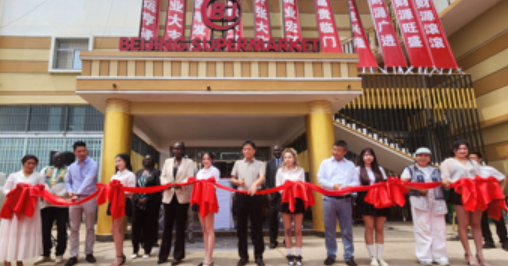
The ongoing expansion of Chinese-owned enterprises across Juba is doing more than just changing the city’s commercial landscape; it is actively reshaping the financial realities of local families by offering affordable commodities and vital employment opportunities. Local activists and residents have warmly welcomed the new Chinese supermarkets and retail hubs launching across the capital’s various markets.
Okwandit Nelson, a local businessman, noted that Chinese investments in major commercial hubs like Custom, Konyo-Konyo, Juba Town, and Munuki have drastically simplified supply chains. Previously, local traders had to endure high expenses and logistical hurdles traveling directly to China to source merchandise. Today, large-scale warehouses and retail centers bring those same products straight to the local market.
“They are facilitating trade by making goods available right here in Juba,” he said. “Someone who would have otherwise traveled all the way to China can now find these items locally, from clothing to electronics—at prices that are quite affordable for the average citizen.”
The truest impact of these businesses is felt in their recruitment strategies, which heavily prioritize the local South Sudanese labor force.
“In many of these large-scale shopping malls and hardware outlets, up to 95 percent of the staff are young South Sudanese, with Chinese personnel strictly confined to high-level administration or security monitoring,” Nelson added.
Other local observers, including Merlin Dimir, point out that for many young employees, these positions have become economic lifelines, allowing them to achieve milestones that once seemed out of reach in a challenging economy.
“Chinese investment has steadily diversified beyond traditional sectors into everyday consumer spaces. Supermarkets, hardware stores, household goods outlets, furniture showrooms, and wholesale solar energy hubs are now common fixtures in the capital and across various states,” he observed. “If you visit these shops, supermarkets, or warehouses, you will find that more than 90 to 95 percent of the staff are South Sudanese.”
Dimir added that under this business model, Chinese personnel represent only about 3 to 5 percent of the workforce, primarily serving in supervisory or administrative roles. While these enterprises operate on a large scale, they rely heavily on local labor rather than an imported workforce.
This approach provides critical jobs for South Sudanese youth, who currently face exceptionally high unemployment rates. Local staff are also increasingly being entrusted with key operational responsibilities, including financial management, cashier duties, sales, and security.
“I recently visited a wholesale hardware shop where only one Chinese manager was present, primarily monitoring the CCTV cameras,” Dimir added. “The cashier, the sales team, and the floor guides were all South Sudanese. The entire building was run by local staff.”
He added that while challenges remain in South Sudan’s broader labor market, these private-sector investments are playing a quiet but vital role in absorbing young job seekers and stimulating the local economy. As the country continues to seek avenues for economic stabilization and youth empowerment, the integration of local labor into these growing retail networks offers a practical, saleable model for private-sector job creation.
Edmond Yakani, the Executive Director of the Community Empowerment for Progress Organization (CEPO), says that fostering this economic growth has also opened doors to deeper social connections. He highlighted that these establishments do more than just provide paychecks; they offer invaluable career development.
“These establishments have created vital job opportunities for South Sudanese citizens, exposing them to the retail sector and offering hands-on experience in management and administration,” he said. “This is a profound benefit and a clear demonstration of people-to-people exchange between South Sudan and China.”
Yakani added that the retail boom has fostered a meaningful exchange of cultural values, marking a breakthrough for community integration.
“South Sudanese are being introduced to Chinese cultural aspects, while the Chinese community is simultaneously learning about South Sudanese culture. This mutual exposure greatly aids in cultural integration, particularly regarding language,” he said. “Today, if you walk into a Chinese supermarket, you will often hear a South Sudanese employee greeting or addressing you in spoken Chinese. This is the beautiful beginning of true cultural exchange.”
Yakani concluded by praising the expansion: “I would like to take this opportunity to formally register my highest appreciation to the Chinese private sector for opening supermarkets here in Juba, such as Beijing, Lily Aubergine Supermarket in the northeast, and many others.”

 and then