



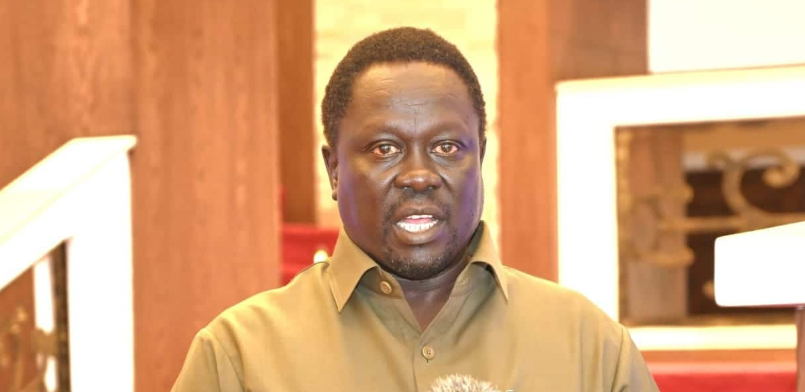
South Sudan’s Vice President for the Service Cluster, Hussein Abdelbagi Akol, has dismissed claims by fellow Vice President Gen. Taban Deng Gai that he was prevented from traveling to his home area in Unity State, calling the allegation “baseless.”
Speaking last month at a prayer service for victims of the Abiemnhom attack, Deng said his request to travel to Unity State since Christmas had not been approved by the president’s office.
He also said he had been unable to meet President Salva Kiir for nearly a year, blaming obstruction by officials within the presidency. However, he met Kiir days after making the complaint public.
During the same event, Deng recounted a conversation with Abdelbagi in which they discussed deadly intercommunal violence between the Ruweng Administrative Area and neighboring Unity State.
“I told him [Abdelbagi], ‘You people don’t assist us so that we can resolve problems facing our people,’” Deng said.
Deng, who first became first vice president in 2016 after replacing Riek Machar during a breakdown in the 2015 peace process, returned to the vice presidency in 2020 under a 2018 power-sharing agreement between Kiir and Machar, who is now detained and facing treason charges.
Under the 2018 peace deal, South Sudan has five vice presidents representing the parties to the agreement.
Speaking at a memorial service in Juba on Saturday, April 4, for the late chief Tungwar Kueigwong Reat of the Leek Nuer community, Abdelbagi rejected Deng’s account and urged leaders from Unity State to prioritize peace and cooperation.
“Taban said recently that I rebuked him. I talked to him and told him, ‘Taban, you are now the prominent leader from Bentiu, because now Dr. Riek is in prison, but you are free and Tut [Gatluak] is around. There are problems in Bentiu, including killings and fighting with your neighbors who are actually part of your people. What is the reason for fighting when those are your people? And you are there and cannot resolve the issue? So I told him that,’” Abdelbagi said.
Abdelbagi, who hails from Northern Bahr el Ghazal State, said he was not convinced by Deng’s explanation that he had been blocked from traveling to Unity State since December.
“I am not convinced by what he said, that he was not allowed to go to Bentiu. It is baseless. If I were a vice president from Bentiu, whether from SPLM or SPLM-IO, and if there were a problem there, I would bring all the people of Bentiu together to work with me for the sake of Bentiu and the development of the area,” he said.
He said divisions among political leaders were fueling insecurity and warned that continued disunity could cost Unity State its representation in the national government.
“You people are not working together, and that is why there is no peace in Unity State. Your people will continue to die, and you will continue to lose your seats in the national government because of disunity,” he said.
The memorial service, held in honor of Sultan Tungwar, also became a platform for calls for unity, accountability, and leadership to end violence in Unity State.
Tungwar, born in 1936 in present-day Unity State, rose within the Leek Nuer community to become a prominent traditional leader. He began his leadership career in 1969 as a border chief mediating between the Misseriya and Leek Nuer communities, later serving as sub-chief, deputy head chief in 1975, and head chief in 1985.
He also held government roles, including head of an appeal court in 1999 and county commissioner in 2001.
Tungwar, the father of the current undersecretary in the Ministry of Water Resources, Lam Tungwar, died on April 2, 2023.

 and then