



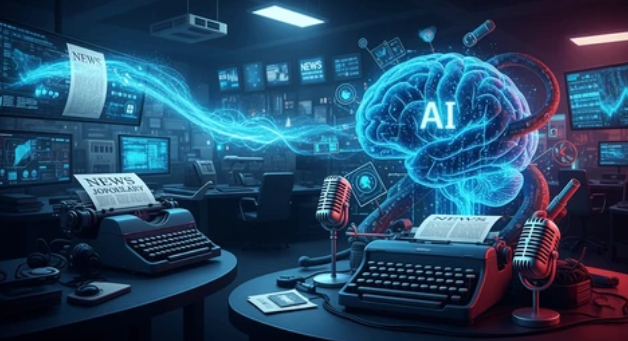
Over 30 news editors from various media houses and representatives from public institutions recently gathered in Juba to confront one of the most pressing transformations facing modern journalism: the rapid rise of Artificial Intelligence (AI) in the newsroom.
The forum, organized to examine AI’s wider implications for public trust, ethical governance, media integrity, and online safety in South Sudan, brought together a diverse coalition of media leaders, regulators, and international development partners.
Opening the discussion, Oyet Patrick Charles, President of the Union of Journalists of South Sudan (UJOSS), set a pragmatic tone for the gathering.
“Artificial Intelligence is no longer a distant concept. It is already with us, and it is actively influencing how information is produced, shared, consumed, and governed,” he stated.
While acknowledging that AI offers massive opportunities for efficiency and newsroom innovation, Oyet warned of a darker side, including misinformation, disinformation, hate speech, privacy violations, and content manipulation. He challenged the room to think critically about the future of the craft.
“We must ask ourselves how to preserve journalistic integrity in this era of AI-generated content and how to ensure that technological advancement strengthens, rather than undermines, public trust, accountability, and democratic participation,” he said.
Oyet also emphasized an urgent need for multi-stakeholder collaboration to fight digital exclusion, online harassment, and technology-facilitated gender-based violence, which disproportionately targets women and girls in the digital sphere.
Sapana Abuyi, Director General of the Media Authority, noted that South Sudan occupies a unique historical position. Because the nation gained independence during an era of rapid global digital transformation, it has the opportunity to leapfrog older systems.
“Our advantage is that South Sudan became independent when these technologies were already moving fast, and we are moving fast with them,” Abuyi said, charting the evolution from basic computers to advanced, generative AI tools. He did not mince words regarding current newsroom vulnerabilities.
“Sometimes when you look at our print media, you can tell a story was simply copied and pasted from AI without proper editing,” he cautioned. “It is up to the human journalist to verify facts, conduct deeper analysis, and ensure the content reflects reality on the ground.”
Abuyi further reminded editors that mainstream AI models still heavily struggle to accurately grasp local South Sudanese languages and cultural contexts, making human gate-keeping non-negotiable.
Later in the forum, serving as the event’s Guest of Honor, Abuyi explicitly clarified the regulatory body’s official stance.
“The Media Authority has officially given the green light for AI integration. It is not forbidden, and journalists should not fear it. AI does not come to replace journalism, nor does it come to take away journalists from the newsroom,” he stated. “Without journalists, the news will not be authentic. You have to be there because your thinking and your decisions put true meaning into the news. AI is simply a tool to use for our benefit.”
The call for profound professional responsibility was echoed strongly by Koang Pal, Program Manager at Eye Radio. He urged media houses to adopt these tools thoughtfully rather than relying on them blindly.
“AI is here, and we must learn how to work with it selectively. If you attempt to use AI blindly for everything, it becomes a challenge. We bear a massive responsibility as media houses in this country,” he said. “Regardless of the ongoing conflicts, crises, or challenges we currently face, this is our country… We must work to mirror the stability and quality of life enjoyed by our neighboring countries. That is the fundamental work of the media—to shape governance.”
He committed to sharing Eye Radio’s ongoing operational experiences with AI, alongside insights into how public institutions are beginning to explore the technology.
This progress, however, faces steep local realities. Participants candidly discussed the severe economic and infrastructural deficits plaguing South Sudanese newsrooms, where rampant power cuts mean journalists must often rely on older smartphones with failing batteries.
Acknowledging these hurdles, Abuyi noted that as donor funding dwindles, many media houses are struggling to afford basic tools, notebooks, or transport. He revealed that the government is actively looking into media capacity-building and is working on a nationwide fiber-optic network to bridge the information gap between rural communities and the capital, Juba.
Representing Norwegian People’s Aid (NPA), Joyce Maker reaffirmed the organization’s dedication to independent journalism, informed public discourse, and gender equality.
As the forum drew to a close, Maker pushed the attendees to turn the day’s heavy theoretical consensus into practical, institutional workflows.
“I think we all agree that AI is here to stay,” she said. “The question is no longer whether we should engage with it, but a matter of how we engage with it responsibly, ethically, and effectively.”
Maker warned against the historic trap of high-level forums where excellent ideas are brought forth, only to vanish because everyone assumes someone else will take the lead.
“I would really want us to start making more action-oriented plans, taking up those roles, and holding each other accountable,” she concluded. “If we say the Media Authority will be tasked with specific items, let’s follow up. If UJOSS is supposed to convene a follow-up, or another media house is supposed to track an initiative, let’s make it a reality so we stop going round in circles.”
In his closing remarks, Abuyi commended UJOSS for creating a vital space for professional brainstorming, reminding journalists that capacity building happens in rooms just like this. “Learning is not a one-day event where you go up and get all the knowledge at once; it is built progressively through forums like this. Continue doing this. Even if there is no formal space, sit under a tree, take some tea, and share your ideas. This is nation-building, and we are building the nation together.”

 and then