



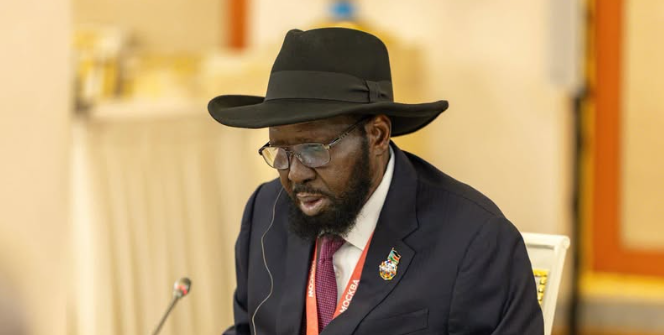
President Salva Kiir on Thursday officially closed the inter-party dialogue in Juba, with participating political parties adopting a series of resolutions calling for greater political freedoms, inclusive participation and improved security ahead of general elections scheduled for February 11, 2027.
The dialogue, launched by Kiir in September, brought together political parties participating in the Juba-based process to discuss electoral preparations and build consensus ahead of the polls. However, it did not include opposition groups outside the country, leaving some major political actors outside the process.
The resolutions were read by Dr. Martin Elia Lomuro, the rapporteur of the inter-party dialogue, during the closing ceremony attended by President Kiir, government officials, political party representatives and other stakeholders.
In a joint communiqué dated November 26, the participating parties reaffirmed their position that the National Elections Commission (NEC) should determine the date for the general elections, while urging the government and relevant institutions to accelerate preparations for the polls.
They also reiterated their commitment to ending the transitional period without further extension, in accordance with the existing political framework and electoral timeline.
Reading from the communiqué, Lomuro said the parties had reaffirmed their agreement that the NEC should determine the date of the elections.
“The parties reaffirmed their agreement that the National Election Commission shall decide the date of the general elections,” Lomuro said.
The resolutions acknowledged outstanding political, institutional, financial, logistical and security challenges that could affect the electoral process, calling for coordinated action by the transitional government, the NEC, the Political Parties Council and other relevant institutions.
On the legal framework, the parties agreed that the elections should be conducted in accordance with existing national laws, including the Transitional Constitution of 2011, as amended, the Revitalised Agreement on the Resolution of the Conflict in South Sudan (R-ARCSS), the National Elections Act and the Political Parties Act.
The communiqué further emphasised that the NEC must exercise its statutory responsibilities in managing polling, counting, transmission, declaration and publication of election results in accordance with the National Elections Act.
On security and political participation, the parties called for neutral, professional and impartial security arrangements throughout the electoral process.
They also urged the government to guarantee freedoms of expression, assembly, movement, campaigning, media access and election observation, while warning against intimidation and political violence.
The parties further called for the protection of political candidates, their supporters and campaign activities, stressing that security forces must respect applicable laws and fundamental rights and freedoms.
On inclusion, the communiqué reaffirmed the importance of meaningful participation by women, young people, persons with disabilities, civil society organisations, faith-based groups, traditional leaders and community-based organisations.
The parties specifically called on political parties and the NEC to uphold the legally prescribed 35% representation for women and promote the peaceful participation of young people and persons with disabilities in the electoral process.
They also urged the government and the NEC to establish legal arrangements to facilitate the participation of eligible refugees, internally displaced people, detainees and South Sudanese living in the diaspora.
The parties further stressed that outstanding transitional obligations under the R-ARCSS would continue beyond the general elections. They encouraged continued engagement with holdout groups and non-signatories to promote dialogue, reconciliation and national stability.
Presidential order
During the ceremony, Lomuro also read a Republican Order signed by President Kiir on November 20, 2026, guaranteeing free and unhindered movement across the country to facilitate peaceful election campaigns.
The order directs organised forces to facilitate and safeguard the movement of candidates and their campaign teams across states and administrative areas.
It also prohibits security personnel and state authorities from arresting, harassing or intimidating candidates and their supporters because of their lawful campaign activities.
However, the order maintains restrictions on the unauthorised possession or movement of unlicensed firearms, incitement to violence, hate speech and tribal mobilisation.
Calls for implementation
Speaking on behalf of the Eminent Personalities, Dr. Aldo Ajou described the inter-party dialogue as an emotional and historic moment, saying South Sudanese had demonstrated their ability to come together to address national challenges.
He said the gathering recalled the unity demonstrated during previous liberation struggles, particularly between 1955 and 1972 and from 1983 to 2005.
“We have never made a mistake in coming together, loving one another and conducting ourselves together without mediation, without cohesion and without foreign pressure,” Ajou said.
He urged political leaders and stakeholders to sustain the spirit of dialogue beyond the electoral process, saying it should also guide efforts to address the country’s political, social and economic challenges.
Ajou said South Sudan had failed to maintain the unity demonstrated during the liberation struggle after gaining independence in 2011, pointing to the outbreak of conflict two years later.
Uganda’s Ambassador to South Sudan, Brigadier General Ronnie Balya, urged the country to focus on economic transformation and accountability as it moves towards the next phase of its development.
Balya said political liberation should be followed by economic liberation, supported by stronger mechanisms to ensure transparency and accountability in the management of national resources.
“The people of South Sudan focus on developing mechanisms to promote transparency and accountability of South Sudan resources,” he said.
Using Uganda as an example, the ambassador stressed that public officials and individuals should be accountable for how they manage and use resources and income.
He said economic transformation required responsible resource management, adding that accountability should remain a key principle in building the country’s future.
Civil society representative Edmund Yakani urged political leaders to ensure that the resolutions reached during the dialogue translated into concrete action.
“We are good at reaching conclusions and producing documents and agreements like this one, but sometimes some of us start making interpretations that drag our feet in translating this aspiration into reality,” Yakani said.
“We want to see the outcome of this inter-party dialogue translated into real action, into a real pathway of moving us non-violently from violence to peace,” he added.
Yakani said civil society would support efforts to implement the resolutions and the presidential order.
“We will stand with you. We will stand with the people of South Sudan. One day, one time, we’ll be in the good books of history that people come and learn from South Sudan,” he said.
Kiir pledges support
In his closing remarks, President Kiir said the government had chosen to pursue general elections and that the country was now moving towards the polls through four critical roadmaps.
He described the conclusion of the inter-party dialogue as another milestone in the electoral process, saying the forum was intended to bring political actors together rather than provide another platform for negotiations and disagreements.
“Instead, its main purpose is for all of us to team up towards the path to peaceful elections,” Kiir said.
He said the resolutions reflected progress towards the country’s electoral objectives, describing elections as the legitimate means through which South Sudanese could exercise their right to choose their leaders.
Kiir said he had received the resolutions and procedural agreements, including provisions relating to the funding of political parties.
He pledged to address restrictions on internal travel in accordance with administrative procedures and said funding would be implemented in line with the law.
“I will try to lift any restrictions on internal travel in accordance with the administrative procedures. Funding will be implemented,” he said.
He later reiterated that political party funding would be provided in accordance with existing laws.
Kiir thanked the Eminent Personalities and regional partners, including the African Union, the Intergovernmental Authority on Development (IGAD) and the East African Community, for supporting the inter-party dialogue.
He subsequently declared the inter-party dialogue officially closed.
Elections preparations
South Sudan is preparing for its first general elections since gaining independence in 2011. The National Elections Commission has rescheduled the polls from December 22, 2026, to February 11, 2027, citing the need for additional time to complete electoral preparations.
The elections have been repeatedly postponed since the transitional period established under the 2018 peace agreement, amid persistent security concerns, funding constraints, political divisions and questions about the country’s readiness to conduct credible polls.
The inter-party dialogue was launched in Juba on September 24 as part of efforts to build political consensus ahead of the elections. However, the absence of major opposition groups, particularly those operating outside the country, underscores the political divisions surrounding the electoral process.
 and then