



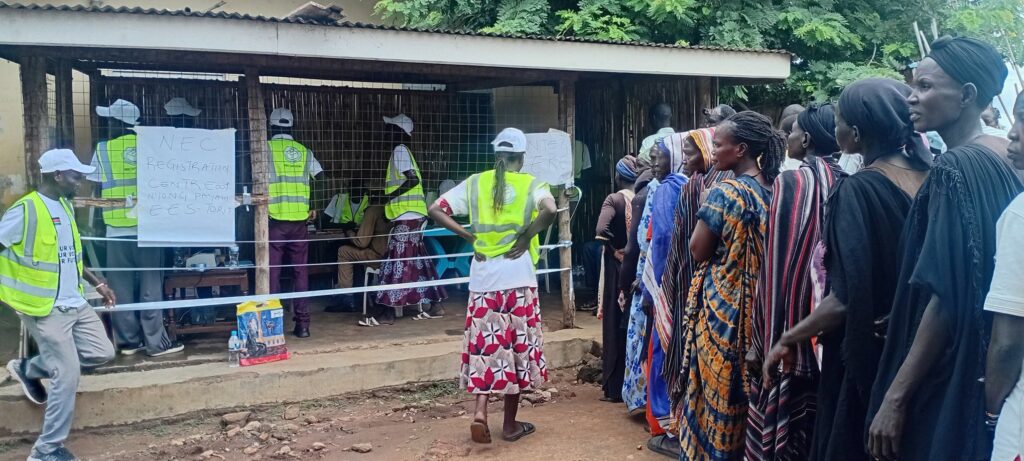
Voter registration is under way across Eastern Equatoria State, but limited civic education, long distances to registration centres and other barriers are raising concerns about the participation of women, young people and residents of remote communities.
The Eastern Equatoria State Election High Committee told Radio Tamazuj on Wednesday that registration materials have been distributed across all eight counties and administrative areas, with more than 450 registration centres established.
Oryema Emmanuel, deputy chairperson of the committee, said registration was progressing, although officials were still awaiting reports from some constituencies before releasing comprehensive figures.
He said six national geographical constituencies had so far reported a combined total of 141,600 registered voters, while figures from five other constituencies in Greater Kapoeta were still outstanding.
Emmanuel declined to provide the total number of registered voters across the state, saying the figures were still being compiled.
“Registration is ongoing, and at each registration centre, people are informed of the number of male and female registrants for the day,” he said.
He acknowledged concerns that registration had started late in some remote communities but said it was too early to determine whether eligible voters would be excluded.
With the registration deadline set for November 28, Emmanuel said there were no plans to extend the exercise.
“There is no extension of the registration date,” he said.
He urged eligible citizens intending to vote in the upcoming elections to visit registration centres and obtain their voter registration slips.
“Those who want to vote or participate in the upcoming elections have to register so that they can obtain a registration slip and be able to cast their votes,” he said.
Barriers to participation
Despite the committee’s assurances that registration materials had reached all areas, residents and civil society representatives say inadequate public awareness and practical difficulties continue to discourage participation, particularly among women and young people.
Neema Lamara Bodo Onorio, a young resident of Hai Melekia in Torit, told Radio Tamazuj that she had not registered, citing personal commitments, but intended to do so before the deadline.
She expressed concern that many young people in her community were unaware of the registration exercise and its importance.
“Most youth in our community, they don’t know about registration. They don’t know what is taking place. They don’t know anything,” she said.
Lamara identified limited awareness, transport costs and long distances to registration centres as factors discouraging young people from registering.
She urged community leaders, authorities and civil society groups to step up civic education and encourage young people to participate in the process.
“I would like mostly the leaders; they have to educate people about it,” she said.
Aloyo Mary, a member of the Eastern Equatoria State Women Association, said some women remained reluctant to register, while others believed they were too old to participate in elections.
She also cited family pressure, particularly disagreements between husbands and wives over where women should register, as an obstacle to participation.
“The woman said she’s going to register at their Payam. Then the husband said, no, you are not going to register there. Let us go in our Payam,” Mary said.
She said women living far from registration centres face additional difficulties, while people with disabilities could struggle to access registration facilities.
Mary, who said she had registered, urged women to exercise their right to choose their leaders.
“You have to register. It is now our right to register so that we go and elect the person whom we want,” she said.
However, she said civic education had not adequately reached grassroots communities, particularly women without access to radio and other information channels.
“The civic education did not reach to other Payams. Even others up to now, they don’t know what is taking place,” she said.
The concerns come as South Sudan prepares for general elections, with voter registration a key step in the electoral process.
With the November 28 deadline approaching, election authorities face the challenge of addressing gaps in public awareness and access to registration centres, particularly in remote communities, to ensure that women, young people and people with disabilities are not left out.
 and then