



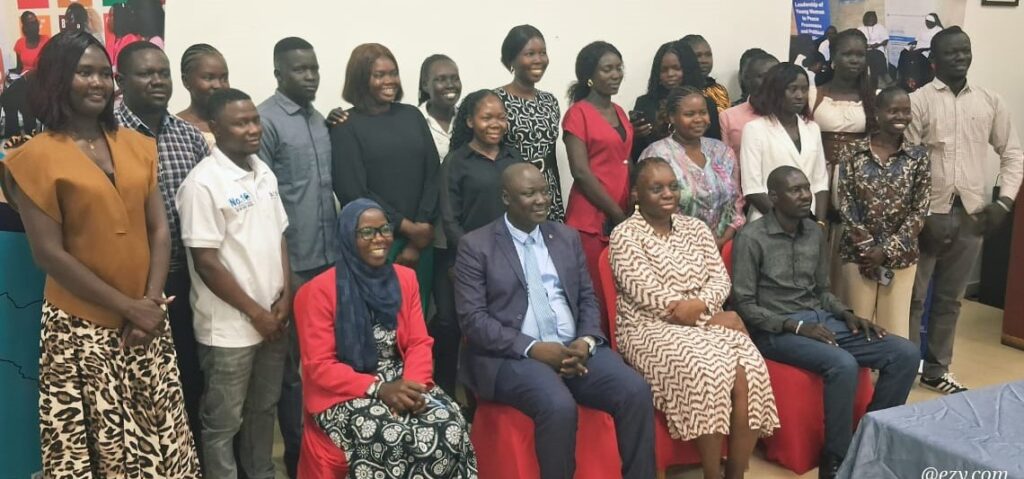
The National Press Club South Sudan (NPC-SS), in partnership with UN Women, on Tuesday concluded a two-day training on gender-responsive and conflict-sensitive journalism, with media leaders urging journalists to apply the skills they gained to promote ethical reporting and gender equality ahead of South Sudan’s planned 2026 elections.
The workshop in Juba brought together journalists from various media outlets to strengthen reporting on gender issues, elections and conflict, as the country prepares for its first national elections since independence.
Poverty Alfred, executive director of the National Press Club South Sudan, praised participants for their commitment, saying their consistent attendance reflected a strong desire to improve journalism in the country.
“I’m excited that we maintained the attendance throughout the training. This shows serious commitment to learning and improving the working environment of journalism in South Sudan,” he said.
Alfred urged journalists to uphold professional standards, noting that their work reaches audiences beyond South Sudan.
“You as a journalist in South Sudan are a journalist in the world. Don’t devalue your work thinking it remains here. It can go beyond South Sudan,” he said.
He encouraged reporters to focus on the concerns of ordinary citizens while maintaining balance and accuracy in their reporting.
“Journalism starts with the people, and authorities have to respond to their demands. That is the real balance, accuracy and professionalism in journalism,” Alfred said.
He thanked UN Women and the Peacebuilding Fund for supporting the training and expressed hope that continued collaboration would help strengthen women’s political participation as the elections approach.
Alfred also urged journalists to translate the training into action by producing more stories on gender-related issues affecting communities.
“We need to see more stories on gender-sensitive issues that exist in our communities. You are the voice of those who cannot speak for themselves,” he said.
Ayaa Irene, chairperson of the Association for Media Development in South Sudan (AMDISS), said the training came at a critical time as the country prepares for elections expected at the end of 2026.
“I encourage you to take this training seriously. The skills you have acquired will help improve gender-sensitive and gender-responsive reporting,” she said.
Ayaa said journalists also have a responsibility to report conflicts ethically despite South Sudan often being described as a post-conflict country.
“Our environment still experiences conflicts, and journalists should approach conflict-sensitive reporting in the most ethical way,” she said.
She also encouraged journalists to strengthen their digital presence to reach wider audiences as media consumption increasingly shifts online.
Sarah Chaat, communications officer at UN Women, commended participants for their professionalism and welcomed the fact that journalists had already begun reporting on the workshop before it concluded.
She thanked media practitioners for partnering with UN Women to promote gender equality and responsible journalism.
“We continue to engage together in advancing gender equality. Thank you for being our partners and for moving things forward on behalf of South Sudan,” Chaat said.
Echoing the workshop’s central message, she reminded journalists of their role in amplifying marginalized voices.
“You are the voice to the voiceless,” she said.

 and then