



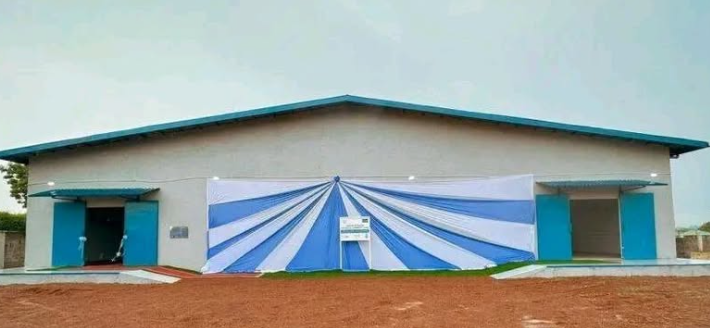
The Deputy Chairperson of the South Sudan HIV/AIDS Commission, Dr. Achol Yom, has called on international partners to actively support the Ministry of Health in sustaining investments made in the health sector.
“Yes, the time will come when the government assumes full responsibility for everything, but for now, please support the Ministry of Health and help us safeguard this investment,” Dr. Yom said on Thursday during the official handover and inauguration of the Gombo Central Medical Store (Dry Commodities Extension), which was constructed by UNDP in collaboration with UNICEF through Global Fund financing.
Addressing key international entities, Dr. Yom emphasized the importance of collaboration and local knowledge.
“To UNDP, I am a strong supporter of your work. I always say that UNDP possesses one outstanding quality—you know how to listen,” she said. “To UNICEF and our other partners: please listen to us as well. We know this country better than anyone, regardless of academic qualifications. So please, listen to us.”
“I believe partner operations are sometimes delayed because the government ought to fund the healthcare of every South Sudanese citizen. We all understand the current situation in South Sudan, so please bear with us; we will rise,” Dr. Yom added.
Describing the newly inaugurated Gombo facility as a major milestone, she commended the entities that contributed and urged citizens to take pride in and look after it.
“This is a beautiful facility. Thank you to everyone who contributed to its realization. When you leave this country and return years later, you will take pride in knowing you helped construct this facility and build this nation,” Dr. Yom said. “To my fellow South Sudanese, let us not take these achievements for granted. Let us work harder, take ownership of what is ours, and demonstrate love for our country. When someone assists us, we express gratitude, but we must continually strive for progress.”
For her part, Yar Manyuon, Director General of Preventive Health Services, urged partners to prioritize structural integration across all health programs to mitigate global funding pressures.
“Facilities like this strengthen South Sudan’s health architecture. Building strong, lasting partnerships between national institutions and international agencies remains vital to our country’s progress,” she said. “On behalf of the government, I express our sincere gratitude to the Global Fund, UNDP, UNICEF, WHO, and all technical teams, engineers, contractors, and program directorates who made this project a success.”
Meanwhile, Mohamed Abchir, the UNDP Resident Representative, said the warehouse complex was a major landmark.
“This achievement by the Ministry of Health serves as a major milestone and an eye-opener for our development partners. We currently spend significant funds renting external facilities just half a kilometer north of here,” he said. “I call upon UNICEF, WHO, and other partners to consider constructing additional facilities on this land.”
“Rather than spending $2 million annually on rent, allocating a fraction of those resources toward permanent structures here will yield substantial savings that can be redirected toward direct healthcare delivery. The land is available, and the administrative requirements are minimal,” he advised.
Dr. Bortolo Hisa, Executive Director of Central Medical Stores (CMS), emphasized how the new warehouse addresses critical operational bottlenecks.
“Today, we gather to witness and formally accept an expansion of our storage capacity, constructed by UNDP in collaboration with UNICEF through Global Fund financing,” he stated. “This additional space directly resolves critical storage bottlenecks that previously forced us to rent commercial warehousing for programs like the Health Transformation Project.”
“While this facility represents a major victory, CMS continues to urge both the government and international partners to secure resources for further expansions at the central, state, and county levels,” Dr. Hisa added.
He said that without adequate storage for medical commodities, healthcare delivery remains incomplete.
Dr. Hisa thanked the Country Coordinating Mechanism (CCM) for their advocacy in mobilizing resources from the Global Fund and GAVI.

 and then