



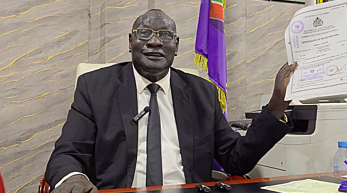
South Sudan Supreme Airlines owner Ayii Duang Ayii on Tuesday denied claims that the carrier had announced a return to commercial operations, saying the airline’s aircraft remain grounded and are still undergoing maintenance and technical preparations.
Speaking to journalists in Juba, Ayii said reports suggesting the airline had resumed flights were based on a misunderstanding of an earlier update regarding the technical assessment of one of its aircraft.
In March 2021, a South Sudan Supreme Airlines Let L-410, with registration HK-4274, performing a charter flight from Pieri to Yuai with 8 passengers and 2 crew, crashed shortly after take-off from Pieri. All on board died in the crash.
“There has been no resumption of flight operations,” he said.
His remarks came a day after the South Sudan Civil Aviation Authority (SSCAA) issued a statement addressing the operational status of the airline and reminding operators that commercial flights cannot resume without meeting all regulatory and certification requirements.
The aviation authority said South Sudan Supreme Airlines’ operations had previously been suspended because of safety-related concerns identified during regulatory oversight and compliance assessments.
“The management of South Supreme Airlines was granted access solely for the purpose of managing and securing its assets and equipment,” the authority said, adding that no authorization had been granted for the airline to resume flight operations until all identified safety concerns had been addressed and approved by regulators.
Ayii said the airline’s previous communication referred only to the successful completion of a technical assessment of a CRJ-100 aircraft and was not intended to signal a service return.
“The aircraft is currently undergoing preparations for maintenance and additional technical work required before any operational deployment can take place,” he said.
Ayii said South Sudan Supreme Airlines respected the authority’s regulatory mandate and remained committed to complying with all safety, certification, and airworthiness requirements before restarting operations.
“The statement was issued in good faith and was intended to provide an update on the aircraft’s technical status,” he said. “At no time did South Sudan Supreme Airlines intend to mislead the public, stakeholders, passengers, regulatory authorities, or government institutions.”
The airline owner also disputed aspects of the regulator’s reference to the company’s suspension, arguing that restrictions on its operations had previously been lifted following decisions by the Council of Ministers and the Ministry of Transport.
According to Ayii, authorities later directed a broader review of the airworthiness status of aircraft operating through Juba International Airport, a process that extended beyond aircraft belonging to South Sudan Supreme Airlines.
The two sides also differed over reports that one of the company’s aircraft had sustained bullet damage.
While Ayii said police reports and photographic evidence had been submitted to authorities, the SSCAA said it had not received any formal documentation regarding the alleged shooting incident and could not independently verify the claims.
The airline has been seeking to restore operations after years of inactivity. While maintenance work and technical assessments are ongoing, Ayii said all regulatory, safety, technical, and operational requirements must be satisfied before flights can resume.
The airline did not provide a timeline for its return to commercial service.
The SSCAA said it remains committed to enforcing aviation safety regulations and reiterated that no airline may conduct commercial operations in South Sudan without meeting all regulatory and certification requirements.
South Sudan has an underdeveloped transport network, and the aviation industry has a poor safety record, with over 55 recorded plane crashes resulting in numerous deaths since independence in 2011.
Most of the accidents have been blamed on old aircraft and weak regulatory compliance. Poor weather, pilot errors, and overloading have also been faulted. In January 2025, 20 oil workers died after their aircraft, which was headed for Juba, came down three minutes after take-off near the oil fields of Unity state in the north.
The nastiest plane crash occurred in November 2015, when an Antonov plane crashed near Juba airport, killing 41 people.

 and then