



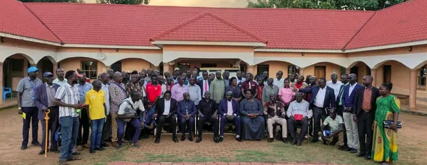
Stakeholders in Central Equatoria State’s Greater Yei held a meeting on Wednesday, during which they pushed for community policing to protect aid workers from abductions and called for stronger cooperation between government authorities, security forces, humanitarian organisations and local communities to address security threats affecting humanitarian workers and civilians.
The meeting, supported by ACROSS with assistance from Christoffel-Blindenmission (CBM), focused on identifying practical measures to improve the safety of humanitarians and communities and strengthen local mechanisms for preventing and responding to security incidents.
An assessment presented during the meeting identified gaps in movement planning, risk assessment, communication, incident reporting, tracking, and accountability. It also identified hotspots, particularly along major roads where security patrols and security presence are limited.
According to the participants, predictable travel schedules and routes could increase the exposure of humanitarian staff, vehicles, and supplies to ambushes, abductions, and other security incidents.
Limited capacity among some staff and drivers in security risk management, emergency response, and safe communication was also identified as a factor contributing to vulnerability during field operations. Poor mobile-network coverage in some areas was cited as another challenge.
Speaking at the close of the meeting, Elisama Wani Michael, Executive Director of ACROSS, appealed to the abductors to come home and cease attacking humanitarian workers.
“We have identified the issue of armed groups and bandits or criminals, and we are appealing to them to please come back home,” he said. “ACROSS and all these humanitarian workers are your people and are saving your people; do not abduct them. I am glad that the church and chiefs are here; please find a way to convince them that God loves them, and does not want them to perish.”
CBM Country Director Francis Okello urged humanitarian and development partners operating in Yei to consider employing more people from the communities where they work. He said greater involvement of locals in humanitarian operations can strengthen community relations and reduce tensions that may arise when personnel are brought in from outside the area.
“You must have a first value of the location where your project is going to be implemented. At least 70 to 80 percent of the people involved in the project should be local,” he said. “Do not tell me that you are going to bring a foreigner and the foreigner will be generally accepted by the local community.”
Let us promote local procurement and recruitment; let us involve stakeholders in our projects,” Okello advised.
For his part, Gaga Frank, the leader of Yei River County Youth Association, called for more vocational skills training so that the youth can be self-reliant. He said this will stop them from joining armed groups or resorting to banditry.
“We need more vocational training so that the youth are equipped with practical, employable skills,” he stated. “If they are employed, I believe they will not be easily manipulated by greedy and power hungry politicians.”
Meanwhile, Alice Siama, the chairlady of the women in Yei, appealed to women to encourage their sons to abandon violence.
“Let us be women who want peace in this country,” she said. “If you can talk to our children out there, tell them to come home because our peace cannot be realized in the bush, but at home.”
James Mugo, a UNMISS official, welcomed the initiative, saying closer cooperation between the government, humanitarian partners and communities is important in addressing insecurity and supporting local peace efforts.
“Let us look into those recommendations because there are words of wisdom in them,” he said. “The first recommendation is the need for communication at the payam level; coordinate with law enforcement agents so that there is no confusion. The involvement of the media is also important.”
Representing the county commissioners, Lainya County Commissioner Huda Laila Micheal said traditional leaders remained an important link between communities and the government and that chiefs could play a key role in addressing issues that undermine security, service delivery and development.
“They have exhausted what we are coming here to discuss, which is accessibility for humanitarian workers,” he stated. “We are going to commit ourselves to what the government is supposed to do.”
Stakeholders called for clearer and more consistent security-clearance procedures involving the Relief and Rehabilitation Commission (RRC) and relevant county authorities, particularly where humanitarian movements involve sensitive information.
Community members were identified as an important source of information about local threats and criminal activity. However, participants said fear of retaliation, harassment or a lack of response from authorities could discourage some residents from reporting incidents.
The meeting therefore called for greater support to community-based structures, including peace committees, community policing groups, women’s networks and local leaders, and for these structures to be better linked to formal early-warning and response mechanisms.

 and then