



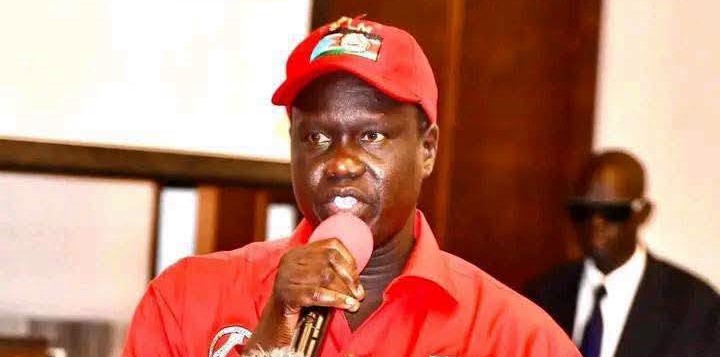
South Sudan should not be dictated to by foreign governments or international partners over its political future, the secretary-general of the ruling Sudan People’s Liberation Movement (SPLM) said on Friday, echoing a warning from President Salva Kiir’s office a day earlier.
Akol Paul Kordit said South Sudanese should take ownership of the country’s political affairs and decide how to move beyond the transitional arrangements established under the 2018 peace agreement.
“The time has come when we have to assume national ownership of our country, of our political affairs,” Kordit said at SPLM headquarters in Juba. “We should not be dictated on what to do with this country. We don’t dictate others, and nobody should dictate us.”
His remarks came as the government faces growing pressure from opposition groups and international partners over its plans to hold presidential and parliamentary elections in December, despite delays in implementing key provisions of the peace agreement.
Kordit said the peace deal had achieved its central purpose of ending the civil war but should not leave South Sudan “hostages of the peace agreement forever”.
“The SPLM will not also allow South Sudan to be a theatre of political experiments,” he said.
Kordit said the future of South Sudan was ultimately in the hands of its citizens and the SPLM.
He also praised the SPLM’s role in the armed struggle against Sudan, saying the movement had mobilised people to fight and die for the country’s independence.
Kordit was speaking while welcoming former members of the Other Political Parties (OPP) coalition, led by Poth Majak Daljang, who joined the SPLM.
His comments followed a statement from Kiir’s office on Thursday saying South Sudan would resist what it described as external direction of its political affairs.
“Partnership does not mean accepting directives from other countries,” the presidency said, adding that political decisions belong to South Sudanese institutions and citizens.
The presidency said international partners remain welcome to support peace and development but should not dictate political outcomes. It also defended plans to hold elections in December 2026, saying the country must move beyond what it called “perpetual transition”.
South Sudan has never held national elections since becoming independent from Sudan in 2011. Kiir and members of parliament were last elected in 2010, before independence.
The government’s election push has drawn criticism from opposition groups, which say conditions for credible polls have not been met, including unresolved provisions of the 2018 peace deal, security-sector reforms and political freedoms.
The government has increasingly framed the planned elections as an issue of national sovereignty, while critics argue that proceeding without full implementation of the peace agreement risks undermining the fragile political settlement.

 and then