



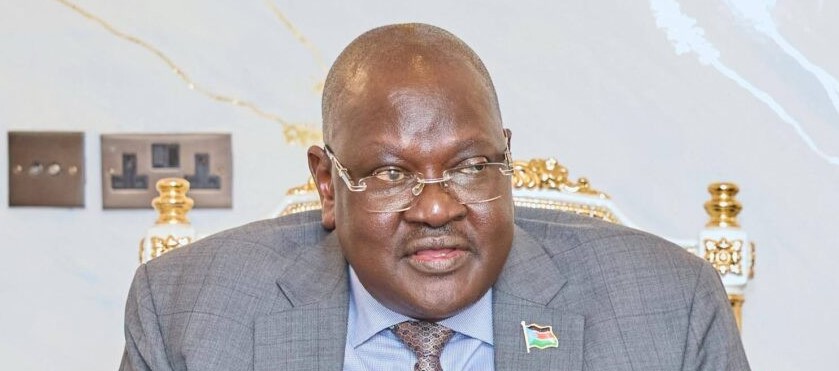
South Sudan’s transitional government is expected to be dissolved in October and replaced by a caretaker administration ahead of elections in December, government spokesperson Ateny Wek Ateny said, despite an electoral law provision requiring the government to end three months before polling.
Ateny, who is also the minister of information, told Radio Tamazuj on Tuesday that the transitional unity government is unlikely to be dissolved on Sept. 22, the date that falls three months before the planned Dec. 22 elections, because President Salva Kiir is expected to be in New York attending the United Nations General Assembly.
“That is what the Constitution says, but on that 22nd, the President will be outside the country, travelling to the United Nations in New York. So, we can expect that thing [dissolution of the government] to happen in October,” Ateny said.
His remarks have prompted concern among civil society activists and political analysts, who say postponing the dissolution could raise legal questions under the National Election Act 2023.
South Sudanese authorities have repeatedly said general elections, delayed for years under the country’s peace agreement, will be held on Dec. 22, 2026.
President Kiir recently signed Constitutional Amendment No. 13, paving the way for elections to be held in December 2026 or before the end of the transitional period.
The prospect of an October dissolution has therefore raised questions about the legal status of the transitional government and the political arrangements that would oversee the country ahead of the vote.
Asked whether the dissolution would affect the positions of the current five vice presidents, Ateny said the structure of the next administration had not been finalized.
“The layout of how it will be done has not yet been shared until that time. We don’t know exactly who would be affected and who will not be affected, so I cannot speculate. The structure is going to be worked out soon,” he said.
Civil society groups have urged the government to comply with the Sept. 22 deadline.
Edmund Yakani, Executive Director of the Community Empowerment for Progress Organization (CEPO), said the government should respect the electoral law.
“As an activist, I hope to see political commitment towards that because that is a requirement by the law and that is what the government has promised citizens—that people are going to go to the election,” Yakani said.
“The enforcement of the electoral law requires the government to be dissolved on 22nd September,” he added.
Yakani said Kiir’s attendance at the U.N. General Assembly should not prevent the government from meeting its domestic legal obligations.
“He can dissolve a day before travel, or even he can issue a decree for the dissolution of the government and leave the decree behind,” Yakani said.
He also said the relevant provisions of the electoral law would need to be amended if the government wants to formally change the Sept. 22 deadline.
“This also can’t happen until they amend the Electoral Act. They need to amend the Electoral Act in order to speak to a change of the 22nd,” Yakani said.
Political analyst Professor Abraham Kuol Nyuon said the law should guide the running of government and that Kiir’s international engagements should not interfere with domestic legal obligations.
He said the president could dissolve the government and establish a caretaker administration even while outside the country, provided the decision is formally communicated through an executive order or decree.
“If the dissolution is done in October, I think that has nothing to do with the election, because we don’t need to amend the Act,” Kuol said.

 and then