



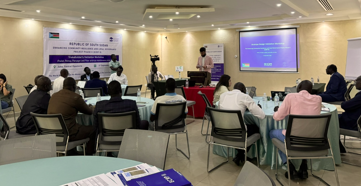
Four airstrips in Jonglei State and the Greater Pibor Administrative Area (GPAA) are set for rehabilitation under the Enhancing Community Resilience and Local Governance Project (ECRP II) to improve emergency access to communities frequently cut off by flooding and poor road connections.
The Padiet, Poktap, and Panyagor airstrips in Jonglei, and Pibor Airstrip in GPAA are undergoing technical review by the government, the International Organization for Migration (IOM), the World Bank, and aviation stakeholders to ensure proposed designs meet safety, regulatory, and operational requirements.
The proposed improvements are expected to strengthen access to healthcare, humanitarian assistance and other essential services in remote areas where roads become impassable during the rainy season.
World Bank Urban Specialist Dominic Kat said communities had identified poor connectivity and difficulties accessing relief as major challenges.
“Our major problem here is accessing relief aid. When we are hungry because of floods, we cannot receive humanitarian support. We cannot receive medical supplies and so on,” Kat said.
He gave the example of a woman experiencing critical complications during childbirth who could require urgent evacuation to Bor or Juba at a time when flooding had cut off road access.
Kat said an airstrip could provide a means of transporting such patients to health facilities when road transport is no longer possible.
The World Bank representative said the airstrips would also facilitate the delivery of essential medicines, educational materials and other services to communities in remote areas.
“If education people want to deliver textbooks there, and the roads are not there, they will use air to deliver textbooks,” he said. “If people want to deliver essential drugs, they will deliver using this transport.”
For his part, Kenyi Gordon Aganson, an ECRP II engineer, said some of the targeted airstrips are currently unusable during the rainy season.
He said communities and local authorities had appealed for improvements, adding that the project aims to make the airstrips longer, wider and smoother to allow light aircraft to land and take off with fewer disruptions throughout the year.
Meanwhile, Nico Chiesa, IOM’s ECRP II Operations Coordinator, said maintaining the airstrips would help reduce the isolation of communities in Jonglei and GPAA that are vulnerable to flooding and other access constraints.
He said improved infrastructure would strengthen connectivity and access to essential services in the affected areas.
The ECRP II is a government project managed by the Ministry of Finance and Planning and implemented by IOM, with support from the World Bank.
South Sudan Civil Aviation Authority officials have also called for aviation safety requirements to be incorporated into the designs.
Meen Chol Majur, the authority’s Aviation Security and Facilitation Manager, said the proposed airstrips should have perimeter fencing to prevent people and domestic animals from accessing runways and taxiways.
The World Bank said the designs must comply with South Sudanese aviation requirements and relevant international standards, while urging stakeholders to ensure quality is not compromised during implementation.
The Ministry of Finance and Planning said the validation process is intended to produce agreement on the final designs before implementation begins.
The project team says the rehabilitation is expected to improve connectivity and help ensure remote communities can access healthcare, humanitarian assistance and other essential services even when flooding disrupts road transport.

 and then