



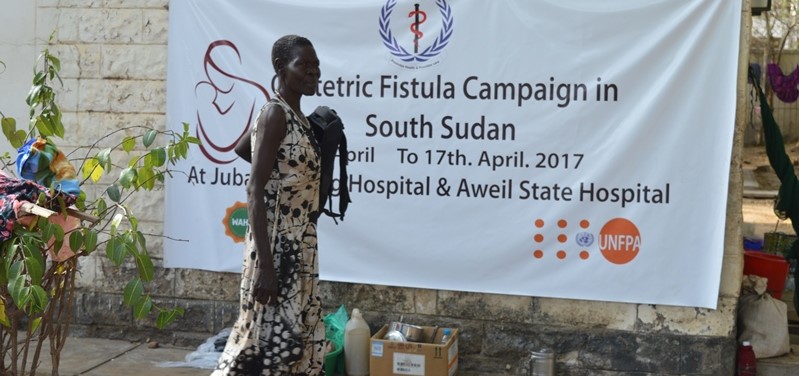
Obstetric fistula survivors in South Sudan on Monday called on the government to recruit more midwives, saying a shortage of skilled birth attendants is contributing to preventable childbirth injuries and maternal health complications.
The appeal was made during a ceremony marking the International Day to End Obstetric Fistula at Juba Teaching Hospital, where survivors, health officials and development partners highlighted the challenges facing maternal healthcare in the country.
Obstetric fistula is a childbirth injury caused by prolonged, obstructed labour without timely medical intervention, creating a hole between the birth canal and the bladder or rectum. The condition often leaves women incontinent and can lead to infection, social stigma and isolation.
Amal Hellen Lam, a fistula survivor and trained midwife, urged the Ministry of Health to employ qualified midwives who remain jobless despite growing demand for maternal health services.
“The government should recruit us so that we can educate mothers about the dangers of obstetric fistula and how it can be prevented,” Lam said.
Lam, who works as a voluntary fistula mobilizer in Juba County, said many trained midwives are willing to serve but lack employment opportunities, adequate remuneration and transport to reach communities in need.
She also called for increased public awareness campaigns to encourage women to seek antenatal care and skilled assistance during childbirth.
“We do not want obstetric fistula to continue affecting women,” she said. “Community mobilization and awareness are needed so that women know what to do during pregnancy.”
The event was organized by the United Nations Population Fund (UNFPA), which supports South Sudan’s efforts to prevent and treat obstetric fistula.
The president of the Association of Gynecologists and Obstetricians of South Sudan (AGOSS), Idioro Ijuku, urged the government and development partners to invest in specialist training to expand treatment services.
“More doctors should be trained in fistula management so that treatment services can be expanded across all ten states and the three administrative areas,” Ijuku said.
Dr. Paul Basan, a fistula officer at the Ministry of Health, said women in remote areas continue to face major barriers to accessing maternal healthcare because of poor roads, weak referral systems and a shortage of skilled health workers.
Central Equatoria State Minister of Gender, Child and Social Welfare Elizabeth Lugor called for comprehensive support for survivors, including psychosocial, economic and social assistance to help them rebuild their lives and reintegrate into their communities.
According to UNFPA, obstetric fistula remains one of the most devastating childbirth injuries affecting women in South Sudan. The condition is primarily caused by prolonged obstructed labour without timely medical intervention and often results in chronic incontinence, social stigma and isolation.
UNFPA estimates that around 60,000 women in South Sudan are living with obstetric fistula, while fewer than 1,000 have undergone corrective surgery.
The agency said it continues to support surgical repair campaigns, train health workers and work with the Ministry of Health to implement the National Obstetric Fistula Strategy.

 and then