



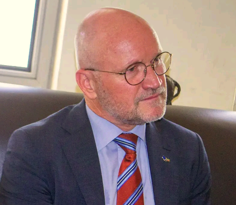
The European Union (EU) has pledged to continue supporting South Sudan’s permanent constitution-making process through 2026, while urging authorities to safeguard the exercise regardless of decisions on the sequencing of elections.
Speaking on Monday at the opening of a two-day civic education and public consultation workshop organized by the National Constitution Review Commission (NCRC) in Juba, Pelle Enarsson, Head of the EU Delegation to South Sudan, reaffirmed the bloc’s commitment to supporting the implementation of the peace agreement and the drafting of a permanent constitution.
“This support will continue throughout 2026 as part of the European Union’s support to implement the peace agreement here in South Sudan,” he said.
The envoy said the EU has supported the NCRC and the constitution-making process since the commission was reconstituted in 2023 through the Max Planck Foundation. According to the EU diplomat, the assistance has included capacity-building training on federalism, civic education initiatives, and the production of guidebooks and handbooks on constitution-making.
Enarsson emphasized that the constitution-making process remains fundamental to South Sudan’s future and should continue irrespective of political decisions regarding elections.
“The work you do and embark on today will matter also after elections and for the future of this country,” he told participants.
The envoy noted that while elections are an important democratic exercise, a permanent constitution provides the long-term framework needed to guide governance and stability in the country.
“An election provides a one-time snapshot of the political landscape while the constitution provides the long-term foundation for the future of the country,” he said.
The diplomat stressed that a permanent constitution is essential for defining governance structures, protecting minority rights, and establishing the balance of power between different levels and branches of government.
“This is where the protection of the rights of minorities can happen, where the balance of power between the centre and regions is identified, and all powers are invested in the executive versus the legislative and judiciary,” he stated. “Without those in place, an election basically answers very little.”
Enarsson acknowledged that South Sudan faces challenges in implementing the 2018 revitalized peace agreement, saying the country is experiencing “an unfortunate time crunch” in completing key provisions of the accord.
“There are proposals on the table to de-link the elections from the constitution-making process,” he said.
While noting that opinions may differ on the proposed sequencing, he maintained that the constitutional process should remain a priority.
“We might argue about the need for this, but whatever sequencing will in the end happen, the work of the NCRC must be safeguarded and continued in the future political setting of South Sudan.”
He described the civic education and public consultation workshops as a critical step toward building a permanent constitution. He urged stakeholders to remain committed to the process despite ongoing political debates.
The constitution-making process is one of the key requirements under the 2018 revitalized peace agreement. It is expected to provide the legal and institutional framework for governance, power-sharing, and the protection of citizens’ rights.
The two-day workshop forms part of ongoing efforts by the NCRC and its partners to raise public awareness and gather citizens’ views ahead of broader national consultations on South Sudan’s permanent constitution.Top of FormBottom of Form

 and then