



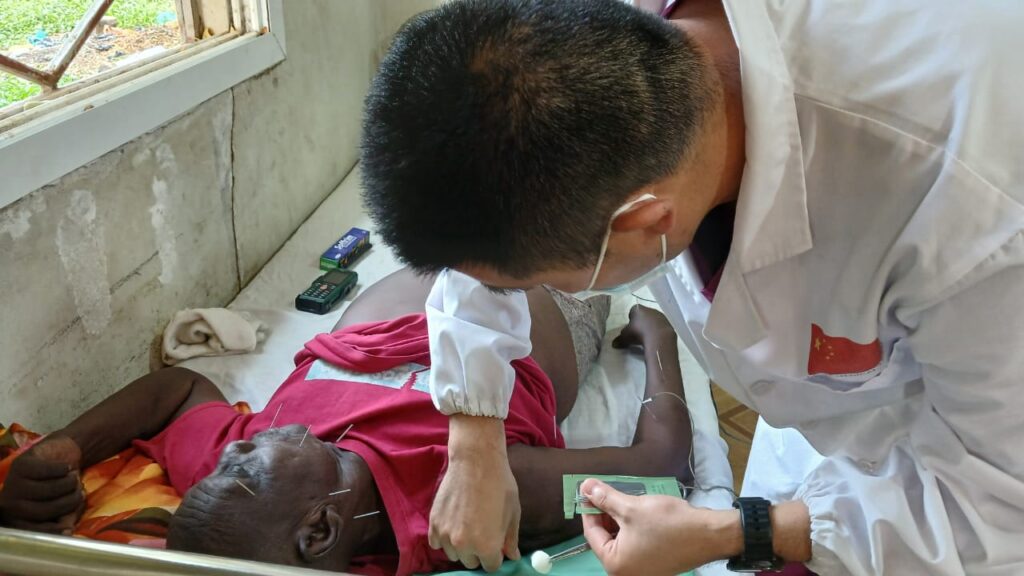
Chinese traditional medicine practitioners are providing treatment to patients at Juba Teaching Hospital as part of ongoing medical cooperation between China and South Sudan.
The team, part of the 14th Chinese medical mission to South Sudan, is using techniques including acupuncture and cupping to treat patients experiencing various forms of pain and mobility problems.
Peter Tuburonigo, 44, a resident of Juba, visited the hospital about a month ago after experiencing pain in his legs, lower back and neck.
He was among several patients who attended the hospital’s Traditional Chinese Medicine facility on Thursday.
Tuburonigo said he had experienced a significant improvement since beginning treatment.
“Ever since I started the treatment, there is a great improvement with regards to the muscles and, you know, even the pain. So I feel happy because I have realised a significant improvement. I hope that things would improve significantly,” he said.
Traditional Chinese Medicine (TCM) is a system of healthcare that developed in China and includes a range of practices, including acupuncture and cupping.
Acupuncture involves inserting thin needles into specific points on the body and is commonly used in traditional medicine for managing pain.
Cupping involves placing cups on the skin to create suction and has traditionally been used for conditions including muscle pain and tension.
Another patient, 30-year-old Hellen Gala, said she had experienced pain in her legs, lower back and neck for several years and that treatment at other clinics had not provided lasting relief.
She said she experienced an improvement after receiving treatment at the Juba facility.
“I have improved. I have been relieved of pain in my back and legs. I now feel better. I have gone for one week and a half without experiencing pain,” she said.
Jacob Pitia, an assistant physiotherapist who works at the facility, said patients treated there include people with disabilities and those recovering from stroke, as well as people experiencing lower-back pain, rheumatism, arthritis and restricted joint movement.
Pitia said he had gained skills in traditional Chinese medicine through training and working alongside the Chinese medical team, including in acupuncture and cupping.
“They teach me where I could not do well. Here in the department, there are two of us who are now giving the needles. Just like today, when he came, he found I had already done the needles. He is only adding some points that I could not identify,” he said.
Jiang Tao, an associate chief physician with the Chinese medical team, said the facility treats between 20 and 25 patients a day.
He said many patients sought treatment for pain affecting the legs, lower back, knees and neck, as well as problems with movement following strokes.
“A lot of patients are suffering from pain and they can’t walk normally. They don’t have a lot of medicine to treat them,” Mr Jiang said.
He said the team is using acupuncture and other traditional Chinese medicine techniques to help relieve pain and improve patients’ mobility.
“Some people cannot move very freely. Movement is a problem. So we use this kind of treatment to treat people, to improve people’s quality of life and to help people move freely again,” he said.
“Traditional Chinese medicine treatments include many ways of treatment, like acupuncture and cupping treatment. This kind of treatment is without medication. We don’t need medication,” he added.
Chinese medical teams have worked in South Sudan for more than a decade.
According to figures provided by the medical mission, 164 Chinese medical personnel have served in South Sudan over the past 12 years, treating more than 70,000 patients, performing more than 1,000 surgeries and conducting more than 1,300 endoscopic examinations.
The teams have also conducted 21 free medical clinics in communities outside major health facilities, where they say more than 30,000 patients were examined and treated.

 and then