



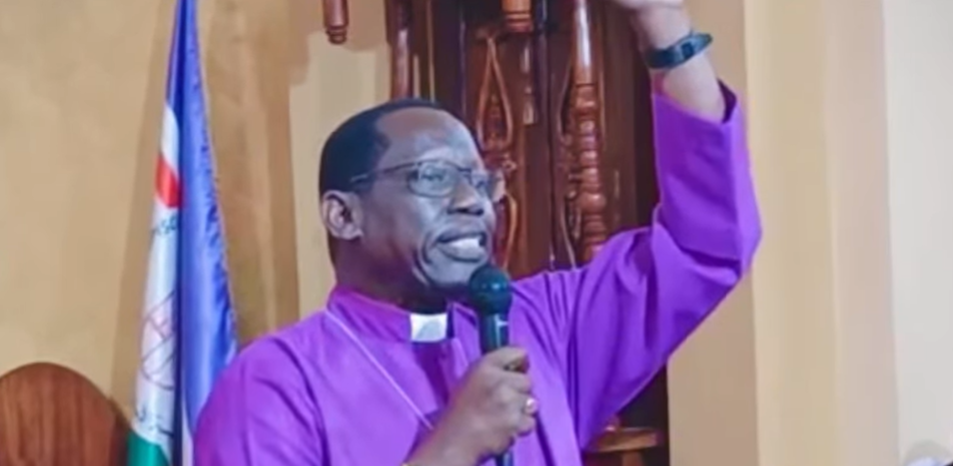
A senior South Sudanese church leader has urged the government to change the date of the country’s planned general election, saying a Dec. 22 vote would fall during the Christmas season and conflict with an important period of Christian worship.
The Rt. Rev. Canon Jackson George Gabriel, assistant bishop of the Episcopal Diocese of Juba, made the appeal on Friday during a requiem Mass for veteran politician Kosti Manibe Ngai at All Saints Cathedral in Juba.
South Sudan’s National Elections Commission has set Dec. 22, 2026, for general elections, which would be the country’s first national polls since independence from Sudan in 2011.
Gabriel questioned why the election had been scheduled so close to Christmas and said the timing had not received enough public discussion.
“We know very well that the elections are going to be conducted during Christmas season,” Gabriel said. “Between 22nd and 26th, Christmas Day is swallowed in.”
He urged South Sudanese to pray for the election period to be changed.
“Let us pray so that that day is exempted, that period is exempted and the election is put somewhere not during Christmas season,” he said.
Gabriel said Christmas is a period when Christians celebrate their faith and the birth of Jesus Christ.
“This is where we celebrate our life. This is where we celebrate our faith,” he said.
Christmas Vote
Gabriel’s intervention puts the election timetable under renewed scrutiny from a senior church figure, adding a religious objection to wider political concerns about the planned vote.
He said Christians should not remain silent about decisions affecting them and suggested that church leaders were sometimes expected to speak on behalf of citizens who were reluctant to challenge those in power.
“As Mama [Rebecca] said, we are cowards to speak out. We fear. We need a bishop to say it. We need a pastor to say it on our behalf,” Gabriel said.
His comments came after Vice President Rebecca Nyandeng de Mabior, who spoke at the same funeral, complained about difficulties accessing President Salva Kiir.
Kiir Access
Nyandeng, a widow of late independence leader John Garang and a vice president responsible for youth and gender, said she could sometimes go for as long as two years without meeting Kiir.
Gabriel questioned how ordinary church leaders could gain access to the president if a vice president struggled to meet him.
“If she cannot meet the big man [Kiir] for two years, what about me, the ordinary bishop?” Gabriel said.
He said church leaders struggled to meet Kiir and suggested that people around the president could be preventing critical voices from reaching him.
“We struggle to meet him as church leaders but it’s not easy because the people who are surrounding him, they fear maybe we will expose what they are doing,” he said.
Gabriel then invoked Manibe’s political legacy, saying the late politician would have challenged Kiir over the election date had he still been in government.
“I believe if a person like Kosti is in this government, he cannot shut his mouth,” Gabriel said. “He will whisper to the president, ‘President, this is not good to hold elections on those days.'”
The comment was Gabriel’s assessment of how Manibe might have responded to the election timetable.
Election Concerns
South Sudan has repeatedly postponed national elections since independence. The government has maintained that it intends to hold the next vote on Dec. 22, 2026.
The planned election has drawn criticism from opposition groups and other political actors, who have questioned whether conditions are in place for credible and peaceful polls.
Among the concerns raised are unresolved provisions of the 2018 peace agreement, political and civic restrictions, security-sector reforms and the readiness of electoral institutions.
The election would be the first national vote since South Sudan became independent in 2011. Kiir and members of parliament were last elected in 2010, before independence.
The government has defended the election timetable and continued preparations for the vote.
The dispute over the date comes as South Sudan faces a broader political question over whether the country can complete its transition to an elected government while implementing outstanding provisions of the 2018 peace agreement.
Political Legacy
Manibe’s body arrived in Juba from Nairobi on Friday after he died on Aug. 11 at the age of 78.
A veteran politician who held senior government positions before and after independence, Manibe became South Sudan’s first finance minister after independence and remained a prominent figure in the country’s political life.
His remains were taken to All Saints Cathedral after arriving at Juba International Airport, where mourners gathered for a requiem Mass.
The funeral also became a platform for reflection on South Sudan’s political trajectory.
Nyandeng said South Sudanese had undermined some of the gains made by those who fought for independence.
“We have inflicted to ourselves things that our enemies did not do to us,” she said.
She also said veterans of the liberation struggle now walk the streets of South Sudan “with their heads down”, expressing frustration over the country’s political direction.

 and then