



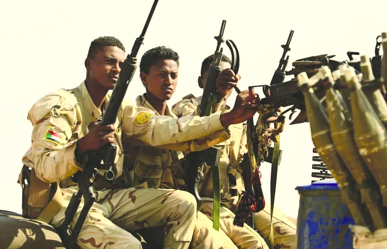
A Sudanese military analyst and retired Air Force Lieutenant, Al-Tayyib Malkabi, believes that the rapidly evolving military developments in Sudan’s Blue Nile Region reflect a shift in combat operations.
He told Radio Tamazuj that control over vital resources, supply lines and strategic locations is assuming increasing significance as hostilities expand and as the warring parties seek to extend their territorial influence.
His assessment comes in the wake of a marked military escalation in the Blue Nile Region in recent weeks, with fighting between the Sudanese Armed Forces (SAF) and the Rapid Support Forces (RSF), allied with forces operating under the Tasis Alliance, spreading to several areas along the Kurmuk and Geissan fronts, accompanied by shifts in control over strategically significant positions.
In the latest developments, the RSF and the Sudan Founding Alliance, known as Tasis, announced on 20 November that they had captured the administrative headquarters of Bau Locality and Village 12 along the Geissan front. Meanwhile, the command of the SAF Fourth Infantry Division confirmed that it had repelled an attack on the Dering area along the Kurmuk front.
Village 12 lies approximately 40 kilometers from Damazin, while Bau and Dering constitute forward positions along the Kurmuk axis leading towards the regional capital.
These developments were preceded by an announcement by Tasis forces in early November that they had seized control of the Sali area. The area holds strategic significance owing to its location along the road connecting Kurmuk and Damazin, as well as its proximity to mining areas, giving control over it military and economic dimensions that extend beyond its immediate geographical importance.
In his assessment of these developments, Lt. Col. Malkabi draws a connection between the shifting battlefield dynamics and stalled political efforts.
“The lack of progress in diplomatic initiatives pursued through the Quad and Quintet frameworks has contributed to the persistent political deadlock, while the warring parties have increasingly sought to consolidate their military positions and strengthen their leverage on the ground,” he stated.
These developments have raised concerns over the potential expansion of hostilities around Damazin, the region’s administrative and military center of gravity, amid mounting displacement and deteriorating humanitarian conditions in conflict-affected areas.
Lt. Col. Malkabi contends that Sudan’s military operational landscape is increasingly shaped by the strategic interplay between resources and supply lines.
“Control over towns and areas of geographical significance is no longer, in itself, the sole benchmark of military progress.” The analyst argues. “Rather, the strategic value of a particular location is increasingly determined by the logistical and economic opportunities it affords, as well as the capacity it gives the controlling party to manoeuvre, secure supply lines or disrupt them.”
This dynamic is particularly evident in the Blue Nile and Kordofan regions, where control over roads, corridors and economically productive areas has become intertwined with military calculations.
Consequently, certain locations have acquired strategic significance disproportionate to their population size or administrative standing, owing to their role in connecting military deployment areas and operational centers.

 and then