



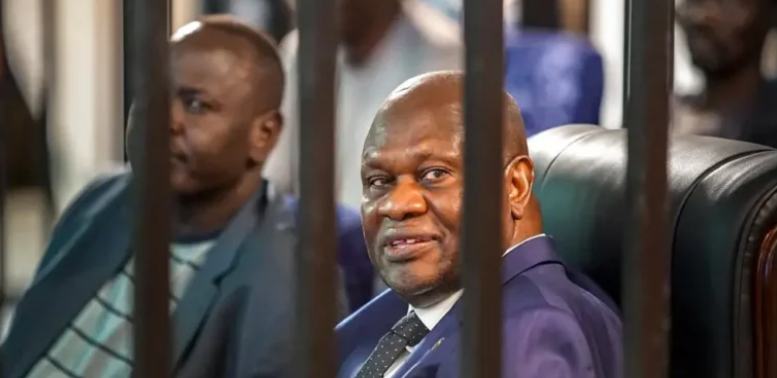
Former First Vice President Riek Machar on Monday blamed poor political and military coordination for the deadly violence in Nasir County, in 2025, saying disagreements among senior commanders undermined efforts to maintain peace.
Machar made the remarks during the 130th session of his trial at Freedom Hall in Juba. He described efforts to coordinate the deployment of South Sudan People’s Defence Forces (SSPDF) troops by river gunboats to Nasir and neighbouring Ulang County, saying he had sought to ensure the forces were received peacefully.
He told the court that disagreements between then Chief of Defence Forces Gen. Paul Nang and Lt. Gen. Gabriel Duop Lam went beyond troop deployments to include the dismantling of checkpoints and roadblocks.
Machar said Nang wanted the SSPDF to handle the operation, while Duop proposed using the Necessary Unified Forces and joint riverine forces to dismantle roadblocks and river checkpoints, respectively.
He accused Nang of being unwilling to work with officers from the Sudan People’s Liberation Army-in-Opposition (SPLA-IO) and said the Joint Defence Board (JDB), which was expected to coordinate military arrangements under the 2018 peace agreement, had become paralysed during Nang’s tenure.
Machar cited the suspension of Assistant Chief of Defence Forces for Logistics Lt. Gen. Welebe Wesley Samson as an example of tensions within the military leadership. He also linked disagreements among commanders to fighting in Tambura and Nagero counties in Western Equatoria State in February 2025.
Military advance
Machar told the court that the gunboats began moving towards Nasir on February 17, 2025, but made slow progress because of engine breakdowns and delays in obtaining spare parts from Malakal. They eventually departed Khor Fulus on February 21, he said.
He alleged that two helicopter gunships were simultaneously bombing villages across Ulang, Nasir, Nyirol and Akobo counties. The bombardments affected settlements along the Sobat River, including Nyathor, Doma and Ying in Ulang County, while the gunboats later joined the shelling using 120 mm and 107 mm mortars, he said.
The gunboats were accompanied by ground troops who clashed with local youth at Nyathor on February 26, Machar added.
He also referred to a helicopter crash near Gel Abur that killed a foreign pilot and a South Sudanese national.
Peace efforts
Machar said civilians were fleeing communities on both banks of the Sobat River as the military advance continued. He told the court that he had written to President Salva Kiir on February 20 and 27, 2025, but received no response.
Following clashes between government troops and local youth at Nyathor, Machar said he consulted then Petroleum Minister Puot Kang Chol, the first accused in the trial, before organising telephone conferences involving then Upper Nile Governor James Odhok Oyai and the commissioners of Nasir and Ulang.
He said he proposed that local communities welcome the incoming forces and that commissioners, chiefs and elders persuade young people to avoid confrontation.
According to Machar, Ulang Commissioner Riek Gai Gatluak reported that youth had threatened to kill him and branded him a traitor because of his position on the deployment.
The commissioner also reported coming under fire while travelling by boat towards Doma with Paramount Chief Kang Gatnor. He eventually secured permission to proceed after explaining that he wanted to help transport wounded people to Ulang hospital, but another group later prevented them from continuing, Machar said.
Nasir Commissioner James Gatluak Lew Thiep also reported difficulties persuading youth to avoid violence, Machar told the court. Some young people were discussing reinforcing their counterparts in Ulang following the clashes with government forces at Nyathor, he said.
Machar said the Nasir commissioner subsequently arranged telephone discussions with paramount chiefs and youth leaders from both counties, allowing him to present his proposal directly.
Community representatives requested time to consult other youth leaders and head chiefs before deciding whether to support the plan, he said.
Reception committees
Machar told the court that subsequent consultations with Ulang chiefs, elders, youth leaders and the county commissioner resulted in an agreement to welcome the gunboats, provided helicopter bombardments and shelling stopped.
He said he accepted the condition and promised to ask the SSPDF to halt the attacks. He proposed establishing reception committees comprising county commissioners, paramount chiefs, head chiefs and two youth leaders in each county to welcome the forces and facilitate their movement.
Nasir leaders made a similar commitment, requesting an end to aerial bombardments and asking that young people gathered in the county town return to their villages, he said.
Machar said he subsequently contacted Lt. Gen. James Koang Chuol Ranley in Malakal and asked him to stop the airstrikes. He also issued a written directive establishing the two committees.
The Nasir committee initially lacked a speedboat to travel to Ulang and meet the advancing gunboats. Machar said he asked the Nasir commissioner to arrange one from Burebiei and instructed the Ulang committee to proceed first, with the Nasir team expected to take over the escort arrangements in Ulang.
Gunboats retreat
Machar said the gunboats encountered further difficulties near Malual junction, where shallow water and sandbars prevented them from proceeding.
He told the court that he convened another telephone conference involving Nang, the Upper Nile governor and the two county commissioners to arrange alternative transport for the troops and their supplies.
They agreed to hire six large boats, each capable of carrying at least 500 soldiers and their equipment. Nang offered to pay $60,000 for the boats, which the Nasir commissioner arranged to have prepared in Bourabie, Machar said.
However, the mission commander decided to return to Malakal after the gunboats freed themselves from the sandbars, despite having been informed that leaders in both counties had agreed to welcome the forces, he said.
The alternative transport arrangement was abandoned and the reception mission called off, Machar added.
By the afternoon of March 2, 2025, the Nasir commissioner had informed him that youth from several sections of the county had returned to their villages, Machar said.
Presidency meeting
Machar also recounted an extended Presidency meeting held on March 3, 2025, to discuss the security situation in Ulang and Nasir.
He said the meeting brought together members of the Peace Implementation High-Level Standing Committee, the National Transitional Committee, civil society representatives and political party leaders.
During the meeting, then Vice President Benjamin Bol Mel reported that fighting was taking place at the Nasir military garrison. He also told the meeting that he had spoken to Tor Gile Thoan on March 2, Machar told the court.
Machar said the meeting adopted five resolutions: appreciation for his letter proposing the reception committees; de-escalation along the Sobat corridor; continued engagement with youth leaders; convening the National Security Council; and holding a press conference involving the ministers of information and petroleum and civil society representatives.
He said he had criticised Kiir for handling the country’s security situation without convening the National Security Council.
The court adjourned proceedings until Wednesday, November 25, 2026, when Machar is expected to continue his defence testimony.

 and then