



Norwegian People’s Aid (NPA) has marked 40 years of humanitarian and development work in South Sudan, urging the government, donors and international partners to strengthen local civil society and ensure inclusive participation in the country’s upcoming general elections.
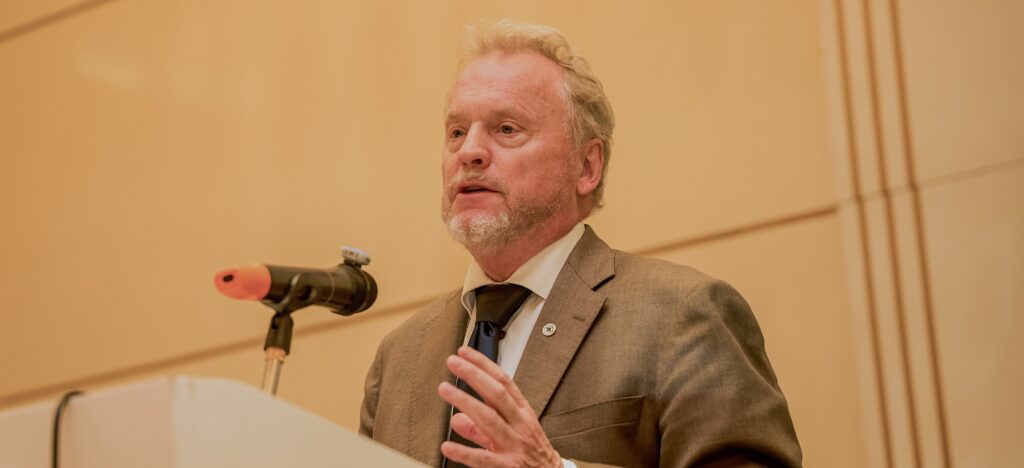
Speaking at the anniversary celebrations in Juba on Thursday, November 12, NPA Secretary-General Raymond Johansen said the organisation’s engagement in South Sudan began in 1986, when a convoy carrying food crossed from Kenya into Eastern Equatoria to assist communities affected by civil war.
Johansen said NPA had chosen to maintain its independence rather than participate in an operation in Sudan, insisting that its humanitarian work should not be dictated by those responsible for oppression.
The event brought together former Vice President Rebecca Nyandeng De Mabior, government officials, diplomats, development and humanitarian partners, civil society representatives, former NPA staff and a visiting delegation from Oslo.
Speakers recognised the organisation’s contribution to humanitarian assistance, peacebuilding, community resilience and development over four decades.
“Forty years later, we are still here. Still standing in solidarity with the people of South Sudan,” Johansen said.
NPA has supported healthcare, agricultural development, women’s empowerment, humanitarian assistance and efforts to strengthen democratic institutions.
Johansen said more than 800,000 patients had received treatment in hospitals supported by the organisation, including during periods of intense conflict and aerial bombardment. Nurses, midwives and other health workers trained through its programmes had helped deliver medical services to hundreds of thousands of people, he said.
In agriculture, NPA established a training centre in Yei, where farmers learned improved techniques that were later introduced in communities across the country.
The organisation also introduced ox-plough technology in the 1990s, helping farmers increase production while reducing the time and labour required for cultivation.
Johansen said NPA continued to promote improved farming methods to strengthen food security and reduce dependence on humanitarian assistance.
On women’s empowerment, he said an estimated 150,000 women had benefited from training programmes aimed at raising awareness of their rights and increasing their participation in public and political affairs.
“Women can do it,” he said, stressing the importance of women’s involvement in leadership and decision-making.
NPA has also worked in mine action, although insecurity previously forced it to suspend operations in the country. Johansen said the organisation had resumed activities through a small development project, with plans to expand its programme.
He warned that landmines and unexploded ordnance continued to threaten communities despite decades of efforts to address the legacy of conflict.
Civic space
Johansen said NPA currently supports more than 20 South Sudanese civil society organisations operating in different parts of the country.
The partnerships extend from Juba to Yambio, Bentiu and Kapoeta, supporting groups working on peacebuilding, women’s rights, media freedom, freedom of expression, civic participation and accountability in natural resource management.
He said civil society had grown significantly since the liberation struggle, when independent civic organisations were largely absent.
Johansen urged the government and international partners to continue investing in local organisations, describing them as essential to sustainable peace and democratic governance.
“To donors, partners and the government, keep supporting local civil society,” he said.
His remarks come amid concerns over restrictions on civic space, press freedom and the ability of civil society organisations to operate independently.
Aid concerns
Johansen warned that South Sudan faces serious humanitarian challenges driven by renewed conflict, declining international assistance and restrictions on humanitarian access.
He said the situation is being compounded by the war in neighbouring Sudan, which has placed additional pressure on communities and humanitarian operations.
He expressed concern about declining international assistance despite persistently high humanitarian needs, warning that conditions could deteriorate further without stronger intervention by the government and international partners.
With general elections approaching, Johansen called for meaningful engagement before, during and after the polls, saying civil society organisations, journalists and other stakeholders must be allowed to participate freely without intimidation or unnecessary restrictions.
He said an inclusive electoral process would be essential to building public confidence, strengthening democratic accountability and advancing the country’s political transition.
Food security
Johansen highlighted South Sudan’s agricultural potential, recalling that in December 2013 the World Food Programme declared an end to general food distribution following a strong harvest that year.
He attributed the achievement to investment in agriculture, saying it demonstrated what communities could accomplish with adequate support. However, renewed conflict broke out shortly afterwards.
He said the experience showed that investing in local communities, rather than relying solely on emergency assistance, could deliver lasting results.
“Investing in the people of South Sudan makes a difference,” Johansen said, pointing to the achievements of local organisations and communities despite difficult operating conditions.
Johansen reaffirmed NPA’s commitment to a peaceful, inclusive and democratic South Sudan, urging the government, donors and development partners to sustain humanitarian programmes, strengthen local institutions and protect the operating space for independent media and civil society.
He said the organisation’s 40-year presence demonstrates the importance of solidarity, investment in people and sustained partnerships in achieving lasting change.

 and then