



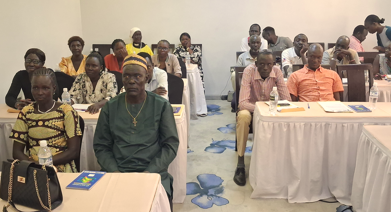
Thirty traditional chiefs and women leaders began a three-day training in Juba on Wednesday aimed at strengthening their understanding of women’s rights, gender-based violence (GBV) laws, and referral mechanisms for survivors.
The training, organized by Global Voices Organization South Sudan (GVO) at Palm Africa Hotel, brought together 21 traditional chiefs and nine women leaders to equip them with knowledge and skills to address protection issues affecting women in their communities.
Speaking at the opening ceremony, Josephine Chandru Drama, Executive Director of GVO, said the training will empower chiefs and traditional leaders to support women’s rights and ensure that communities are aware of the legal protections available to women.
“We are having three days of training for traditional chiefs on women’s legal entitlements, protection issues, land rights, GBV legal frameworks, and referral pathways,” she said.
According to Chandru, the initiative aims to help traditional leaders understand that women have constitutionally guaranteed rights, including the right to acquire, control, and own land.
“The main purpose of this three-day training is to equip the chiefs and traditional leaders to support women’s protection issues in communities to understand that women have rights and entitlements that are constitutionally mandated for them to acquire, control, and own land,” she said. “We will be sharing with them to understand their jurisdiction so that they know which cases they can handle, and then they can also refer cases that are beyond their mandate.”
Chandru stated that the workshop will help participants identify key protection challenges affecting women in their communities and develop bylaws to address them.
For his part, Brig. James Dak Carlos, Director of the Special Protection Unit in the Ministry of Interior, stressed the important role traditional chiefs can play in combating gender-based violence and protecting vulnerable groups.
“We are targeting issues to deal with conflict related to gender-based violence, sex or gender-based violence, forced marriage, and trafficking and adoption of children,” he said. “Chiefs play a very great role in society because they are part of the community. They live with the community, they know who the criminals are, and they know how they can eradicate the cases of gender-based violence.”
“For us to pin down the perpetrator, we have to report, and the chiefs will also play a great role through the churches and through other organizations, encouraging the community to report,” Brig. Dak added.
He said chiefs must advise communities to enroll children in school and stop early and forced marriages.
Meanwhile, Lafaye Madit Malondo, the area chief of the New Site suburb in Juba, said he hopes the training will deepen his understanding of national and international legal instruments that protect women’s rights.
“We shall be paralegals because we will learn all the laws that guide our communities and us,” he said.
Malondo pledged to share the knowledge gained during the training with members of his council and community and to encourage citizens to report cases of gender-based violence.
Organizers say the training will help create a network of community leaders capable of responding to protection concerns, supporting survivors, and promoting respect for women’s rights across South Sudan.

 and then