



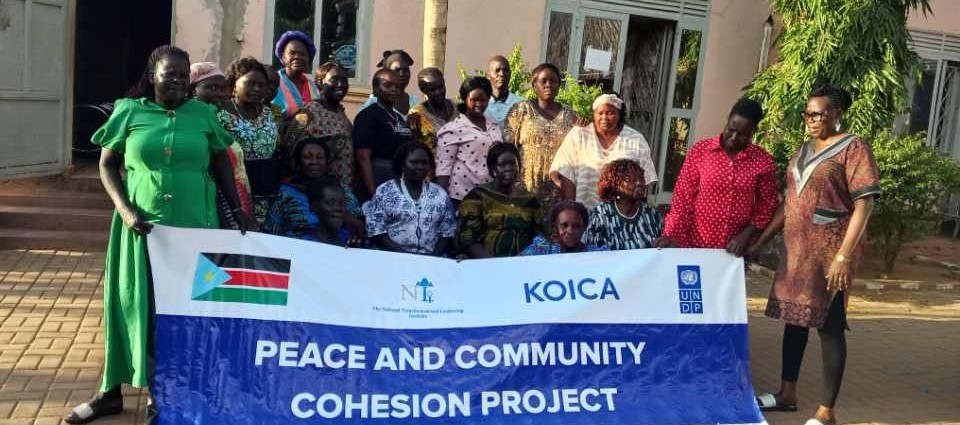
Twenty women leaders from across Eastern Equatoria State have completed a two-day training on transformational leadership and peacebuilding aimed at strengthening their role in conflict prevention, mediation and community cohesion, organizers said on Wednesday.
The training, held in Torit, was organized by the United Nations Development Programme (UNDP) through its Peace and Community Cohesion Project with funding from the Korea International Cooperation Agency (KOICA). It was implemented in partnership with the state ministries of Peacebuilding and Gender, Child and Social Welfare and facilitated by the National Transformational Leadership Institute at the University of Juba.
Participants received training in leadership, conflict prevention, conflict resolution and community engagement, with a focus on the role of women in promoting peace at the grassroots level.
Speaking on behalf of the participants during the closing ceremony, Davidika Ikai Graciano said the programme had strengthened their understanding of leadership and collective responsibility.
“The two days have been very important in transformational leadership. We learned about power within, power with and power over, as well as the Ubuntu philosophy, which teaches us to work together and share responsibilities,” she said.
Graciano said participants were committed to applying the skills gained to address conflicts affecting communities across the state.
“We cannot keep these skills in our offices or homes. We must return to our communities and use them to help people find peaceful solutions,” she said.
Margaret Ladu of the UNDP Peace and Community Cohesion Project encouraged participants to share the knowledge gained and mentor young women in their communities.
“One woman cannot do it alone. We need to bring the younger generation along. I encourage each participant to mentor at least ten young women and share the lessons learned from this training,” she said.
Ladu also urged participants to begin implementing their peacebuilding action plans immediately, saying communities urgently needed local initiatives to address conflict and strengthen social cohesion.
Dominica Idwa Vitale, Director General in the State Ministry of Gender, Child and Social Welfare, said sustainable peace depends on changing attitudes and behaviours within communities.
“Transformation means moving forward. Each of us has changed in one way or another, and it is now our responsibility to bring that change to our communities,” she said.
Vitale called on participants to develop practical approaches to changing mindsets among women, men and youth, describing social transformation as a critical element of peacebuilding.
Dr. Betty Achan Ogwaro of the National Transformational Leadership Institute said peacebuilding requires sustained commitment from communities and not only government institutions.
“It is not enough to receive training. The knowledge gained must be applied,” she said, urging participants to extend peacebuilding efforts to conflict-prone areas across Eastern Equatoria.
Fr. Auxilio Odume Raymondo, Director General in the State Ministry of Peacebuilding, described peace as a shared responsibility and urged women to work across political, ethnic and social divides to promote lasting stability.
“Our focus must be peace because peace is life. Peacebuilding is not the responsibility of government alone; it is the responsibility of every individual,” he said.
The training concluded with participants developing action plans to support peacebuilding initiatives in their communities, reinforcing the role of women as key actors in conflict prevention, social cohesion and sustainable peace.

 and then