



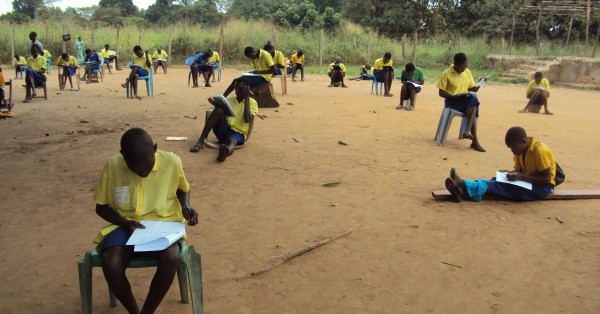
The Governor of Western Equatoria State has ordered an evaluation of the state’s education system, directing officials to conduct a full audit of all schools as a first step toward reversing what he described as a sustained decline in learning standards.
Governor Badagbu Daniel Rimbasa issued the directive during a swearing-in ceremony for state officials on Tuesday, tasking the newly appointed Minister of General Education and Instruction, Patrick Riruyo, with leading the assessment and producing actionable reforms based on the findings.
“The education of Western Equatoria is deteriorating; it is going backwards,” Rimbasa said. “Now we need it to move forward.”
Central to the governor’s directive is a mandatory school-by-school review to determine which institutions remain operational and which have ceased functioning. Rimbasa ordered the ministry to document the status of every school across the state, citing the need for accurate baseline data to guide resource allocation and intervention strategies.
“The schools which are working, I need to know them. Those which are not working, I need to know them, so that we are able to concentrate our efforts to transform our education system,” he said.
The governor directed the ministry to assess challenges, opportunities, strengths, and weaknesses within the sector, framing the exercise as a diagnostic prerequisite for any subsequent reform.
He said funds had been secured to support the education sector for one month and instructed ministry officials to ensure disbursement is tied to verified school needs.
Rimbasa also noted that the return of displaced communities to areas including Tombura, Nagero, Mundri East, Mundri West, and Ndjangere has created an urgent need to evaluate which schools can be reopened and what resources they require. He said assessment teams should prioritize those counties to facilitate the safe return of students.
The state evaluation push comes as South Sudan’s education system grapples with chronic data gaps, underfunding, and the destruction of school infrastructure during years of conflict. International aid agencies have repeatedly cited the lack of reliable education statistics as a major barrier to effective programming in the country.
Toby Adams, a lecturer and education expert, said the governor’s focus on assessment was timely but cautioned that evaluation must be accompanied by follow-through. He said many previous reform initiatives in South Sudan had failed due to weak monitoring and the absence of post-assessment implementation plans.
“An audit is useful only if it leads to targeted investment,” Adams said. “You cannot improve what you do not measure, but measurement without action will not reopen a single classroom.”
Adams called for the evaluation to include teacher performance metrics and student learning outcomes, not just infrastructure counts. He also urged the government to assess teachers’ welfare and salary arrears as part of the review, arguing that staff conditions directly affect educational quality.
Wanga Emmanuel, chairperson of civil society organizations in Western Equatoria, welcomed the emphasis on evaluation but stressed that the ministry must have the capacity to carry out a credible assessment.
He called for the revival of regular school supervision at county and district levels, saying supervisory structures that once monitored teaching activities and curriculum implementation had largely collapsed.
“Without proper supervision, we have no way of knowing whether our schools are functioning or failing,” Wanga said. “The governor’s directive must include restoring that oversight mechanism.”
Martin Juma Ngorowu, chairperson of the Information, Communication, Culture, Youth and Sports Committee at the state legislative assembly, said the evaluation should extend to assessing the distribution of national government education incentives. He said disparities in how resources reach teachers across different counties have undermined morale and made it difficult to assess true performance levels.
Ngorowu also said insecurity remains a complicating factor in any assessment, as instability in areas such as Mundri East and Kediba has prevented education officials from accessing schools to conduct evaluations.
He urged authorities to improve security to allow assessment teams to reach remote communities, noting that recent relative peace in Tambura and Nagero offered an opportunity to gather data in those areas.
The governor has not specified a timeline for completing the assessment or a deadline for the ministry to submit its findings.

 and then