



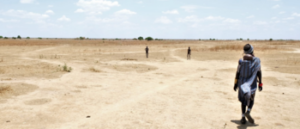
A severe drought has triggered food shortages and displacement in Imehejek Administrative Area, Eastern Equatoria State, local officials said, as families abandon their farms and rely on wild foods to survive.
Crops including sorghum, groundnuts, and maize have failed due to prolonged lack of rainfall, according to Angelo James Ayonyang, a member of the Eastern Equatoria State Transitional Legislative Assembly representing the area. He said he witnessed the situation during a recent visit to the area.
“There is too much hunger because of the drought,” Ayonyang told Radio Tamazuj. “It has taken a long time without rain, and it has become very difficult for residents to survive.”
Some families have moved to urban centres including Torit, Juba, and Kapoeta, while others have returned to Kakuma refugee camp in Kenya, Ayonyang said. “Some of them returned from Kakuma with the hope that life would be better here, but they found the situation is now very difficult,” he said. “Some say the situation is even worse than Kakuma, so they went back.”
Ayonyang called on the government and humanitarian agencies to conduct assessments. “They need to go for assessment and see with their own eyes because, for me, I saw it. The situation is not good,” he said.
He warned that without assistance, more people could leave in the coming months. “Even next month, I think new people will be leaving the area because life is not easy,” he said.
Residents with livestock are selling cattle in markets such as Torit to buy food, but the money does not last long, Ayonyang added.
The administrator of Imehejek Administrative Area, Lino Attari Obiong, said the hunger was affecting a wide area and described it as part of broader climatic changes. He urged residents to remain calm and avoid desperation-driven crime.
“This situation is covering the whole area,” Obiong said. “It is not a particular place; it is affecting the entire mountain.”
The most vulnerable groups include internally displaced people, the elderly, and those unable to move elsewhere, he said.
Residents described women and children as the worst affected.
Mary Ihure Louis, a resident of Imehejek town, said women are collecting wild fruits such as small bamboo plants, which are cooked for days to remove toxins. “The sorghum, groundnuts and maize we cultivated dried up and nothing was left in the farms,” she said. “We don’t know what will happen. Only God will rescue people because I am seeing nothing ahead. Children are suffering.”
She appealed for seeds that can mature quickly once rains return. “We request seeds that can yield within two months so that the population can return to farming when rains come,” Mary said.

 and then