



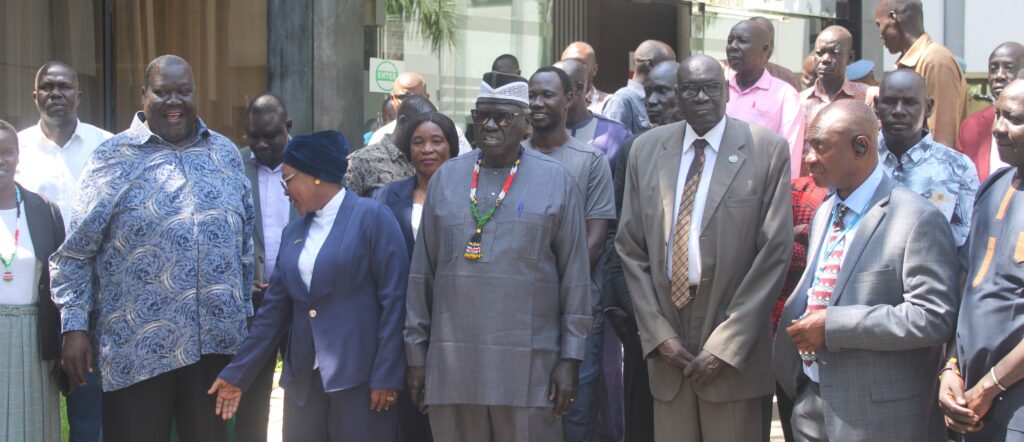
South Sudan’s government on Tuesday called for the creation and legal protection of livestock migration corridors as part of a broader push to reduce recurring clashes between herders and farming communities over land and water.
Speaking at a two-day policy dialogue on rangelands, pastoralism and wildlife conservation in the capital Juba, Minister of Livestock and Fisheries Onyoti Adigo Nyikwac said competition over grazing land had become a major driver of communal violence and required long-term policy solutions.
“Most of the killing here in South Sudan from our indigenous people is because of livestock—either cattle herders among themselves or cattle herders with farmers,” Onyoti said. “We need to look at these things seriously and amicably so that we get a solution.”
The minister said the government plans to strengthen sustainable rangeland governance by protecting migration routes. “We need to have corridors so that the cattle should not go to the farms of the people,” he said.
South Sudan’s livestock sector supports an estimated 12 million cattle, 14 million goats and 13 million sheep, Onyoti said, adding that the industry holds enormous economic potential but faces challenges including climate change, disease outbreaks, poor veterinary services, weak market infrastructure and resource-based conflicts.
He said the government was shifting from emergency response to long-term investment in rangeland restoration, livestock production, veterinary care, peacebuilding and market development. “These challenges cannot be addressed through humanitarian intervention alone,” he said.
Also addressing the forum, Minister of Lands, Housing and Urban Development Michael Chiangjiek urged pastoralists, farmers and state institutions to cooperate in preventing disputes over natural resources. “Our people, especially the farmers and the pastoralists, should properly engage and coexist together so that conflicts over resources like land, water and pastures should not again arise,” he said.
Chiangjiek called on the government and development partners to implement recommendations from the dialogue, adding that the outcomes would strengthen existing policies and promote community peace.
Robert Lado, chairperson of South Sudan’s Land Commission, said the country should treat livestock and wildlife as strategic economic assets, warning that oil revenues would not sustain its future.
“The oil is almost exhausted; we need to rely entirely on our livestock and wildlife,” he said, noting that despite its large cattle population, South Sudan exports very little livestock.
Victor Fasama, a civil affairs officer with the United Nations Mission in South Sudan (UNMISS), said sustainable rangeland management was critical to reducing conflict, protecting biodiversity and strengthening climate resilience. “The rangelands are under pressure. Climate change, conflict over resources, land-use change and the loss of traditional systems are threatening livelihoods and wildlife,” he said.
Fasama urged the government to adopt policies legally protecting grazing routes and migration corridors, and called for greater recognition of pastoralists as custodians of natural resources. “We must move from seeing pastoralism as backward to seeing it as climate-smart, low-carbon and resilient,” he said.
The two-day dialogue, organised by the Ministry of Livestock and Fisheries in collaboration with the Food and Agriculture Organisation, government agencies and development partners, brought together policymakers, pastoralists, researchers, civil society and private sector representatives.

 and then