



The United States on Monday proposed a U.N. Security Council resolution to expand an arms embargo to all of Sudan and explicitly include unmanned aerial vehicles, systems and related technologies, drawing opposition from Sudan, China and Russia.
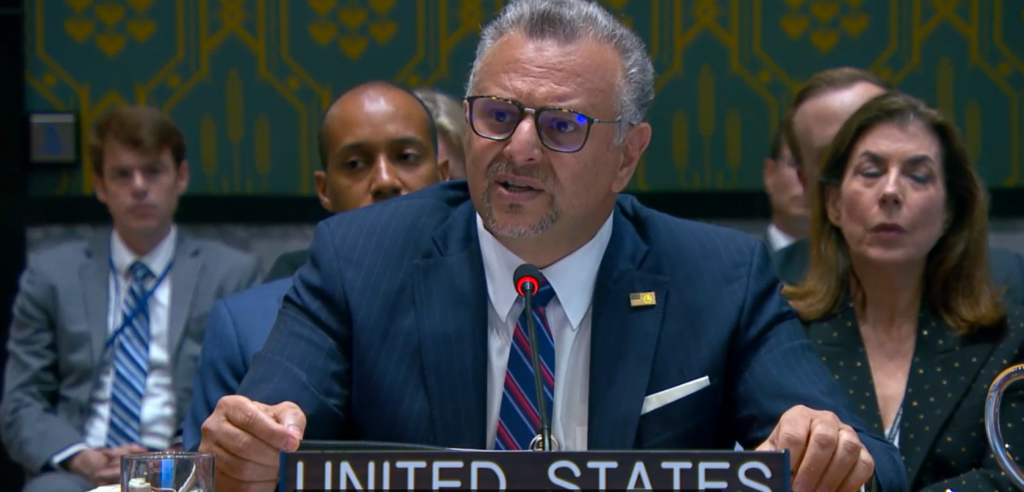
The proposal came as the Security Council met to discuss Sudan’s war, with briefings from senior officials including Massad Boulos, the U.S. president’s senior adviser for Africa, Arab and Middle Eastern affairs, and Sudan’s U.N. ambassador, Al-Harith Idriss.
Boulos said the draft resolution contained four main measures: extending the arms embargo beyond Darfur to all of Sudan; clarifying that drones, drone systems and related technologies fall within the embargo; increasing the number of experts on the U.N. panel monitoring the sanctions regime; and directing the panel to work with other regional expert panels to improve reporting on violations of the asset freeze, travel ban and arms embargo.
The measures were intended to reflect the realities of Sudan’s war, curb external military support and increase pressure on the warring parties to end the conflict, Boulos said.
“These measures do not seek to create any advantages or disadvantages among the parties or alter battlefield dynamics beyond pushing for a swift end to fighting,” he said.
The Security Council established its Sudan sanctions regime in 2005 under Resolution 1591, imposing an arms embargo on parties fighting in Darfur as well as targeted travel bans and asset freezes on designated individuals.
The resolution also established a Panel of Experts to assist the sanctions committee in monitoring implementation and investigating the financing and supply networks of armed, military and political groups.
Boulos said the war between the Sudanese Armed Forces (SAF) and the paramilitary Rapid Support Forces (RSF) had undermined their claims to legitimate governance, while civilians had been driven from their homes, looted and forced to shelter from air and drone attacks.
He said armed drones had killed more than 1,120 Sudanese civilians in the first half of 2026, accounting for about 80% of recorded civilian deaths during that period.
Drones had also damaged markets, health facilities, humanitarian convoys and critical infrastructure, worsening humanitarian needs across the country, he said.
Boulos accused the RSF of obstructing humanitarian access and attacking water stations and electricity networks. He said the group had recently killed at least 14 civilians in Um Arda in North Kordofan and displaced more than 4,000 people.
He also said the army had carried out more than a dozen drone attacks and raids in North and South Kordofan in August, including a strike on Jabra al-Sheikh that killed five civilians.
Both sides were prioritizing territorial gains and military victory over a humanitarian truce and negotiations, Boulos said, urging the Security Council to strengthen its tools to protect civilians and hold perpetrators accountable.
France backed extending the arms embargo to cover all of Sudan.
Danish Foreign Minister Lars Lokke Rasmussen, whose country holds the Security Council presidency this month, called for expanding the mandate of the International Criminal Court to cover the whole of Sudan.
Rasmussen said the Security Council had a responsibility to help end a conflict that was destabilizing the wider region and called for a humanitarian truce leading to a full ceasefire.
He also urged donors to increase humanitarian assistance, announcing a Danish contribution of $15.6 million that would bring Denmark’s total funding for Sudan since 2023 to about $105 million.
Sudan rejects proposal
Sudan’s U.N. ambassador, Al-Harith Idriss, rejected the proposed expansion of the arms embargo beyond Darfur, saying it would equate the national army with the RSF and undermine Sudan’s sovereignty.
Idriss said the proposal was not a technical adjustment to the existing sanctions regime but a fundamental change to its scope.
He called instead for maintaining existing measures while strengthening enforcement against violators and scrutinizing external networks supplying weapons and drones.
Idriss said the Sudanese government remained committed to protecting civilians, citing the establishment of a national protection mechanism and efforts that had facilitated the voluntary return of 5.8 million displaced people by the end of June.
He said Sudanese authorities adhered to international humanitarian and human rights law and that security forces were redeploying as the government regained territorial control.
China, Russia oppose expansion
China urged the Security Council to exercise caution over sanctions on Sudan, warning against expanding punitive measures while the council considers changes to the sanctions regime.
Chinese Ambassador Li Song said sanctions should be used only to encourage peace and should not become an end in themselves or a substitute for diplomacy.
Any measures, he said, should respect Sudan’s sovereignty, territorial integrity and legitimate concerns.
Li warned that expanding the scope and severity of sanctions could undermine Sudan’s long-term stability and disrupt its economy. He urged the international community instead to strengthen enforcement of existing measures and support political dialogue.
Russia’s U.N. ambassador, Vassily Nebenzia, also rejected the U.S. proposal to expand the sanctions regime and arms embargo across Sudan.
Nebenzia criticized Western economic measures against Sudan, including a European Union ban on Sudanese gold imports and U.S. restrictions on international financial institutions providing credit and technical assistance, describing them as policies of “economic strangulation” that harmed ordinary Sudanese.
He also rejected what he described as an attempt to draw moral equivalence between the two sides over the use of weapons and drones. Nebenzia accused the RSF of using strike drones indiscriminately against civilians, while saying the army was conducting operations against insurgent forces seeking to destroy the state.
Nebenzia warned of a critical situation in El Obeid, where he said rebel attacks were continuing against overcrowded civilian shelters. He also cited fertilizer shortages in the Persian Gulf region and rising fuel prices as threats to Sudan’s planting season.
He said humanitarian assistance should be delivered in coordination with the Sudanese government rather than bypassing Khartoum, and criticized international mediation efforts by the Sudan Quartet, accusing it of using pressure and coercion against Sudanese authorities.
China and Russia, as permanent members of the Security Council, have veto power and can block adoption of the draft resolution.

 and then