



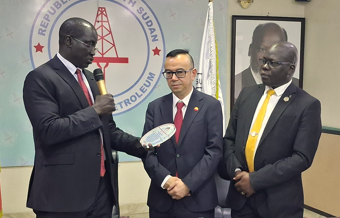
The Ministry of Petroleum on Thursday announced that oil production by the Greater Pioneer Operating Company (GPOC) has increased to 60,158 barrels per day, up from 40,000, marking a significant milestone.
Speaking during a ceremony to honor He Yanhui, the GPOC President, Petroleum Ministry Undersecretary Dr. Santino Ayuel Longer commended the company’s efforts in reversing declining production trends in the country’s aging oil fields.
“Today (Thursday), we celebrate not merely a production milestone, but a testament to vision, resilience, innovation, and professional excellence,” he extolled Yanhui. “Under your distinguished leadership, GPOC has successfully achieved a production level of 60.158 barrels per day as of 29 May, an accomplishment that deserves the highest recognition and admiration.”
According to the announcement, the increase is in blocks 1, 2, 3, and 4 in Unity State, which were opened and operated by GPOC.
Dr. Ayuel highlighted that the achievement comes despite the challenges associated with operating mature oil fields that have been in production for nearly three decades.
“This achievement is particularly significant when viewed against the realities of operating one of the world’s mature oil fields, with nearly three decades of production history,” he said. “As experts in the industry understand, mature fields naturally face substantial production decline rates. In the case of GPOC, the natural decline rate stands at approximately 25 percent annually.”
“However, through strategic leadership, rigorous technical studies, and the implementation of effective professional measures, GPOC has successfully reversed this trend,” Ayuel added.
He said residual oil recovery studies, combined with fast-track field development strategies and innovative production enhancement programs, have not only sustained production but also generated significant growth. He added that newly developed infrastructure contributed more than 6,171 barrels per day to the current output, demonstrating the effectiveness of the company’s development strategy.
According to Dr. Ayuel, the increase in production goes beyond operational success and signals renewed confidence in South Sudan’s petroleum industry.
“This achievement extends beyond production figures and operational success. It represents confidence in the future of South Sudan’s petroleum sector,” he said. “It reinforces the importance of partnership, technology, innovation, and the collective determination to unlock the full potential of our natural resources for the benefit of our people.”
“The Government of the Republic of South Sudan remains fully committed to supporting all efforts aimed at strengthening and developing the oil and gas sector,” Ayuel added.
While celebrating the production increase, the Undersecretary also emphasized that more work remains to be done to maximize recovery from existing fields and develop new opportunities.
“Together, we remain committed to maintaining high production levels, maximizing recovery from mature assets, pursuing new development opportunities, and preparing for the next phase of growth in the petroleum sector,” he concluded.
For his part, He Yanhui, the GPOC president, said today’s announcement was not only about the increment but also the company’s commitment to maintaining the current production capacity. He stressed that the company is working diligently to increase oil production while minimizing operational risks in the field.
“We are trying to sustain the current production by using all our talent to endure all risks in the oil fields,” he said. “We are using all of our talents to control all risks in the field. We are trying our best to create thinking, creativity, and technology to increase our international assistance. And also, we are trying our best for the diplomacy of the region.”
“Moving forward, I really appreciate all of your support from all of our partners and allies, particularly the local community,” Yanhui added.
Meanwhile, Eng. Lual Chol Dak, Director General for Petroleum Exploration and Production at the Ministry of Petroleum, said there are currently three oil-producing blocks operating in Paloch, Unity State, and Tharjath.
“In the DAR Petroleum, which is in Blocks 3 and 7 in Paloch, we have 100,000 barrels per day. Then we have GPOC, which is Blocks 1, 2, and 4 in Unity, which operates now 60,000 barrels per day, and we have SPOC operating in Tharjath with production of 14,000 bpd,” he explained. “The total production is 174,000 barrels per day, and we are moving ahead to improve production beyond this.”
South Sudan relies heavily on oil revenues, which account for the bulk of government income. The latest production increase is expected to provide a boost to national revenues at a time when the country continues to face economic challenges.
The increase in output represents a major milestone for an industry that has faced repeated disruptions since South Sudan gained independence in 2011. Oil production once exceeded 300,000 barrels per day shortly after independence, but later declined sharply because of civil conflict, insecurity, aging infrastructure, and technical challenges in the oil fields.
The sector suffered a further setback in 2024 when exports through Sudan were disrupted after damage to a key pipeline carrying South Sudanese crude to Port Sudan on the Red Sea. Sudan has been engulfed in a civil war since April 2023 between the Sudanese Armed Forces (SAF) and the Rapid Support Forces (RSF), a conflict that has damaged infrastructure, disrupted trade routes, and complicated the movement of South Sudanese oil exports.

 and then