



South Sudan has faced a state of chronic, systemic dependency on international humanitarian assistance since gaining independence in 2011. This reliance is not merely a temporary response to localized emergencies, but rather a structural feature of a nation heavily impacted by decades of civil war, political fragmentation, economic volatility, and severe climate vulnerability.
In a significant step to address immediate shortages, government officials and Chinese diplomats gathered in Juba to finalize the handover of thousands of metric tons of emergency food supplies.
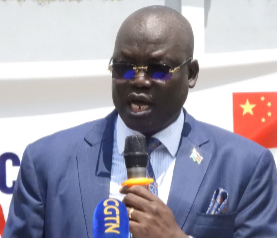
William Chan Achuil, Undersecretary of the Ministry of Humanitarian Affairs and Disaster Management, expressed the government’s sincere appreciation to the People’s Republic of China for its continued friendship, solidarity, and unwavering support.
“This contribution comes at a critical time when many of our communities continue to face severe food shortages and other humanitarian challenges,” he said. “It reflects the strong partnership between our two nations and demonstrates China’s commitment to supporting our food security efforts.”
Chan noted that the arrival of the final shipment marks the completion of a major bilateral logistics effort.
“Today (Monday), we are witnessing the handover of the final consignment of 37 containers. This concludes the delivery of wheat and rice previously received, bringing the total to 3,256 metric tons of food donations from the People’s Republic of China,” he stated. “This essential donation will significantly strengthen food security for our intended beneficiaries: returnees, internally displaced persons (IDPs), especially those affected by floods, disabled individuals, and vulnerable households across the country.”
Meanwhile, Ma Qiang, Ambassador of the People’s Republic of China to South Sudan, extended warm greetings to the government and people of South Sudan, framing the aid package as part of a broader international framework.
“The 3,256 metric tons of rice and wheat provided by China have all been successfully delivered to Juba. This food assistance marks a key step in implementing the partnership actions unveiled at the 2024 Beijing Summit of the Forum on China-Africa Cooperation (FOCAC),” he said. “It is a vivid demonstration of China’s commitment to building a community with a shared future for humanity, carrying the sincere goodwill of 1.4 billion Chinese people toward South Sudan.”
Acknowledging the severe climate and humanitarian hardships facing the host country, Ambassador Qiang noted that the Chinese Embassy worked hand-in-hand with South Sudanese authorities to expedite the rollout, successfully distributing the first three batches in the first half of this year.
He further emphasized that Beijing’s foreign policy framework aims to balance immediate relief with structural development:
“Our assistance always follows the principle of combining ‘giving fish’ with ‘teaching how to fish.’ Since South Sudan’s independence, China has continuously provided complete facilities, technical cooperation, material assistance, and emergency humanitarian aid,” the envoy stated. “We have helped build hospitals and schools, and implemented vital livelihood projects such as borehole drilling, water supply systems, and road construction.”
The ambassador added that since 2012, over 5,000 South Sudanese officials, technical personnel, and students have traveled to China for capacity-building training programs and academic studies—specifically within the agricultural sector—to enhance the nation’s capacity for self-driven development.
For his part, Albino Akol Atak, South Sudan Minister of Humanitarian Affairs and Disaster Management, lauded the event as a powerful symbol of genuine friendship at a moment of acute national vulnerability. He highlighted that South Sudan is currently trapped under the weight of multiple, overlapping humanitarian emergencies.
“Climate change has become an existential threat to the livelihoods of our people. Recurrent floods and droughts affect more than one million South Sudanese every year, destroying homes, farms, and critical infrastructure,” he explained. “This year, forecasts indicate that the impact of drought may even exceed that of flooding in several parts of the country.”
This environmental instability is exacerbated by geopolitical pressures. Since April 2023, the conflict in Sudan has forced more than 1.4 million people to cross the border into South Sudan, approximately 67 percent of whom are fleeing South Sudanese returnees. This sudden demographic shift has placed unprecedented pressure on already exhausted public services, host communities, and state resources.
Minister Atak extended formal compliments on behalf of President Salva Kiir, confirming that the fourth and final phase of the food aid distribution will be executed with strict professionalism and oversight. He credited the collaborative efforts of the Relief and Rehabilitation Commission (RRC), the ministry’s technical advisors, and Betty Scopas, the Director General for Early Warning Systems, for ensuring the secure arrival of the consignment.
“As we prepare for the upcoming seasonal climate shifts, the needs of our people remain immense,” Atak concluded. “We respectfully look forward to our continued partnership with the government of the People’s Republic of China as we work together toward a resilient, food-secure future.”

 and then