



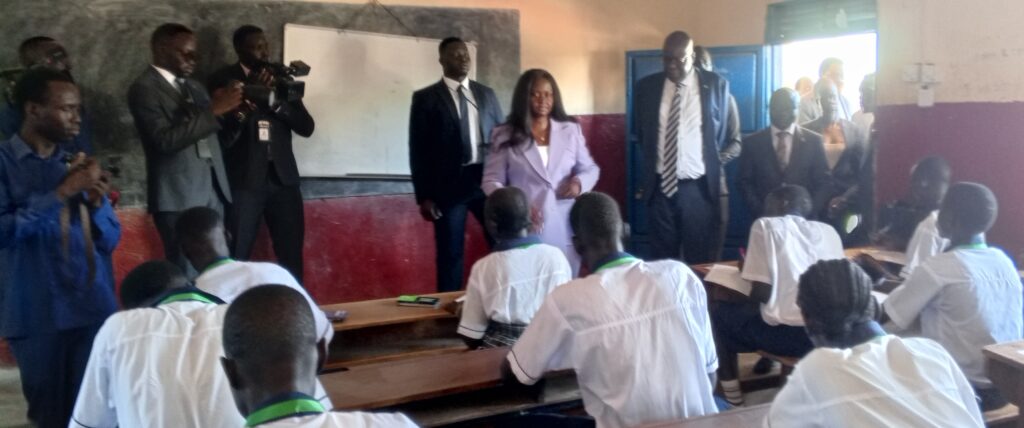
South Sudan on Monday commenced its 2026 Certificate of Primary Education examinations, with 87,892 candidates expected to sit the national tests amid concerns over inadequate school facilities, teacher shortages and limited support for learners in some public schools.
The examinations, which run from November 16 to 20, are being administered across 518 examination centres, drawing candidates from 2,007 primary schools nationwide, according to Presidential Senior Envoy on Special Programmes Adut Salva Kiir.
Speaking during the launch ceremony at Juba One Boys Primary School in Juba, Adut said the candidates represent the hopes and aspirations of their families and the country, urging education authorities to ensure the examinations were conducted transparently and without malpractice.
“The credibility of our national examinations is a shared responsibility,” she said, calling on examination officials, invigilators and security personnel to uphold professionalism, impartiality and accountability.
However, the commencement of the examinations has also drawn attention to the difficult conditions under which some public schools operate, raising concerns about whether learners are receiving the support and facilities necessary to complete their education.
James Paul Agustino, headteacher of Juba One Boys Primary School, said the institution, established in 1948, was struggling with inadequate teaching staff, a lack of a school feeding programme, insufficient drinking water and an incomplete perimeter fence.
He said the school had only 10 government-employed teachers and four volunteer teachers, which he described as insufficient to meet its teaching needs.
Agustino also expressed concern over the absence of a feeding programme, saying some pupils left school before lessons ended because they attended classes without food.
“Children cannot go to school with an empty stomach. Most of them run away from school before time,” he said.
He added that the school was also struggling to meet its monthly water bills, which sometimes ranged between 500,000 and 600,000 South Sudanese pounds, an expense that many parents could not afford to support.
The headteacher further said part of the school’s compound had remained unfenced since its establishment, raising concerns about the safety of pupils and the protection of school property.
Caretaker Minister of General Education and Instruction Dr. Kuyok Abol Kuyok acknowledged the fencing problem, warning that the school was threatened by land grabbers.
He said land grabbing and encroachment on school grounds had become major concerns in Central Equatoria State and called for efforts to preserve public school land for future generations.
“The issue of the fence is a major problem faced in this particular school,” Kuyok said, adding that the institution needed protection against people attempting to encroach on its land.
Meanwhile, Lupai Satimon Andrew, caretaker Minister of General Education and Instruction in Eastern Equatoria State, representing the Central Equatoria State government at the ceremony, said 27,015 candidates were sitting the examinations across the state.
Of these, 13,135 were girls and 13,880 boys, taking the tests at 620 centres, according to the minister.
He urged candidates to remain calm, manage their time and avoid examination malpractice, while calling on teachers and parents to continue supporting learners.
Nationally, the 87,892 registered primary examination candidates include 46,966 boys and 40,924 girls, according to figures released by the Ministry of General Education and Instruction.
The national figure represents an increase of 3,077 candidates, or 3.5%, compared with the 84,815 registered in 2025.
Adut said the government remains committed to strengthening education delivery, improving learning environments and supporting teacher development, describing education as a critical investment in building a peaceful and prosperous country.
She also urged parents and guardians to encourage children throughout the examination period, saying their support was essential to learners’ confidence and success.
The examinations are being conducted following an adjustment to the 2026 academic calendar, which was shortened by one month to allow schools to complete national examinations ahead of the general elections scheduled for December 22.
Pupils in rebel-held areas excluded
Pupils eligible to sit the Primary Eight examinations in opposition-held areas of South Sudan, particularly Akobo and Panyijiar counties, did not take the tests on Monday, despite peaceful protests by candidates last week demanding to be included.
SPLA-IO-appointed Commissioner of Akobo County John Wiyual Lul told Radio Tamazuj that the Primary Eight examinations did not take place in the county this morning because examination papers had not been delivered.
He said about 90 candidates were eligible to sit the Primary Eight examinations, while 20 students were expected to take the Senior Four examinations. He said the students are South Sudanese and had the same right to sit national examinations as their counterparts elsewhere in the country.
Wiyual said Akobo authorities had assured education officials that they would provide security and protect those delivering the examination papers. However, he said, there appeared to be people who wanted to exclude students from the county from sitting the examinations.
He said he had received information that the Primary Eight examinations might be extended to Wednesday instead of starting on Monday, but it remained unclear whether the arrangement would be implemented.
It was also unclear whether pupils in Akobo and Panyijiar would be given separate examinations or allowed to sit the national tests at a later date.
Primary Eight examinations are scheduled to run from November 16 to 20, while Senior Four examinations are due to begin on November 23 and end on December 1.
Both Panyijiar and Akobo are under the administration of the Sudan People’s Liberation Army in Opposition (SPLA-IO), rather than the government in Juba. The political and administrative divisions have complicated coordination between national and local authorities over examination arrangements.

 and then