



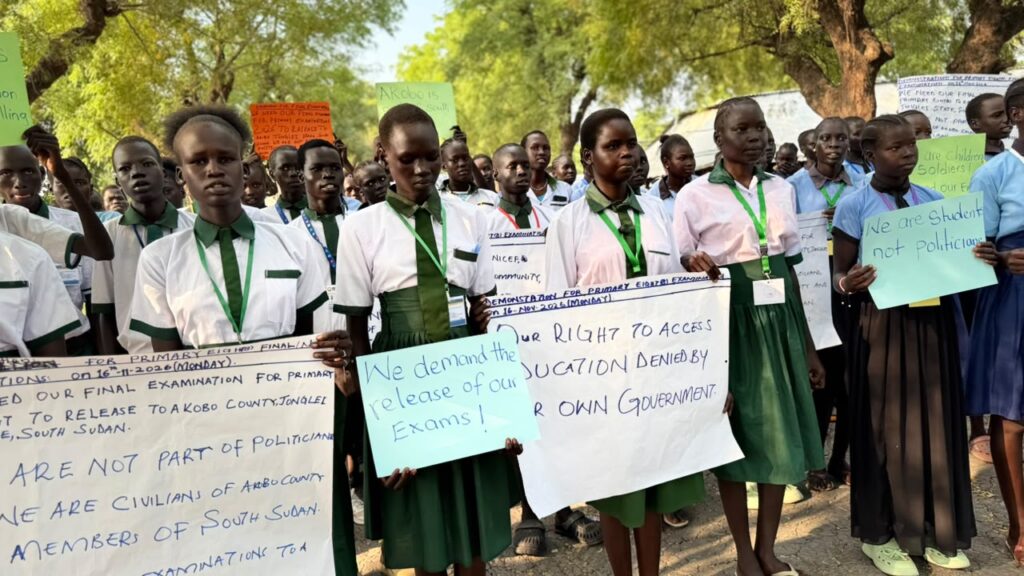
The recent protests by students in Akobo over the delivery of examination papers raise a fundamental question: How long should an entire generation continue paying the price for prolonged political and military confrontations?
The students are justified in demanding their right to education. However, the conversation must go beyond examination papers. It must address the underlying conditions that have repeatedly disrupted education, healthcare, humanitarian operations, government administration, and other essential services across Akobo and the wider northern counties of Jonglei State.
Education cannot thrive in an environment where insecurity, armed confrontations, and political divisions repeatedly undermine the institutions responsible for delivering public services.
A. Recognizing those who are taking action
I sincerely commend stakeholders from Greater Lou and Gawar, particularly Hon. Dr. Marial Benjamin, Hon. Denay Chagor and other community leaders who have openly demonstrated their willingness to support the delivery of examination materials to Akobo despite the prevailing security challenges and the presence of armed opposition elements in the area.
Their willingness to step forward, take risks, and prioritize the education of our children deserves recognition. However, such initiatives should not end with the delivery of examination papers. They should become opportunities for broader community engagement, political dialogue and reconciliation.
These leaders have the social influence, relationships and moral responsibility to engage their sons and daughters who remain within the opposition movement. They should extend the same determination demonstrated in facilitating examinations to convincing young people in the armed opposition to disengage from unnecessary military confrontations and embrace peaceful political participation.
If community leaders can risk their safety to deliver examination papers, they should also invest their influence in bringing their young people away from the battlefield.
We cannot continue delivering examination papers to children while allowing the conditions that prevent them from attending school to persist.
A responsibility that extends to SPLA-IO leadership
The SPLA-IO leadership must recognize that controlling territory is not equivalent to governing a population. Political and military ambitions should never take precedence over the welfare and future of civilians. Communities need functioning schools, healthcare facilities, markets, humanitarian access, roads, and legitimate civilian administration.
The prolonged presence of armed opposition structures in civilian areas, military mobilization, and insecurity have contributed to an environment that makes public service delivery increasingly difficult.
I therefore call upon SPLA-IO commanders and political leaders to:
1. Prioritize civilian protection: Refrain from using civilian towns and institutions for military purposes and facilitate the restoration of civilian administration.
2. Pursue peaceful disengagement: Create opportunities for dialogue, reconciliation and the peaceful reintegration of armed youth into civilian life.
3. Protect education: Ensure that schools, examination centres, teachers and students are not caught up in military confrontations.
4. Facilitate humanitarian access: Allow humanitarian organizations and essential service providers to reach vulnerable populations without unnecessary obstruction.
5. Choose political dialogue over chronic military confrontation: Recognize that sustainable political change cannot be built at the expense of another generation’s education and development.
B. A message to the White Army and armed youth
Our young people must understand that their greatest contribution to their communities is not necessarily carrying a gun.
The White Army and other armed youth have an important responsibility to protect their communities, but that responsibility should not become a justification for endless mobilization, political manipulation, or participation in destructive confrontations.
Our young people should be in classrooms, universities, hospitals, agricultural fields, businesses, and public institutions.
They should be acquiring knowledge, developing professional skills and building livelihoods rather than repeatedly sacrificing their lives in conflicts whose consequences will be inherited by their own children.
Do not exchange your textbooks for ammunition. Do not surrender your future to the political ambitions of competing leaders.
C. The way forward: Community-led peace and development
I propose that stakeholders from Greater Lou and Gawar, elected representatives, traditional authorities, religious leaders, youth representatives, and other influential community figures establish a sustained peace and development initiative. Such an initiative should pursue three immediate priorities:
1. Political engagement: Convene structured dialogue with SPLA-IO political and military representatives to reduce hostilities and facilitate the restoration of civilian administration.
2. Youth disengagement: Encourage young people to abandon unnecessary armed mobilization and pursue education, vocational training, agriculture and productive livelihoods.
3. Essential services: Develop practical arrangements with the national and state governments, humanitarian partners and local communities to restore education, healthcare, humanitarian access and other essential services.
This should not be another political declaration or a temporary humanitarian intervention. It must be a sustained community-led effort to break the cycle of insecurity, isolation and chronic emergency.
D. Our collective choice
Greater Akobo, Lou and Gawar deserve more than emergency interventions and repeated appeals for humanitarian assistance.
Our communities deserve functioning institutions, educated children, healthy populations, economic opportunities and sustainable development.
The time has come for community leaders to use their influence to exercise responsibility, and armed opposition commanders to reconsider their priorities, and young people to reclaim their future in the SPLA/SPLM-IO.
The communities in Northern Jonglei have experienced enough military confrontation in the Northern part of Jonglei State by the SPLA/SPLM-IO. The next generation deserves a different inheritance.
Akobo needs education, peace, security, and development — not permanent military confrontation.
Let us deliver examination papers today, but let us also work together to ensure that tomorrow’s children will not need political negotiations and security risks simply to access their classrooms.
Let us win the war against illiteracy before we lose another generation to war.
The views expressed in ‘opinion’ articles published by Radio Tamazuj are solely those of the writer. The veracity of any claims made is the responsibility of the author, not Radio Tamazuj.

 and then