



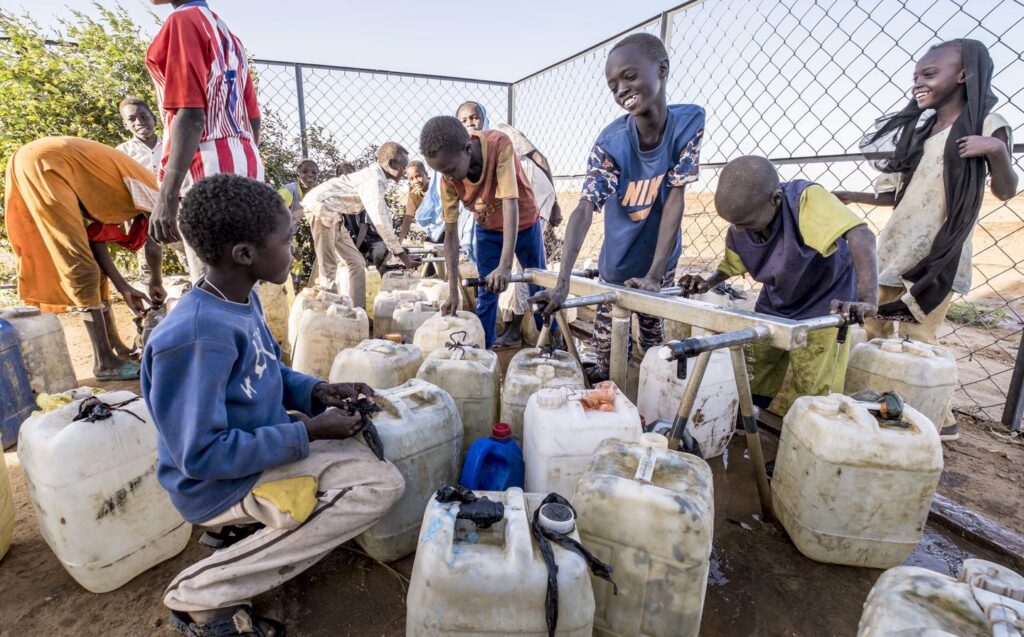
Residents in several neighborhoods in Damazin and Rosseires towns, in Sudan’s Blue Nile State, are grappling with worsening drinking water shortages as scheduled electricity cuts disrupt water supply operations, leaving many households struggling to meet their daily needs.
The scheduled power outages, which run from 6 p.m. to 6 a.m., have significantly reduced water distribution, with some residential areas experiencing prolonged interruptions or a complete loss of supply.
Residents have called on the relevant authorities to introduce alternative solutions to keep water pumping stations operational, including installing solar-powered systems to reduce their dependence on the electricity grid.
Al-Fadil Hassan, a resident of Damazin’s Arkawit neighborhood, told Radio Tamazuj that communities in the city’s northern districts were experiencing severe water shortages, with some areas receiving no piped water whatsoever.
“Banat and Arkawit are among the worst-affected neighbourhoods,” he stated. “We urge the authorities to take immediate measures to restore a reliable water supply.”
In Rosseires, the crisis has affected several southern and eastern neighborhoods, including East Rosseires, Al-Dagra, Al-Shuhada, Al-Maban and the Southern District, which encompasses Al-Ragarig, Block 17, Al-Laouta, Khamsa Buyut, Al-Batari and South University.
Other affected areas include Al-Asasir, Jami Al-Fur, Al-Batahin, Al-Firdous, Al-Tahrir and parts of East Central, as well as Al-Wahda, Geissan, Central Soba and Al-Faranagha neighbourhoods.
Sami Al-Zein, a resident of Rosseires, told this publication that water supplies had been severely disrupted following the shutdown of power facilities as a result of drone attacks.
“The disruption has affected water distribution across residential neighbourhoods, with supplies currently reaching only the city center,” he said.
Al-Zein explained that some community initiatives had resorted to transporting water in tankers to meet residents’ needs, while others were being forced to travel directly to the Nile to collect water.
In Damazin, the northern neighbourhoods affected by the shortages include Banat, Arkawit, Al-Murabba’at, Al-Safa, Al-Shahid and Al-Manshiya.
Residents have appealed to the relevant authorities to address disruptions in the water distribution network and ensure that households receive a regular and dependable supply.
Mahjoub Ahmed, a resident of Banat neighborhood, said that electricity outages have triggered a severe water crisis, forcing residents to rely increasingly on the Nile as their primary source of drinking water.
“Many households have been compelled to collect water directly from the river, while the price of a 20-litre jerrycan had surged to 2,000 Sudanese pounds during the complete power outage,” he stated. “The price subsequently dropped to 1,000 Sudanese pounds following the partial restoration of electricity.”
Ahmed said the cost of purchasing water had become an unbearable financial burden for low-income households, with some families spending approximately 7,000 Sudanese pounds a day to meet their basic water needs.
He called for urgent measures to bring the crisis to an end and alleviate the mounting hardship facing residents.
Meanwhile, Ihab Al-Sir, an engineer and civil society activist, confirmed to this publication that Rosseires locality was experiencing an acute water crisis.
“I urge the government to review its electricity rationing schedule to ensure that water pumping stations can continue operating and maintain a steady supply to affected communities,” he said. “Several of the affected neighborhoods are hosting internally displaced people who had fled armed conflict elsewhere in the region, placing additional pressure on already strained essential services.”
The activist also appealed to the government and humanitarian organizations to intervene urgently and introduce alternative solutions to stabilize water supplies.
He warned that a prolonged crisis could further aggravate living conditions and deepen humanitarian needs in the affected areas.
Radio Tamazuj was unable to obtain a comment from the Water Corporation.
The burden is particularly severe for low-income households, for whom the water shortages have compounded an already difficult combination of economic hardship, deteriorating basic services and insecurity.

 and then