



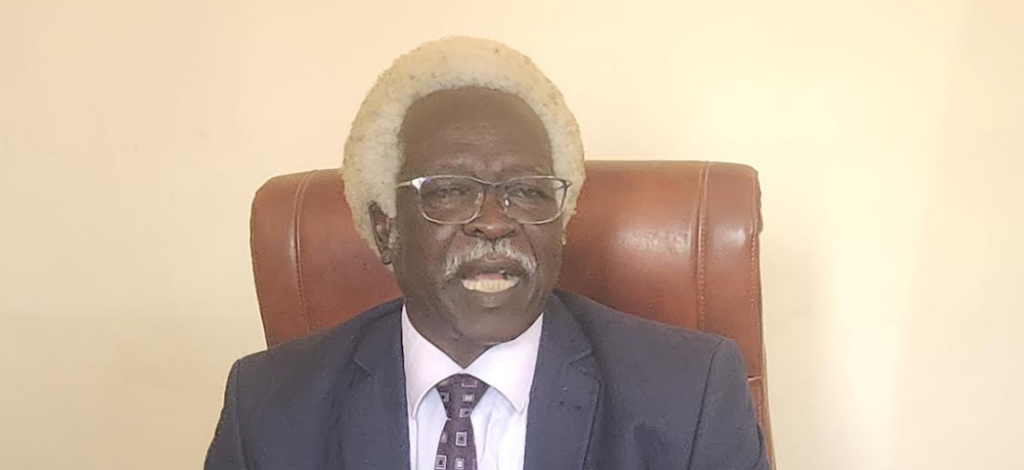
South Sudanese presidential aspirant Kornelio Kon Ngu has called for the postponement of an inter-party dialogue scheduled for this week, arguing that recent constitutional amendments have changed the political framework ahead of elections.
The dialogue, initially scheduled for 17 September, has been postponed to 24 September. It is due to begin at 10am at the main hall of the Revitalised Transitional National Legislative Assembly in Juba. The government has not given a reason for the one-week delay.
Kon, who leads the opposition National United Democratic Front (NUDF) and is the third deputy speaker of parliament, made the remarks at a press conference in Juba on Saturday.
He said his faction of the National Alliance of Political Parties supports holding elections, but argued that the inter-party dialogue should instead take place after the vote under an elected government.
Kon said the dialogue was initially intended to discuss political issues that could be incorporated into constitutional amendments. But parliament has already passed Constitutional Amendment No. 13, which President Salva Kiir has signed into law.
The amendment removes requirements for the completion of the permanent constitution-making process and a national population and housing census before elections can be held.
“Is there a need now for inter-party dialogue? Resolutions of the inter-party dialogue would have been included in the constitutional amendments. Now the constitutional amendments have been done and the inter-party dialogue is yet to take place,” Kon said.
“As the alliance we are saying the upcoming inter-party dialogue is meaningless. We call for postponement of inter-party dialogue and we want it to be done by the elected government after elections,” he added.
Kon said any dialogue should be more inclusive and involve political parties outside South Sudan, rather than only groups taking part in the current process in Juba.
“The main problem is with the political parties that are outside the country, not those that are already inside,” he said.
Election preparations
Kon also questioned whether the National Elections Commission (NEC) can organise a credible election within the remaining time, particularly as voter registration has yet to begin.
The NEC said on 2 September that no voters had been registered and that an electoral register had not yet been established. It said it was still preparing for registration, including training electoral officials and assessing registration centres.
The commission has maintained that the election will take place on 22 December.
The preparations have coincided with a change in the NEC leadership. President Kiir removed NEC chairperson Abednego Akok Kacuol on 15 September and appointed Gabriel Bol Deng Majok, the commission’s former secretary-general, as his successor. No public reason was given for Akok’s removal.
South Sudan has repeatedly postponed national elections since gaining independence in 2011. Under the current political roadmap, the transitional period was extended in 2024 and elections were moved from December 2024 to December 2026. The current transitional period is due to expire in February 2027.
Constitutional dispute
Kon also criticised the process through which the constitutional amendments were adopted, saying political decisions should involve broader consultation among political parties.
He questioned the composition of the planned inter-party dialogue, saying it should include all political parties rather than selected groups.
“For us, the inter-party dialogue has no meaning,” he said.
Parliament passed Constitutional Amendment No. 13 on 1 September, and President Kiir assented to it the following day. The amendment removed the requirement for the permanent constitution and national population and housing census to be completed before elections.
Kon said political parties should have been more involved in decisions affecting the country’s constitutional and electoral arrangements.
Dispute over Kon’s presidential bid
Kon’s call to postpone the inter-party dialogue comes amid a dispute over his leadership of the National Alliance of Political Parties and his bid for the presidency.
He announced in August that he would challenge President Kiir in the December election. His candidacy initially received backing from some parties within the alliance.
Eight parties later withdrew their support for Kon as alliance chairman, accusing him of violating the alliance’s rules, making unilateral decisions and failing to consult member parties.
The faction also rejected his nomination as the alliance’s presidential candidate, saying he had not been endorsed by its Leadership Council.
Kon’s supporters rejected the move and said he remains the legitimate chairman. His ally and alliance secretary-general, Richard Valent Omwony, said the group had already settled on Kon as its presidential candidate.
Kon said his political programme remains focused on elections.
“Our goal is to have elections in 2026. Our programme is fixed. We want people to vote for us,” he said.

 and then