



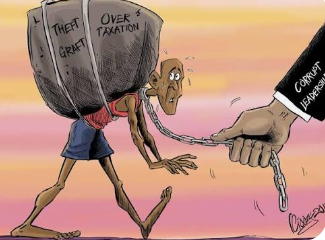
Sometimes a small roadside story reveals more about a country than any policy report. In Juba, tea shops and small traders increasingly gather around checkpoints. On the surface, this looks like ordinary business: people need tea, food, airtime and cigarettes, and traders follow crowds. But beneath this small economy lies a deeper question about corruption, poverty, public authority and the values shaping South Sudan.
A tea seller once narrated an encounter that stayed with me. A traffic police officer came to her shop after a day at the roadside and tried to buy baby formula. He searched through his uniform pockets, pulling out folded South Sudanese pound notes collected in small amounts. According to the story, the money came from bribes, informal payments, and extortion of motorists, in total contravention of traffic police law.
The tea seller looked at him and asked: “Are you going to use the money you collected from bribes and extortion to buy milk for your baby? Are you sure that money is clean enough for your child?” The officer froze. For a moment, the transaction stopped being about money and became a question of conscience.
The money may be spent, but its source still matters
Economically, money is money: if a shop accepts it, the baby drinks milk. Nonetheless, societies cannot survive on transactions alone. They also depend on values, trust, and the belief that public authority is exercised for citizens, not against them. A father’s wish to feed his child is deeply understandable. Yet the child’s innocence cannot cleanse the source of the money.
This is the subtle danger of corruption: it rarely presents itself to the beneficiary as corruption; it appears as school fees, medicine, rent, food, or baby milk. That is how unethical conduct becomes normal, especially when low pay, delayed salaries, and difficult living conditions make survival hard. Poverty is real, and the government must pay public servants fairly and on time. But hardship cannot become a permanent excuse for abusing citizens.
When checkpoints become money extraction points
A checkpoint should represent security, order, and the rule of law. It should protect citizens and regulate movement fairly. But when checkpoints become associated with harassment, informal payments, and daily “collections,” their meaning changes. They become extraction points. Once tea sellers, transport operators and small businesses organize themselves around that flow of people and money, corruption begins to create an entire ecosystem.
This should concern policymakers because the problem is no longer only one officer taking money. It is a system of expectations: the officer demands because motorists pay; motorists pay because they fear delay or harassment; traders gather because the checkpoint creates traffic and cash. Over time, everyone adapts to a practice that should never have become normal.
The moral cost is bigger than the money
We often discuss corruption in terms of missing funds, inflated contracts, and financial loss, but corruption also changes people’s understanding of right and wrong. The most dangerous stage is not when people commit corruption; it is when they stop being ashamed of it. Then the question shifts from “Is this right?” to “Why should I not do it when everyone else is doing it?” That is how institutions decay.
The tragedy is that children may inherit the consequences. A child may drink milk bought with corrupt money today but grow up tomorrow in a society where hospitals lack medicine, roads are poor, schools are underfunded, and citizens no longer trust public institutions. In that sense, corruption does not merely steal from the state. It steals from the future.
What kind of country are we building?
If citizens increasingly believe that every interaction with government requires payment, public trust collapses. If a young person grows up seeing public officials use their positions to extract money, what lesson does that young person learn about public service? A police uniform should not become a license to collect money. A government office should not become an investment opportunity. Public authority is held in trust for citizens.
Leadership must also lead by example. Petty corruption at checkpoints cannot be fought seriously while larger corruption is tolerated elsewhere. If a junior officer is punished for a small bribe while powerful officials escape accountability, citizens hear the wrong message: corruption is not forbidden; it is only forbidden for some people. South Sudan needs standards that apply from the checkpoint to the highest office.
What should be done? First, improve the pay and working conditions of frontline public servants. Second, strengthen internal accountability and investigate complaints of extortion. Third, make checkpoint procedures clear, with visible official fees where applicable, proper supervision and safe complaint channels. Fourth, public education must address not only the illegality of corruption but also its moral and social consequences.
Most importantly, we must rebuild the social stigma against corruption. We should not admire unexplained wealth, celebrate those who use public office for private gain, or teach children that survival justifies everything. Integrity must again become a public expectation, not a private luxury.
Before taking money from a citizen, every public servant should ask: “Would I be comfortable explaining the source of this money to my child?” And every political leader should ask: “Would I be comfortable if the next generation copied the way I exercise public power?”
Juba is growing. Businesses are expanding. Roads are busier. Families are struggling to survive. But beneath this activity is a larger struggle over the values that will shape our state. Will public authority serve citizens, or extract from them? Will we build institutions based on trust, accountability, and the rule of law, or institutions where citizens expect to pay before receiving a service?
The story of a police officer struggling to buy milk should not simply make us feel sorry for him. It should make us pause and ask: Where did the money come from? What did it cost someone else? What does it teach the child? And, most importantly, what kind of South Sudan are we building with the choices we make today?
The future of a country is not built only in parliament, ministries, or political negotiations. It is also built at checkpoints, in markets, in offices, and in quiet moments when an individual chooses between what is convenient and what is right.
The writer is a policy and political analyst; a contributor on good governance and liberal democracy in South Sudan and Africa. He can be reached via boboyaj40@gmail.com.
The views expressed in ‘opinion’ articles published by Radio Tamazuj are solely those of the writer. The veracity of any claims made is the responsibility of the author, not Radio Tamazuj.

 and then