



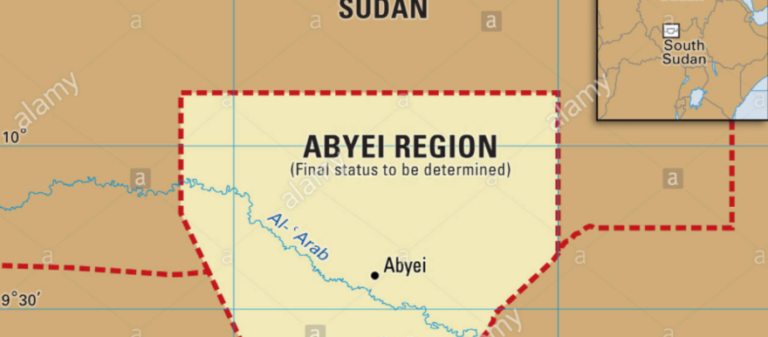
The Comprehensive Peace Agreement (CPA), signed in 2005, was brokered to end Sudan’s long-running civil war. The agreement established separate mechanisms for addressing the conflicts in Southern Sudan, Abyei, Southern Kordofan and Blue Nile.
For Southern Sudan, the CPA provided for a referendum on self-determination at the end of a six-year interim period, giving voters the choice between unity with Sudan and secession. The Interim Constitution of Southern Sudan, adopted in 2005, incorporated the right to self-determination as a constitutional principle.
On disputed and claimed areas along the north-south border, the Sudan People’s Liberation Movement (SPLM) and the National Congress Party (NCP) established the Technical Border Committee (TBC) to identify and demarcate the boundary between Sudan and Southern Sudan. While the committee addressed much of the boundary on paper, several areas remained contested and required separate political or legal processes.
Among them was Kafia Kingi. The author argues that the issue received far less political attention from the Government of Southern Sudan than Abyei during the interim period and in the years following South Sudan’s independence.
The Fertit, who are among the traditional inhabitants of the area, are now divided by the Sudan-South Sudan border, with Kafia Kingi administered as part of South Darfur in Sudan. The author’s view is that the limited attention given to Kafia Kingi, Mile 14 and Magenis has disadvantaged communities from those areas and that their concerns deserve greater consideration in South Sudan’s border and territorial discussions.
The Abyei question
The CPA contained a separate Abyei Protocol. Article 1.1.2 defined Abyei as the area of the nine Ngok Dinka chiefdoms transferred to Kordofan in 1905. The protocol also recognised the traditional grazing and movement rights of the Misseriya and other nomadic groups.
During the interim period, residents of Abyei were to have citizenship and representation in both Western Kordofan and Bahr el Ghazal. The protocol also provided for a separate referendum on the area’s political future to be held simultaneously with the referendum on Southern Sudan.
In January 2011, South Sudan held its independence referendum, with 98.83% of voters choosing secession. South Sudan became independent on 9 July 2011.
The Abyei referendum, however, was not held. The Abyei Referendum Commission was never established, leaving the territory’s final status unresolved.
Emerging issues in the Abyei conflict
The dispute over Abyei has deep historical and political roots. The Ngok Dinka and Misseriya have competing claims and interests in the territory, while the wider Abyei question became closely linked to the Sudanese civil wars and the negotiations between Khartoum and the SPLM.
The Abyei Protocol provided for the establishment of the Abyei Boundary Commission (ABC), comprising representatives of the Government of Sudan, the SPLM and international experts. Its task was to determine the boundaries of the area of the nine Ngok Dinka chiefdoms transferred to Kordofan in 1905.
The ABC’s findings became highly controversial. Ngok Dinka representatives and their supporters accepted a wider interpretation of the historical boundaries, while the Government of Sudan disputed the commission’s conclusions. The disagreement contributed to the failure to establish a mutually accepted administration and to proceed with the referendum.
The author argues that the ABC’s interpretation of the boundaries also contributed to new disputes involving neighbouring communities in what is now South Sudan. In his view, communities whose lands were included within the boundaries claimed for Abyei have subsequently challenged those claims, creating a new layer of conflict beyond the traditional Ngok Dinka-Misseriya dispute.
The author therefore argues that the parties and international actors involved in the Abyei process have a responsibility to examine the consequences of the boundary dispute and consider mechanisms for addressing the grievances of affected communities.
Boundaries between Abyei and neighbouring areas
The northern boundary remains contested between the Ngok Dinka and the Misseriya. The Government of Sudan rejected the ABC findings, arguing that the commission had exceeded its mandate in defining the Abyei area.
The dispute was subsequently referred to arbitration. In July 2009, an arbitral tribunal constituted under the Permanent Court of Arbitration issued its final award on the delimitation of Abyei. The PCA records the case as a dispute between the Government of Sudan and the Sudan People’s Liberation Movement/Army concerning the delimitation of the Abyei area.
The arbitration reduced the area claimed by the ABC and established a revised boundary. However, the award did not resolve the wider political dispute over Abyei’s final status or the referendum.
On the eastern side, the author argues that claims involving areas around Aliny and Abiemnhom also became part of the wider territorial dispute. He maintains that the 2009 arbitral award addressed some of these issues by revising the boundaries established by the ABC.
On the western side, the author points to disputes involving Gok Machar and parts of Aweil East County, arguing that these have created additional tensions between the Ngok Dinka and neighbouring South Sudanese communities.
In the author’s assessment, the failure of the parties to agree on the boundaries of the nine Ngok Dinka chiefdoms contributed to the failure to establish the Abyei administration and, ultimately, the Abyei Referendum Commission.
Regional efforts to resolve the Abyei conflict
The failure to implement the Abyei Protocol led to increased involvement by the African Union. The African Union High-Level Implementation Panel on Sudan and South Sudan, chaired by former South African President Thabo Mbeki, proposed measures addressing Abyei’s administration, pastoralist rights, border arrangements, revenue sharing, economic development and the eventual referendum.
The proposal included immediate, medium- and long-term measures intended to address the dispute. However, Sudan and South Sudan failed to reach agreement on its implementation.
At the bilateral level, South Sudan subsequently established the Abyei Area Administration through Republican Order No. 03/2015. The government also established a high-level committee on the final status of Abyei to engage with Sudan and follow up on proposals and decisions concerning the territory.
The author argues that the committee has faced limitations because it was established unilaterally and has not secured a comprehensive agreement with Sudan or neighbouring communities.
He also argues that the boundary disputes have contributed to tensions between the Ngok Dinka and other South Sudanese communities whose lands are alleged to have been included within the boundaries claimed for Abyei.
This raises a broader question: now that the original Abyei dispute has generated additional territorial claims and community-level tensions, does the existing Abyei framework provide an adequate mechanism for addressing disputes between the Ngok Dinka and neighbouring South Sudanese communities?
A related question is whether South Sudan and other stakeholders should develop an additional conflict-resolution mechanism to address these emerging disputes, while preserving the existing legal and political framework governing Abyei.
Conclusion
Any discussion of a final settlement for Abyei must take account of the complexity of the dispute and the divisions among the communities concerned.
One challenge identified by the author is disagreement among Ngok Dinka themselves over Abyei’s ultimate political status. According to this view, some favour integration with South Sudan, while others have advocated alternative arrangements, including autonomous status or continued association with Sudan.
The author argues that such differences are not new and were already evident during the negotiations between the Government of Sudan and the SPLM in the early 2000s. In his assessment, divisions within the Ngok Dinka community have complicated efforts to develop a unified position on the territory’s future.
A second challenge is the continuing dispute between the Ngok Dinka and Misseriya over territory, access and Abyei’s final status. The Abyei Protocol recognised the interests of both communities, including traditional grazing and movement rights.
These unresolved differences raise questions about whether Sudan and South Sudan can agree on Abyei’s final status without first addressing the competing interests of the communities directly affected by the dispute.
The policy recommendations will be examined in Part Two of this article.
The writer, Hakim Chol Ayii, is a researcher on politics and governance. He can be reached at akimchol@gmail.com.
The views expressed in ‘opinion’ articles published by Radio Tamazuj are solely those of the writer. The veracity of any claims made is the responsibility of the author, not Radio Tamazuj.

 and then