



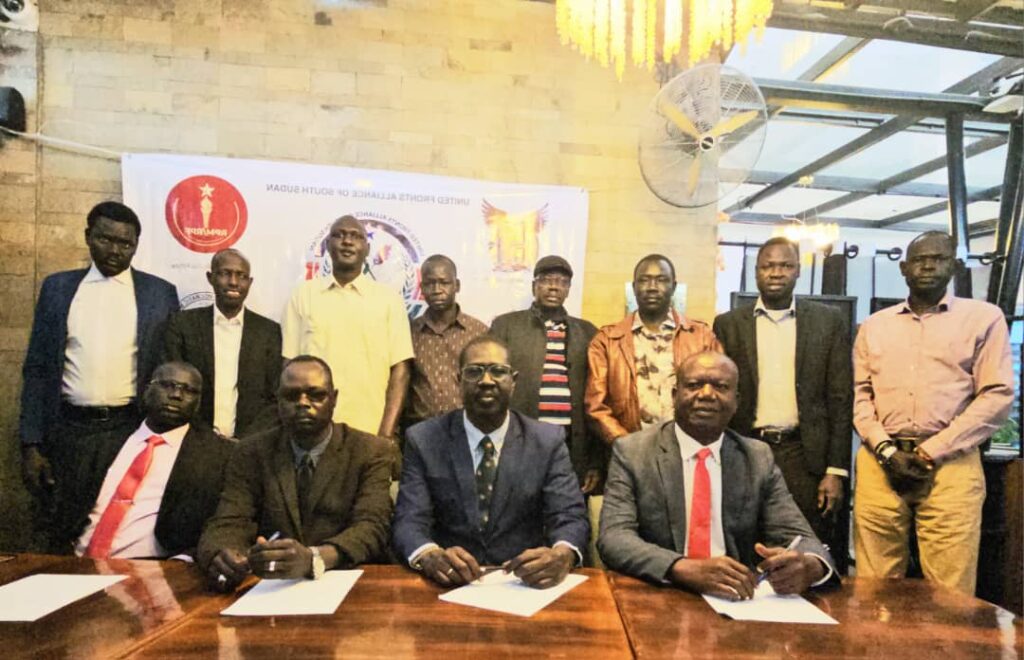
Four South Sudanese opposition groups operating outside the country have agreed to form a political and military alliance, the United Fronts Alliance of South Sudan (UFASS).
The groups signed a memorandum of understanding on 30 September 2026, according to a copy of the agreement seen by Radio Tamazuj.
The signatories are General Malang Kerubino Kuanyin of the Hope and Salvation Front/Army (HSFA), Ambassador Adel Sandrai of the Revolutionary Patriotic Movement/Front (RMP/RPF), General Philip Stephen Dak Onwar of the South Sudan United National Front/Army (SSUNF/A), and General Dau Deng Ahecyl of the South Sudan Democratic Movement/Army (SSDM/A).
The four signed in their capacities as chairmen and commanders-in-chief of their respective organisations.
The agreement describes UFASS as a political and military alliance that will coordinate the activities of its member groups and promote what they describe as a federal system of government in South Sudan.
Its stated objectives include ending the conflict through an inclusive political process, strengthening state institutions and the rule of law, reforming the security sector, rebuilding the economy and tackling corruption and impunity.
The groups also pledge to reject ethnic mobilisation and hate speech and to protect civilians in accordance with international humanitarian law.
How the alliance will operate
The memorandum establishes a High Council of the Alliance as the supreme decision-making body. It will comprise the four leaders, the chief of the joint allied forces and one senior representative from each member group.
The alliance will also have an executive leadership made up of a chairperson, deputy chairpersons and a secretary-general. A secretariat will be responsible for its day-to-day administration and coordination.
Each group will retain its own identity but has agreed to operate under the UFASS banner in national and international engagements.
The agreement says the four groups will coordinate their political, human and material resources and abide by decisions of the High Council.
It further states that UFASS will be the sole negotiating platform for the four groups in peace processes, political dialogues and engagements with the Intergovernmental Authority on Development (IGAD), the African Union, the United Nations and international partners.
South Sudan’s opposition remains fragmented, with several political and armed groups operating inside and outside the country. Some have formed alliances and called for an inclusive political process ahead of the planned December 2026 elections.
Federalism
UFASS says its vision is of a peaceful and stable federal South Sudan in which states and regions elect their own leaders, while a president serves as head of state and an executive prime minister is accountable to parliament.
The memorandum does not provide details on how the proposed system would be introduced or how it would relate to South Sudan’s existing political and constitutional arrangements.
The agreement provides for disputes between member groups to be resolved through the High Council and, where necessary, through an independent mediation committee appointed by the council.
The memorandum will remain in force until a permanent constitution for the alliance is adopted. Any amendment requires the written consent of all four parties, while any party wishing to withdraw must give 90 days’ written notice.
The agreement was signed by General Malang Kerubino Kuanyin as chairman and commander-in-chief of the Hope and Salvation Front/Army, Ambassador Adel Sandrai as chairman and commander-in-chief of the Revolutionary Patriotic Movement/Front, General Philip Stephen Dak Onwar as chairman and commander-in-chief of the South Sudan United National Front/Army, and General Dau Deng Ahecyl as chairman and commander-in-chief of the South Sudan Democratic Movement/Army.

 and then