




In every household, visitors are expected to respect the home they enter, while the owner is expected to listen to the views and advice of those who visit. But when the two disagree over an important family matter, the question becomes: who has the final say, and how can they resolve the disagreement without damaging the relationship?
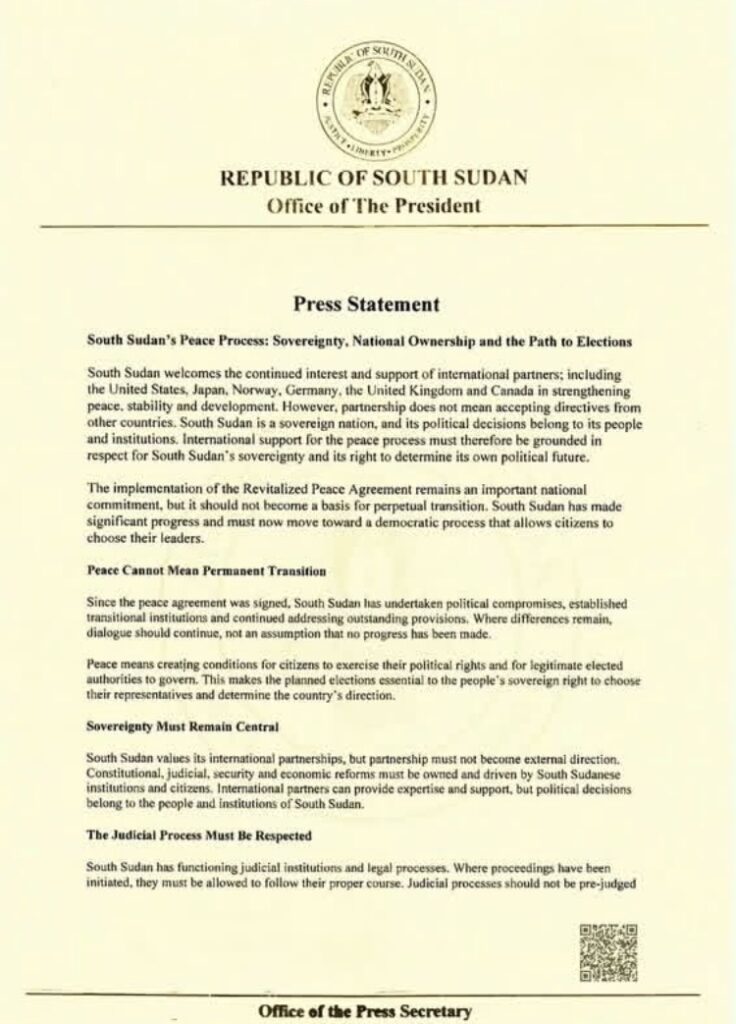
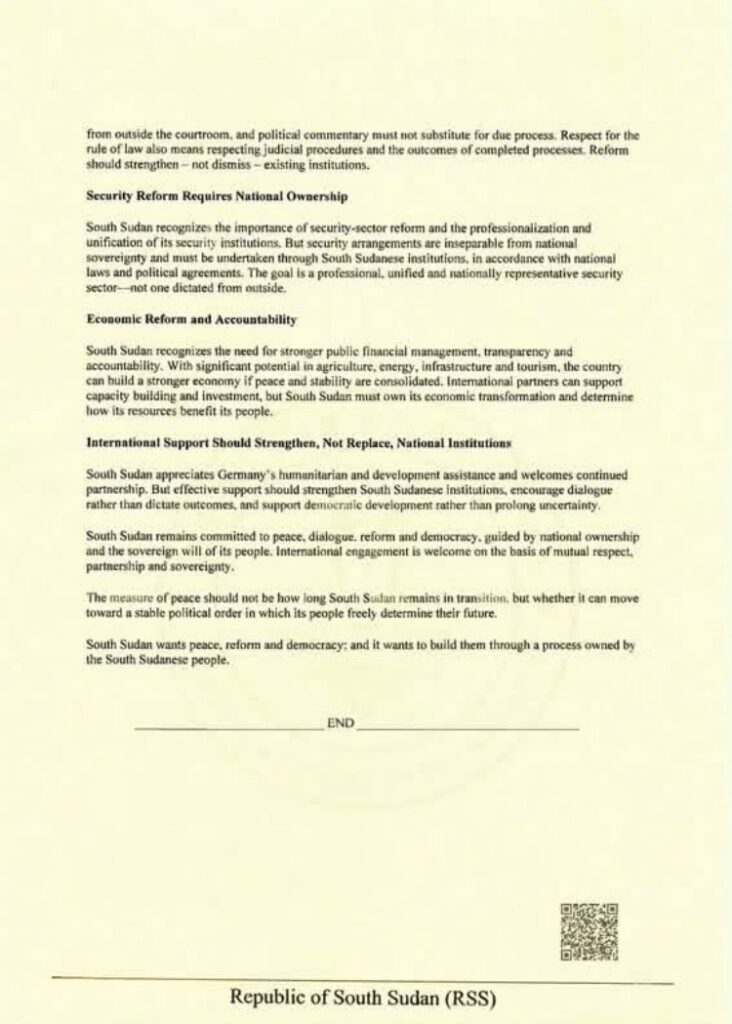
This analogy offers an interesting way to understand the growing differences between the Government of South Sudan and the international community over the country’s electoral process.
My opinion is not intended to determine who is right or wrong. Rather, it encourages both sides to step away from public exchanges and consider a more constructive approach: sitting together, listening to one another, and addressing concerns through dialogue.
The host and the guests
South Sudan is a sovereign country, and its government has the primary responsibility for managing its internal affairs and making decisions about the country’s political and electoral processes.
At the same time, South Sudan’s international partners have played an important role in peacebuilding, humanitarian assistance, development and institutional support. Their concerns about peace, stability, political participation and the credibility of elections should therefore not simply be dismissed. The challenge is finding the right balance.
A visitor cannot take control of someone else’s household. But a responsible household owner should not automatically reject advice from a visitor simply because it comes from outside. The same principle can apply to South Sudan and its international partners.
Beyond public exchanges
Disagreements are normal in any relationship, particularly when important political and national interests are involved. The concern arises when those disagreements increasingly take the form of statements and counter-statements through the media.
Public statements can explain positions, but they rarely resolve complicated political questions.
When one side speaks publicly, and the other responds publicly, the discussion can easily become a cycle of accusation, defense, and counter-accusation. In the process, the real issues may receive less attention than the disagreement itself.
The more important question, then, is: What problems are we trying to solve, and how can we solve them together?
Addressing the bottlenecks before they become crises
South Sudan’s electoral process faces important challenges that require serious attention. Questions around political participation, electoral institutions, security, funding, voter registration, civic education, and public confidence cannot be addressed through political rhetoric alone.
These issues require engagement among the government, political parties, civil society, electoral institutions, and international partners.
Rather than waiting for disagreements to become deeper political crises, the concerned parties should identify potential obstacles early and discuss practical ways to address them.
Dialogue would allow the government to explain its position and international partners a chance to present their concerns directly.
Dialogue does not mean surrender
Sometimes, people may perceive that agreeing to dialogue means accepting the other side’s position. It does not. Dialogue is not surrender. It is a mechanism for understanding differences and finding common ground.
The Government of South Sudan can defend its sovereignty while engaging openly with its international partners. Likewise, international partners can raise concerns without attempting to assume the role of the country’s decision-makers.
The objective should not be to defeat the other side. The objective should be to find solutions that protect South Sudan’s peace, stability, and political future.
From the microphone to the table
Perhaps the most important shift needed is from public confrontation to private engagement. A microphone can communicate a position, but a table can help resolve a disagreement.
Instead of exchanging strong words through the media, the government and its international partners could convene a structured dialogue to discuss the electoral process, identify areas of disagreement, and establish practical steps to address the challenges ahead.
Such a meeting should not be about determining who is more powerful: the household owner or the visitor. It should ensure that both the host and the guests understand their responsibilities.
Finally, South Sudan has a responsibility to protect its sovereignty and lead its political affairs. Its international partners, meanwhile, have a legitimate interest in supporting peace, stability, and a credible political process. These responsibilities do not necessarily have to conflict.
The Government of South Sudan should be willing to listen to constructive concerns. At the same time, the international community should approach its engagement with respect for South Sudan’s sovereignty and on-the-ground realities.
Ultimately, South Sudan does not need more arguments through the media; it needs more conversations around the table. The host should listen to the guests, and the guests should respect the host.
The real question, then, is not who is more powerful, but how both sides can work together to prevent today’s disagreements from becoming tomorrow’s crises.
Dialogue may not solve every disagreement, but refusing to dialogue can make every disagreement harder to solve.
The writer is a media specialist and development practitioner. He can be reached via leek2daniel@gmail.com.
The views expressed in ‘opinion’ articles published by Radio Tamazuj are solely those of the writer. The veracity of any claims made is the responsibility of the author, not Radio Tamazuj.

 and then