



South Sudan’s promised general election is approaching a dangerous contradiction. The country is officially expected to vote on 22 December 2026, yet many political, legal, financial, and operational foundations required for a credible election remain incomplete or invisible to the public. Instead of voter registration, civic education, constituency demarcation, and published polling procedures, citizens are witnessing uncertainty and leadership changes in the institution responsible for conducting the vote.
An election is not created by announcing a date. It becomes real when citizens can see and participate in an orderly, lawful, and transparent process. South Sudanese want the opportunity to choose their leaders. The urgent question is whether the political leadership has made the decisions, provided the financing, and protected the institutions needed to convert that desire into a credible democratic exercise.
South Sudan has not held a national election since independence in 2011. In September 2024, the government extended the transitional period by another two years and moved the election to 22 December 2026, citing unfinished essential tasks (Reuters, 13 September 2024).
That extension created an additional 27 months for preparation. Nevertheless, crucial activities remain unresolved: the permanent constitution, electoral legislation, an agreed electoral system, constituency delimitation, voter registration, security reform and conditions for free political competition. In February 2025, the United Nations warned that the constitution-making and census timelines did not fit comfortably within the schedule for a December 2026 election. More than a year later, the gap between the political calendar and operational reality remains wide.
Voter registration is decisive. Without an agreed register, the country cannot determine who may vote, where citizens should vote, or how ballots and staff should be distributed. South Sudan must also establish how refugees, internally displaced people, returnees, pastoralist communities, persons with disabilities and citizens in conflict-affected areas will participate. When these questions remain unanswered close to polling day, the date begins to resemble a political slogan rather than an implementable national programme.
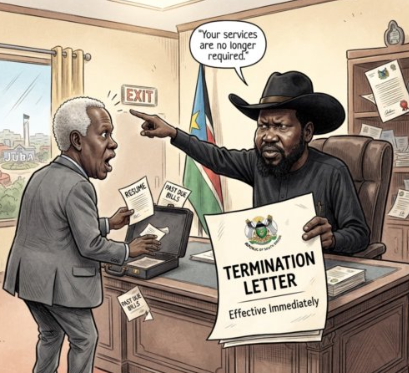
President Salva Kiir’s dismissal of National Elections Commission Chairperson Professor Abednego Akok Kacuol on 15th September 2026 deepened public uncertainty. No reason was publicly given, and Gabriel Bol Deng Majok, formerly the commission’s secretary-general, was named as his replacement about three months before the scheduled vote (Associated Press, 16 September 2026).
Changing the leadership of an electoral body is not automatically illegitimate. Commissioners may be replaced on lawful grounds, including incapacity or serious misconduct. But timing, procedure and explanation matter. A removal shortly before polling, without a transparent public account, raises questions about institutional independence, operational continuity and political interference.
The commission should be the public’s anchor of certainty. It should publish a binding calendar, disclose its budget, explain voter-registration procedures and demonstrate that its decisions are protected from partisan manipulation. The incoming chairperson should immediately state what has been completed, what remains outstanding, how much funding has been received, and whether 22 December remains operationally achievable. Silence will strengthen suspicions of either another postponement or tighter political control.
Elections require timely expenditure for registration materials, constituency mapping, polling staff, ballots, transport, warehouses, communications, civic education, security, observation and dispute resolution. Yet, as of 20 September 2026, there is no sufficiently detailed public statement establishing the total approved cost, the amount released by the Ministry of Finance, expenditure to date and the remaining shortfall. No responsible analyst can therefore state confidently how much money the government currently has for the whole process.
This lack of financial disclosure is itself evidence of the problem. A credible national election cannot rely on unpublished allocations, emergency transfers or an expectation that international partners will eventually pay. The government must provide the core resources because elections are a sovereign responsibility. Partners may offer technical assistance, but they cannot substitute for domestic political commitment.
South Sudan’s wider public-finance crisis intensifies this concern. A 2025 United Nations investigation alleged extensive diversion and mismanagement of public resources, including billions of dollars channelled through the Oil for Roads programme. The government disputed aspects of the findings, but the report reinforced demands for transparent public spending (Reuters, 16 September 2025). The government should publish a costed electoral budget, monthly releases and expenditure reports, with parliamentary and audit oversight.
It would be inaccurate to claim that every citizen has abandoned hope. South Sudanese continue to demand accountable government and the right to choose their representatives. What is disappearing is confidence that the present process will deliver that opportunity fairly and on time. Repeated extensions have created electoral fatigue: each postponement promises time to complete outstanding tasks, but many of the same tasks remain unfinished when the next deadline arrives.
Confidence is also weakened by political and military confrontation. The detention and prosecution of First Vice-President Riek Machar, fragmentation within the peace government and conflict between government and opposition-aligned forces have narrowed political space. The SPLM-IO has warned that election activities in areas under its influence could lead to confrontation, illustrating the danger of proceeding without a binding political and security settlement (Associated Press, 22 June 2026). An election conducted while major actors are excluded and parts of the country remain insecure may produce ballots, but not legitimacy.
The warning signs are now visible: a fixed date without a comprehensive published calendar; no completed voter register; unresolved constitutional and electoral questions; insufficient information on constituencies and polling centres; uncertainty over refugees and displaced citizens; continuing armed conflict; restricted political space; leadership changes inside the commission; and no transparent, fully financed budget. Together, these are not minor administrative delays. They indicate an electoral process approaching institutional collapse unless urgent corrective decisions are taken.
First, the Presidency, peace-agreement parties, other opposition groups, civil society, faith institutions, women, youth, and displaced communities should enter an urgent and time-bound electoral dialogue. Its purpose must be to determine honestly whether the remaining work can meet the December deadline.
Second, the commission must publish a detailed operational calendar covering registration, constituency delimitation, party and candidate nomination, campaigning, polling-staff recruitment, ballot production, observation, voting, counting, results, and dispute resolution. Third, the government must disclose and release a protected electoral budget according to an agreed schedule, with transparent procurement and independent audit.
Fourth, the commission’s independence must be defended. The legal basis for recent leadership changes should be explained, commissioners should enjoy security of tenure and parties, and observers should receive equal access to electoral information. Fifth, political and civic space must reopen. Parties should organise peacefully, while journalists, civil society and observers work without intimidation. Hate speech and ethnically divisive mobilisation must be investigated regardless of political affiliation.
Sixth, the parties must recommit to a nationwide cessation of hostilities. Election workers cannot register voters where they risk arrest or attack. If an independent technical assessment concludes that a credible vote cannot be held on 22 December, any adjustment must not become another open-ended extension. It should be short, lawful, nationally negotiated and tied to measurable benchmarks, public reporting and consequences for non-performance.
South Sudan is not short of agreements, roadmaps or declarations. It is short of binding decisions followed by implementation. The leadership must organise a genuinely inclusive and credible election, negotiate a strictly conditioned corrective timetable, or allow uncertainty to destroy what remains of public trust.
Citizens should not be asked to believe in an election they cannot see being prepared. Voter cards, registers, polling centres, civic education, political freedoms, security guarantees and transparent financing are the practical manifestations of an election. Without them, 22 December is merely a date on paper. No decision means no movement forward; without immediate corrective action, the election will remain a song sung at citizens’ doorsteps – audible, familiar, and increasingly difficult to believe.
The author is a researcher and writer specializing in humanitarian and development issues in South Sudan. He has a degree in Sociology and Political Science from the Catholic University of Eastern Africa and a Master’s in Peace and Development Studies from the University of Juba.
The views expressed in ‘opinion’ articles published by Radio Tamazuj are solely those of the writer. The veracity of any claims made is the responsibility of the author, not Radio Tamazuj.
References
– Reuters. South Sudan postpones long-delayed election by two years. 13 September 2024.
– Reuters. UN report details systematic looting by South Sudan’s rulers. 16 September 2025.
– United Nations Web TV. Nicholas Haysom briefing on the situation in South Sudan. 5 February 2025.

 and then